Why standard women’s clubs do not fit a shorter golfer
“Women’s clubs” is not a size. It is a band, and the band starts higher than a lot of people realize.
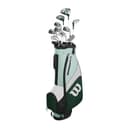
Wilson publishes the clearest version of this, and it is worth reading carefully because the numbers apply far beyond Wilson. Its women’s standard build is for heights of 63 to 69 inches — 5 ft 3 in to 5 ft 9 in. Its petite build is for 59 to 63 inches, which is 4 ft 11 in to 5 ft 3 in. Its tall build runs 69 to 73 inches. Three builds, and the one sitting on the shelf in most golf shops is the middle one.
So if you are 5 ft 1 in and you were handed a standard women’s set, you are playing clubs built for someone four inches taller than you. Nothing about that is your swing. It is the same problem as a bike with the saddle too high: you can ride it, you will compensate, and the compensations become habits.
What a too-long club actually does is push you away from the ball. To reach the ground with the clubhead you either stand further back, straighten up, or let your hands get too high at address — and each of those makes the low point of your swing land somewhere other than the ball. The symptoms are thin shots, fat shots and a strike that moves around for no reason you can identify. Our guide to topping the ball covers the technique half; the length half is this page.
The measurement that beats height: fingertip to ground
Height narrows the choice. It does not finish it, because arm length varies independently of how tall you are — two golfers both 5 ft 2 in can need club lengths an inch apart.
That is why Wilson publishes a second number alongside the height band, and it is the one to use: fingertip to ground. For the women’s petite build it is 24 to 26 inches. Standard is 26 to 28.5 inches, and tall is 28.5 to 30 inches.
Measuring it takes thirty seconds. Stand up straight in flat shoes on a hard floor, arms hanging relaxed at your sides, shoulders down rather than hunched. Have somebody measure from the tip of your longest finger straight down to the floor. Do not reach, do not stretch, and do not do it in heels.
Then read the two numbers together. If height says petite and fingertips say petite, you are done. If height says petite and fingertips say standard, you have long arms for your height and standard length is probably right. If they disagree the other way, trust the fingertips. Our full guide to club length works through the wrist-to-floor version of the same measurement and what to do when the two readings fight.
And the bands meet rather than overlap, which catches out exactly one group: golfers at 5 ft 3 in, where petite ends and standard begins. If that is you, the fingertip measurement is the whole decision.
What “petite” actually changes
One inch, in almost every case. The Precise M5 listing is the only one here that states it in its own title — Petite Size -1"— and one inch off standard is the normal increment across the whole category. Nobody else publishes a figure, so nobody else lets you check.
An inch sounds trivial and is not. It moves the whole club closer to you, which lets you stand at a comfortable distance from the ball with your arms hanging rather than reaching. It also makes the clubhead easier to control, because the head is closer to your hands — the same principle that makes a 7-iron easier to strike than a driver, applied to the whole bag at once.
What it does not do is add distance. A shorter club swings a fraction slower at the same effort, so in theory a petite set is marginally shorter-hitting than the standard build. In practice the opposite happens, because distance for a beginner is overwhelmingly a function of how close to the middle of the face you hit it, and correctly-sized clubs find the middle far more often. Anyone telling you to play longer clubs for more distance has the arithmetic backwards.
Two things change with a proper petite set and one thing does not. The lie angle is usually adjusted along with the length, so the sole sits flat on the ground instead of toe-down. The shafts are usually lighter and softer. And the grips are usually the same size, which is why grip sizeis worth checking separately — smaller hands and a standard grip is a common and cheap-to-fix mismatch.
What we ranked on
Whether the listing publishes a height band.This is the top criterion and it separated the field immediately. One set — the Wilson — publishes a height range and a fingertip-to-ground range for its petite build. Nobody else publishes either. That single fact is the difference between buying a size and buying a word.
Whether it publishes the length change as a number. The Precise M5 puts -1"in its own title. That is less information than Wilson gives but it is a real figure you can act on: an inch off a standard women’s build. Everything below these two publishes the word “petite” and no number at all.
Whether the petite build is its own listing.It matters more than it should. Every set on this page is a separate ASIN for the petite build, at a separate price — which is exactly how you want it, because a size chosen from a dropdown is a size you can get wrong at checkout. Several well-reviewed women’s sets bury petite in a variant selector, and the single most common complaint about buying golf clubs online is receiving the wrong length.
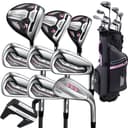
What is in the bag.For a first set, completeness beats quality, because a bag that is missing a wedge sends you shopping again in a month. Wilson publishes its contents club by club: a 13-degree driver, a 5-wood, a 5-hybrid, irons 6 through 9, pitching and sand wedges, a putter, a bag and three head covers. PGF publishes a piece count — 14 and 11 respectively — without saying which pieces. Precise publishes neither on these listings.
Whether the flex is published. Length is half of fitting a slower swing and flex is the other half. The PGF Lady Diamond publishes a regular flex, which is honest and also slightly unusual on a petite set. Wilson publishes graphite in everything except the putter. The remaining three publish no flex at all, which is a real gap rather than a nitpick.
Price, in context.The spread on this page is wide — the premium set is roughly double the cheapest. We have deliberately not ranked on price, because the most expensive set is also the only one that publishes a fit, and that is worth paying for. But the honest version of the advice is this: a correctly-sized cheap set beats an incorrectly-sized expensive one every time, so if the budget caps you at the bottom of this page, buy the bottom of this page and do not feel short- changed. Our budget set roundup makes the same argument across the whole category.
What nobody on this page publishes
Four things, and we would rather name them than imply we know them.
Club lengths in inches.Not one of these five listings tells you how long the 7-iron is. For a page about length, that is remarkable, and it is why the Precise M5’s -1"and Wilson’s height band carry so much weight: they are the only two anchors available.
Lie angles. A petite build normally adjusts lie along with length so the club sits flat. Normally. Nobody here states it, so we will not claim it for any specific set.
Lofts, beyond one.Wilson publishes a 13-degree driver. That is the only loft figure anywhere on this page. Thirteen degrees, for the record, is a lot of driver loft and exactly right for a slower swing — the reasoning is on our driver loft page. If the set driver still gives you trouble off the tee, driver vs 3-wood makes the case for teeing off with the fairway wood that came in the same box.
Shaft weights. Nothing. Which means nobody can honestly rank these sets on how light they are to swing, and anyone who does is guessing.
Petite, or just short clubs?
A reasonable question with a clear answer: buy the petite build, do not cut down a standard set.
Shortening a club changes more than its length. It makes the shaft play stiffer, it lightens the swing weight so the head feels like it has disappeared, and it leaves the lie angle wrong for the new length. You end up with a club that is the right size and the wrong everything else. A set built petite from the factory has the length, the lie, the shaft and the swing weight matched to each other, which is the whole point.
The exception is a single club you already own and love. Taking an inch off one wedge is a cheap job at any club shop and the consequences are small at that end of the bag. Doing it to a whole set is a false economy, and in this price range the petite set costs less than the re-shafting.
Nothing in the Rules constrains you here, incidentally. Club length is capped at the long end, not the short end, and Rule 4.1b limits you to 14 clubs without saying a word about which ones or how long. A bag of petite-length clubs is as legal as any other.
If a complete set is not what you want
Two alternatives, both legitimate.
Irons only.If you already have a bag, a putter and a driver you get on with, a women’s iron set solves the actual problem without replacing things that work. Our best women’s golf ironsroundup is the page for that — with the caveat that iron sets are even less likely than complete sets to publish a petite build, so check the listing word by word.
A full women’s set in the standard build. If your fingertip measurement came out at 26 inches or more, you are standard and should buy standard even if you are under 5 ft 3 in. Our best golf sets for women roundup covers that field properly, and men’s vs women’s clubs explains what actually differs between the two, which is less about gender than about length, flex and weight.
And if you are shopping for someone at the other end of the height range, the same logic runs in reverse on our best golf clubs for tall men page — same criterion, same absence of published figures, opposite inch.
What a correctly-sized set will and will not fix
It will fix the strike problems that come from standing wrong because the club made you. It will make a comfortable address position possible, which is the thing every beginner lesson starts with and the thing a too-long club quietly prevents. And it will stop you building compensations that you then have to un-build.
It will not fix a slice, add distance, or replace practice. If the ball is curving hard right, that is a swing-path problem and the right-sized club will slice just as reliably as the wrong-sized one. If you have never had a lesson, one lesson will do more for your scorecard than any set on this page.
What it does is remove an excuse that was never yours. There is a particular kind of frustration in a beginner who has been told their swing is the problem for two seasons while standing over clubs built for someone four inches taller. Getting the length right does not make you good. It makes the practice count.