How we picked these rangefinders
Each unit was assessed against its published listing specification — stated features, slope capability, stabilization, range. We have not walked a course with these and we are not going to claim a lock time we did not measure. Three criteria drove the ordering.
1. Confidence that it locked the flag
The single most useful feature on a golf rangefinder is confirmation — usually a vibration or a visual signal — that tells you the laser hit the pin rather than the trees fifty yards behind it. A number without that confirmation is worse than no number. Every pick here except the budget option provides it.
2. Switchable slope
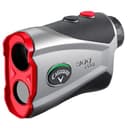
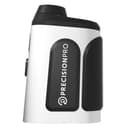
Slope-adjusted distance accounts for uphill and downhill. It is genuinely useful and it is not permitted in most competitions, which is why the feature to look for is a slope mode you can switch off rather than one that is always on. Bushnell calls theirs Shift; Callaway and Precision Pro have equivalents.
3. Whether the price is defensible for a beginner
The Bushnell costs more than a complete beginner golf set. It is a better device in every measurable way, and we still would not tell a first-season golfer to buy it. We have said that plainly on its card rather than burying it. It is also the outgoing generation now, which changes the calculation if you find it discounted — our Bushnell Tour V6 Shift review compares its published spec with the newer model line by line.
If you want the reasoning behind the top pick in full, our Callaway 300 Pro review goes through pin lock, switchable slope and the three golfers who should buy something else entirely. If slope is the feature you came for, the best rangefinders with slope narrows this list to the units that read it — and ranks them on whether you can switch it off, which is what makes them legal in competition.
And if there is already a rangefinder in the house that was bought for hunting, read golf versus hunting rangefinders before you buy a second one. The two are built to lock onto opposite targets, which decides whether the one you own is usable on a course.
What does slope actually do?
A plain laser gives you the straight-line distance to the flag. Slope compensation adds or subtracts yardage based on elevation change, so a shot playing thirty feet uphill might read 150 yards line-of-sight but 158 yards “plays like”.
For a beginner on a flat parkland course, the difference is small enough to ignore. On a hilly course it is the difference between a good shot and a shot that comes up short every time. If your home course has genuine elevation, slope is worth paying for; if it is flat, it is a feature you will switch on twice and forget.
The critical practical point is competition legality. Under the Rules of Golf, using a device to measure elevation change for the purposes of deciding a shot is not permitted unless the device’s slope function is disabled. Devices with a physical toggle make this straightforward; devices with slope permanently on cannot be used in a competition at all. Every slope-capable pick here has a switch.
Laser or GPS?
A laser rangefinder points at a target and measures it exactly. A GPS device knows where you are on a mapped course and tells you distances to the front, middle and back of the green.
For a beginner, a laser is generally the better first purchase for two reasons. It works on any course without a subscription or a course map, and it teaches you precise distances to the things you are actually aiming at — including the bunker you are trying to carry.
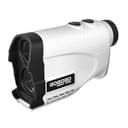
The counter-argument is real, though: a laser requires you to hold it steady and find a small target, which some golfers find genuinely difficult. That is exactly what image stabilization addresses, and it is why the TecTecTec pick is on this page. If your hands are unsteady, buy stabilization rather than a cheaper unit you will find frustrating.
Do beginners actually need one?
No, and we would rather say so. A rangefinder is not the first purchase a new golfer should make. In rough order of value, the money goes: a complete set, then balls and a glove, then a sand wedge, then shoes, and then a rangefinder.
But once you are past that list, it is arguably the best value item left, because it is the only one that gives you information rather than equipment. The usual counter is that beginners are not accurate enough for exact yardages to matter. That is exactly backwards: a beginner who does not know their distances makes club-selection errors of two or three clubs, which is a far bigger miss than any swing inconsistency.
One caveat about pace of play. Lasering every shot slows a round down, and the etiquette guide is worth reading if you are new. Take your reading while others are playing, not when it is your turn.
How to use one without annoying your playing partners
Three habits make the difference. Take your yardage while walking to your ball or while someone else is hitting, not after you arrive. Laser the flag once and trust it rather than re-checking three times. And keep it somewhere you can reach without unpacking your bag — the magnetic mounts on several of these units exist precisely for that reason on a cart.
Finally, remember what the number is for. Knowing you have 150 yards is only useful if you know what your clubs do. Spend a session at a range measuring your own distances with each iron and write them down; that piece of paper, combined with the laser, is worth more than any club upgrade on this site. Our clubs explained guide has typical beginner distance ranges to compare against.