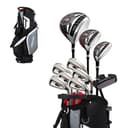
Why length matters more than anything else you can buy
A golf club is a lever you swing around your own body, and its length decides how far you have to stoop to put the sole of it flat behind the ball. Get the length right and you stand tall, your arms hang, and the club returns to the ball on the path it left on. Get it an inch and a half short - which is what a six-foot-four golfer is handed by a standard men’s box - and you have to lose that inch and a half somewhere. You will lose it in your knees, your spine or your arms, and whichever one you pick becomes a habit within a month.
The miss it produces is worth knowing, because it gets misdiagnosed as a swing fault so often. Clubs that are too short sit with the toe up when you address the ball properly, so to get the sole flat you drop your hands, which flattens your swing plane and pushes the strike toward the heel. The result is thin shots, heel marks on the face and a ball that starts right. Tall golfers are routinely told they have a path problem when what they have is a tape-measure problem.
Lie angle rides along with it. Lie is the angle between the shaft and the sole, and a club that sits too upright or too flat for your posture sends the ball sideways even on a well-struck shot. A longer-build set is designed around a taller player’s posture rather than bent to fit it afterwards, which is why ordering the right box beats adjusting the wrong one.
How tall is “tall” for golf clubs?
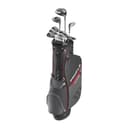
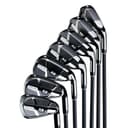
Standard men’s clubs are built for roughly five foot eight to six foot one. The Wilson Profile Platinum listing draws the line in exactly that place: it describes the tall configuration as the one for golfers over about six foot one, and it adds about an inch to each club. Precise does the same on its A9 iron set, which is also listed in a tall +1 inch size, and that listing’s framing is blunt - if you are over about six foot two, the extra inch is a more useful upgrade than any amount of head technology.
Rough bands, then, and they are bands rather than rules because arm length varies as much as height does:
- Up to about 6'1"- standard men’s length is almost certainly right. Buy on forgiveness and completeness instead, starting with our best golf clubs for beginners.
- About 6'1" to 6'4" - a tall or +1 inch build is the right default. This page is written for you.
- Over about 6'4" - a +1 inch build gets you most of the way, but this is where buying standard clubs and having them extended by a fitter starts to be the better answer.
One measurement beats height, and it is free: the distance from your wrist to the floor while you stand up straight with your arms hanging. Two golfers of the same height with different arm lengths need different clubs, and wrist-to-floor is what captures the difference. What size golf clubs do I need walks through taking that measurement at home and what to do with the number.
The three routes a tall golfer can take
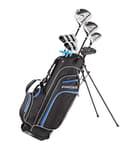
Buy a set listed in a tall build.Cheapest and simplest, and it is what the picks above are. The catch is that the tall option is rare, so your choice of set is narrower than an average-height golfer’s. If you are left-handed it narrows again - the Precise M5 left-hand set is offered in short, regular and tall, while the tall Aspire XD1 configurations in that line are listed as right-handed only.
Buy standard and have the clubs extended. A fitter cuts in an extension and re-grips, charged per club, which adds up fast across fourteen clubs. It is the right answer over about six foot four, or if you have already bought the wrong box. It also lets the fitter adjust lie at the same time, which a tall-build box cannot do. Our guide to whether golf club fittings are worth it covers what that appointment involves.
Buy individual clubs in a longer build. The most expensive route and rarely right for a first bag, because you pay club-by-club for the fourteen clubs a package set delivers in one box. It becomes sensible later, once you know which clubs you actually use - complete set vs buying individually lays out the maths.
Two things tall golfers over-buy, and one they under-buy
Over-bought: stiffer shafts. Being tall is not the same as swinging fast. Height gives you a longer arc, which can produce clubhead speed, but plenty of tall beginners swing at a moderate tempo and get handed a stiff shaft on the assumption that a big golfer needs one. If your drives will not climb, the shaft is the suspect - regular vs stiff shaft is the conversation to have before you spend anything.
Over-bought: extra-long drivers. A longer driver shaft does raise potential clubhead speed, and it also makes the club harder to control and the middle of the face harder to find. Tall golfers already swing on a wide arc; buying length on top of it mostly buys misses. The Rules of Golf also set equipment conditions and the 14-club limit in Rule 4, which is worth a glance before you experiment with anything unusual.
Under-bought: bigger grips. Tall golfers tend to have larger hands, and a grip too thin for your hand makes the fingers over-active through impact, which closes the face and produces a hook. Midsize grips are cheap and the change is immediate. What size golf grip do I need has the measurement, and our grip roundup has the picks.
A last piece of advice that costs nothing. If the set you want is only sold in standard length, that is not automatically a no - it is a “price plus extensions” calculation. Add the fitter’s per-club charge to the set price and compare it against the tall-build options above. Often the tall box wins, which is the whole reason this page exists.