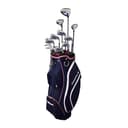
How we picked these sets
Every set below was chosen from its published listing specification — what is in the box, what sizing is offered, what bag it ships with. We have not hit these clubs and we do not claim to have. What we can do honestly is compare what each listing states against what a woman starting golf actually needs, and say clearly where a cheaper set is the smarter buy.
1. Correct sizing offered, especially petite
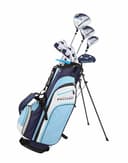
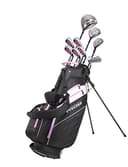
This is the criterion that moved sets up and down the list. A women’s set sold in one size only will fit some buyers badly, and length is the fitting variable that matters most to a beginner. Every Precise and Aspire set here is offered in regular and petite, and choosing correctly between them will do more for your golf than any component upgrade.
2. Genuine slow-swing design, not just a shorter shaft
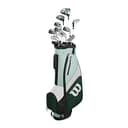
Wilson’s SGI designation stands for Super Game Improvement — the company’s most forgiving category, engineered around helping a slower swing get the ball airborne. That is a different thing from a men’s head on a shorter shaft, and it is the main reason the Wilson set leads.
3. Completeness, so there is nothing else to buy
A beginner should be able to open one box and go to a course. Every set here includes driver, fairway wood, hybrid, irons, putter, headcovers and a bag. The only thing several of them omit is a sand wedge — see our wedges roundup for the cheap fix.
Regular or petite? The one decision that matters
Standard women’s clubs are built for roughly 5’4” to 5’9”. Petite sets are typically an inch shorter throughout and suit golfers under about 5’4”. Tall configurations, where offered, add an inch for golfers over about 5’9”.
Getting this wrong is the most common equipment mistake in women’s golf, and it is completely free to get right — it just means ordering the correct box. A club that is too long forces you to stand further from the ball and swing around your body; a club that is too short makes you crouch. Both produce inconsistent contact that no amount of practice fully corrects.
If you are close to a boundary, go shorter. A slightly short club can be gripped normally and swung comfortably; a club that is too long cannot be fixed without a workshop.
Do you need women’s clubs at all?
Not necessarily — and this is worth saying plainly, because the industry rarely does. If you are tall and swing at a reasonable speed, a men’s set in a softer flex may fit you better than a women’s set. Clubs do not know who is holding them; they only respond to height, swing speed and hand size.
The reason we recommend women’s sets to most women starting golf is statistical rather than ideological: the combination of shorter length, lighter weight and softer flex matches the majority of women’s builds and swing speeds better than the men’s equivalent does. But if you are 5’10” and athletic, look at the men’s beginner sets as well, ideally in a senior or regular flex.
The same logic runs the other way. A slower-swinging man is often better served by a senior-flex set than a regular one — we cover that in our senior sets guide. Flex is about swing speed, not gender.
What is missing from every set here
Complete sets are complete in the sense that you can play a round out of the box. They are not complete in the sense of covering every distance. Two gaps recur across all five.
A sand wedge. Most package sets include a pitching wedge and stop, which leaves you nothing for a bunker. A budget 56-degree wedge costs very little and is the highest-value addition to any of these sets.
Balls and tees. Obvious, but easy to forget on the first trip. Our beginner golf balls roundup covers what to play — soft, low-compression balls suit slower swing speeds particularly well, which is the same principle as a softer shaft.
One thing you do not need to add: more clubs. The Rules of Golf allow 14, and most of these sets contain fewer than that on purpose. Missing out the hardest clubs is a feature of a beginner set, not an omission.
A note on the way these sets are marketed
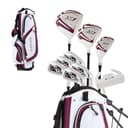
Women’s golf equipment is still sold with more emphasis on color than on specification, and it is worth looking past that. Two of the sets here are listed primarily by their color option, with the shaft flex and length buried in the description. Read for the sizing and the flex first, then pick whichever color you can live with for the next few years.
The encouraging context: the National Golf Foundation reported a record number of beginners taking up the game in the United States, with women making up roughly a third of adult participants. The equipment market has been slow to catch up with that, but the sets on this page are genuine, properly-specified golf clubs rather than novelties — which was not always true a decade ago.
Two neighbouring pages
A woman with a slower swing who rides a cart should start at best golf clubs for senior women, which ranks the sets around length, launch and the bag. And if your package-set irons are the only weak link, replacing that block alone is cheaper than a new bag — see best women’s golf irons. Our top pick also has a page of its own — the Wilson Profile SGI review covers the flex and length options its listing publishes.