Driver vs 3-Wood
Everyone tells beginners to leave the driver in the bag. Here is what the two clubs actually differ by on paper, what that does to a tee shot, and when the advice is wrong.
How this is funded: we earn a commission if you buy through our links, at no extra cost to you. It never changes which product we recommend, and we’ll tell you when we’d skip one. Full disclosure.
You are on the first tee. There is a driver in the bag and a 3-wood next to it, and everyone who has ever given you golf advice has told you to use the 3-wood. They might be right. They are also, almost always, unable to tell you why.
So here is the why, from the only numbers that are actually published. Pick any one maker and compare a driver against a 3-wood from the same family, and the two clubs differ by about two inches of shaft and about six degrees of loft. Everything you have ever been told about this decision is those two numbers playing out.
1. The two numbers, from one maker’s own tables
Cleveland makes both clubs our drivers and fairway woods roundups lead with, which makes it the cleanest available comparison — same brand, same stock shaft family, same design language, so the only things left to differ are the ones that define the club type.
The Launcher XL 2 driver is published at a 460cc head, a length of 45.5 inches, and lofts of 9.0, 10.5and 12.0 degrees, at a D2–D3 swing weight and 319 g of total club weight in regular flex.
The Halo XL Lite 3-wood is published at 43.75 inches and 16.5 degrees, at a D0 swing weight and 307 g in regular flex. The same table lists the 5-wood at 43.25 inches and 19.5 degrees, and the 7-wood at 42.75 inches and 22.5 degrees — every number going the same direction as the club gets more lofted.
That is the whole comparison: 1.75 inches shorter, six degrees more loft. Both clubs even ship with the same stock shaft model, the Aldila Ascent PL 40, in the same 44–47 g weight band. Nobody publishes a carry distance for either one, and you should distrust any page that gives you one, because distance is a property of your swing and not of the club.
2. What 1.75 inches of shaft actually does
A longer shaft swings the head on a wider arc, and a wider arc at the same effort means a faster clubhead. Faster clubhead means more ball speed means more distance. That part is uncontroversial, and it is why driver shafts are the longest legal thing in the bag.
The cost is that the center of the face becomes harder to find. The clubhead is further from your hands, so a small error in your body’s position becomes a bigger error at the face. A longer club also tends to produce a flatter, rounder swing, which is the swing shape most likely to deliver the face open and start the ball right.
So the trade is not “distance versus accuracy” in the abstract. It is more distance when you catch it, less often catching it.Whether that is a good trade depends entirely on how often you currently catch it — which is a fact about you, not an opinion about clubs.
3. What six degrees of loft actually does
Loft does two things at once, and the second one is the one nobody mentions.
The obvious job is launch. More loft sends the ball up more steeply, which means a thin or low strike still gets airborne. This is why a 3-wood off a tee feels so much more forgiving than a driver: the shot you would have topped with a 10.5-degree face still flies with a 16.5-degree one.
The less obvious job is curve control. More loft puts more backspin on the ball, and backspin and sidespin compete. A ball spinning hard backwards curves sideways less for the same amount of sideways tilt on the face. That is the real mechanism behind “the 3-wood goes straighter” — it is not that your swing improves when you pick it up, it is that the same swing error produces a smaller miss.
This is the identical principle behind the advice on our driver loft page: a beginner buying a 9-degree driver because that is what they saw on television has bought a club that both launches lower and curves more. If a 3-wood is beating your driver off the tee, the first thing to check is whether your driver has enough loft, not whether you should stop using drivers.
4. The decision, hole by hole
Here is the framework we would actually use, and it is not “always 3-wood”.
Hit the driver when a miss is survivable. Wide fairway, rough on both sides rather than water or out of bounds, nothing to carry. These are the holes where the extra 20 yards is free and the bad outcome is a slightly awkward second shot. Take the distance.
Hit the 3-wood when a miss is expensive. Trees tight on one side, out of bounds down the right, a forced carry you only just make with a good drive, or a hole where you cannot reach the green in two anyway. On those holes the driver is buying you distance you cannot spend.
Hit the 3-wood when the hole is short enough that the driver creates a problem. This one catches people out. On a 300-yard par 4, a well-struck drive can leave you a 40-yard pitch, which for most beginners is harder than a 100-yard full swing. Our guide to breaking 100 is built almost entirely on removing these self-inflicted awkward distances.
Hit whichever one you have actually practiced. If you own a driver and have never hit it anywhere except the first tee, it will keep behaving like a club you have never hit. The range is where this gets decided; our range guide has a way to spend a bucket that answers this question in about twenty balls.
5. The test that settles it for your swing
Do not take our word for it and do not take your playing partner’s. Buy a bucket, and alternate: driver, 3-wood, driver, 3-wood, ten of each, all from a tee peg. Keep a count of two things only.
How many finished in a space you would call a fairway.Not how far they went — how many you would have been happy to walk to. Be honest about the ones that went 40 yards right.
Where the worst three finished. This is the number that decides your scorecard. A club with a longer good shot and a much worse bad shot costs you strokes, because the bad shots are the ones that end up behind a tree or in a hazard.
Most beginners find the 3-wood wins on the first count by a mile and the second count by more. Some find they are almost identical, in which case hit the driver and enjoy yourself. A few find the 3-wood is worse, and that is real too — a 43.75-inch club with a shallow face is unforgiving if your tendency is to hit the ball on the way up with a high tee. Then you tee the 3-wood lower and the driver higher and you have learned something no article could have told you.
6. The part of the answer that is not about the tee
There is one asymmetry worth stating plainly, because it is the strongest argument for owning a driver even if you rarely use one.
A driver does exactly one thing: it hits a ball off a tee peg. A 3-wood is asked to do two, and the second is much harder. Off the ground, with no tee under the ball, a 43.75-inch club with a shallow face is one of the most demanding shots in golf — which is precisely why our fairway wood roundup argues most beginners should buy a 5-wood or a 7-wood rather than a 3-wood, and why a hybrid often beats both.
So the tee-shot comparison and the buying decision are not the same question. If you want a club to tee off with that is easier than your driver, a 3-wood is a fine answer. If you want a club for long shots from the fairway, a 3-wood is close to the worst answer in the bag and a 5-wood or a hybrid is a better one. Our how to hit a 3-wood guide covers the ball position and the strike that make the off-the-deck version possible.
7. What about a 5-wood, or a hybrid, off the tee?
Worth raising, because for a lot of beginners the right answer to “driver or 3-wood” is neither.
Cleveland’s own table gives you the ladder in one line: 16.5 degrees at 43.75 inches for the 3-wood, 19.5 degrees at 43.25 inches for the 5-wood, 22.5 degrees at 42.75 inches for the 7-wood. Every step down is shorter and more lofted, which means every step down is easier to strike and shorter in the air. The question is never “which club goes furthest”; it is “which is the longest club I can put in play most of the time”, and for a genuine beginner that is often the 5-wood.
A hybrid goes one step further again. It is shorter still, with a smaller head that most people find easier to aim and far better out of trouble. Off a tee on a tight par 4 it is a legitimate choice and it is the whole argument of our driver vs hybrid page. The cost is obvious and acceptable: you will be hitting a longer second shot, from the fairway, with a club you can actually hit.
The one thing we would not recommend is skipping the top of the bag altogether and teeing off with an iron on every hole. It works, it is safe, and it caps how good you can get, because the long clubs only ever become hittable by being hit. Alternate. Put the safe club in play when the hole demands it and the longer club in play when it does not, which is also the honest reading of what clubs a beginner actually needs.
8. What the Rules say (and do not say)
Nothing in the Rules requires you to carry a driver, and nothing stops you carrying three 3-woods instead. Rule 4.1b limits you to 14 clubs and leaves the selection entirely to you; the USGA’s own clubs hub says the same in plainer language. Club length is capped at the long end, not the short end, so there is no Rules reason a beginner cannot play a bag with no club longer than 44 inches.
One practical note that is a Rules note: if you do carry both and your set came with a 14-club complement already, check the count. Our 14-club limit page has the penalty, which is harsher than most beginners expect and is applied per hole.
9. If you are buying rather than choosing
Three picks below, and a clear order. If nothing in your bag is a problem yet, buy nothing: a set driver and a set 3-wood will not be what is costing you shots in your first season, and the honest ranking of where a beginner’s money goes is in our when to upgrade guide.
The driver, the 3-wood, and the cheap way to own both
The first two are the exact clubs whose published tables this page quotes, which is why they are here rather than a ranking we did not perform: they are the pair that let us compare a driver and a 3-wood with one variable changed. The third is for the reader who wants a 3-wood to tee off with and does not want to spend. All three were re-checked as live and in stock on October 27, 2026 before being listed, and every price below is live and carries the date it was checked.
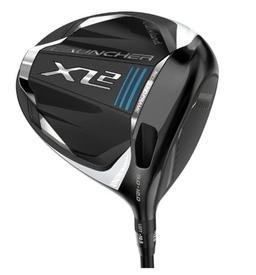
Cleveland Launcher XL 2 Driver
A big, stable, forgiving head from a respected brand — the pick if you want something a step above a package-set driver without paying flagship-tour prices.
- What it is
- 460cc driver, 45.5 in, lofts 9.0 / 10.5 / 12.0 degrees
- Who it’s for
- The reader whose driver is the problem - a forgiving head at a loft that works
Price as of November 21, 2026. #ad How we’re funded
Specs read from the product listing, on July 23, 2026.
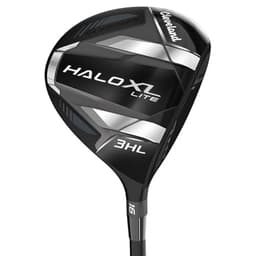
Cleveland Halo XL Lite 3-Wood
The best fairway wood here for a golfer who has decided to stick with the game. Cleveland's Halo family is engineered around launch from awkward lies, and a 3-wood you can actually hit off the deck is worth more strokes to a beginner than any driver. The Lite build makes the hardest club in the family easier to swing at beginner speeds.
- What it is
- 3-wood, 16.5 degrees, 43.75 in, Aldila Ascent PL 40 shaft
- Who it’s for
- The reader who wants a 3-wood that is genuinely easier than their driver off a tee
Price as of November 21, 2026. #ad How we’re funded
Specs read from the product listing, on September 29, 2026.
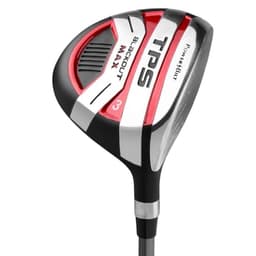
PowerBilt TPS Blackout Max #3 Fairway Wood
The cheapest way to put a 3-wood in the bag. It is a blunt instrument and we are not going to dress it up, but if you need a tee club that is not a driver and money is the constraint, this is a legitimate answer.
- What it is
- Budget 3-wood, right-handed
- Who it’s for
- Anyone testing whether they even like teeing off with a wood
Price as of November 21, 2026. #ad How we’re funded
Specs read from the product listing, on August 11, 2026.
| Pick | What it is | Who it’s for |
|---|---|---|
| Cleveland Launcher XL 2 Driver | 460cc driver, 45.5 in, lofts 9.0 / 10.5 / 12.0 degrees | The reader whose driver is the problem - a forgiving head at a loft that works |
| Cleveland Halo XL Lite 3-Wood | 3-wood, 16.5 degrees, 43.75 in, Aldila Ascent PL 40 shaft | The reader who wants a 3-wood that is genuinely easier than their driver off a tee |
| PowerBilt TPS Blackout Max #3 Fairway Wood | Budget 3-wood, right-handed | Anyone testing whether they even like teeing off with a wood |
So which one?
Carry both. Tee off with the 3-wood on the holes where a bad shot costs you a stroke, and with the driver on the holes where it does not. Then go to the range and find out which of them you actually hit, because that answer is about your swing and not about 1.75 inches of graphite.
And if the real problem is that both of them curve violently right, neither club is the answer and the slice guide is. A 3-wood slices too. It just slices less far.
Friendly guidance, not coaching. Tee & Tempo is written by a golf enthusiast, not a teaching pro. Our picks come from published specs and honest buyer-fit reasoning — we compare the numbers so you don’t have to, but we haven’t hit every club ourselves. When in doubt, hitting a few at a shop or a lesson beats any article.
Frequently asked questions
Should a beginner hit driver or 3-wood off the tee?
Hit whichever one you find the middle of more often, and find that out on a range rather than on a scorecard. Most beginners strike a 3-wood more reliably, because it is shorter and more lofted, so it is the safer default on a tight hole. But a modern beginner driver is built to be forgiving, and 'never hit driver' turns into never learning to hit it. Carry both, and use the 3-wood when the hole punishes a miss.
How much further does a driver go than a 3-wood?
On a well-struck shot, typically 15 to 25 yards for an amateur, and the gap comes from two published numbers rather than magic: a longer shaft and less loft. Cleveland lists its Launcher XL 2 driver at 45.5 inches and 10.5 degrees, and its Halo XL Lite 3-wood at 43.75 inches and 16.5 degrees. On a mis-struck shot the gap can reverse completely, which is the whole reason this question exists.
Is a 3-wood easier to hit than a driver?
Off a tee, yes for most golfers, because the shaft is shorter and the extra loft gets the ball up even on a thin strike. Off the ground it is one of the hardest clubs in the bag, which is a different question. If you only ever hit your 3-wood from a tee peg, it is an easy club. If you expect it to work from a fairway lie, be ready for that to take a while.
Can I just carry a 3-wood and no driver?
Yes. There is no Rule requiring a driver - Rule 4.1b caps you at 14 clubs and says nothing about which ones. Plenty of golfers tee off with a 3-wood for a whole season and score better for it. The cost is distance on the holes where distance is free, and the benefit is more tee shots in play. If your bag has room, the honest answer is carry both.
Why is a 3-wood 43 inches and a driver 45 inches?
Because they are built for different jobs. A driver only ever hits a ball sitting on a tee, so the maker can use every inch of shaft to chase clubhead speed. A fairway wood has to work off the ground, where a shorter shaft and a steeper angle of attack make clean contact possible. Cleveland's own tables show the pattern inside one family: 45.5 inches for the driver, 43.75 for the 3-wood, 43.25 for the 5-wood and 42.75 for the 7-wood.
Which club should I buy first, a driver or a 3-wood?
Neither, if your clubs came as a complete set - the set driver and set wood are fine for a first season, and your money does better on lessons or balls. When you do upgrade, a forgiving driver changes more tee shots than a new 3-wood does, because it is the club you hit on more holes and the club whose misses cost the most.
Does a 3-wood go straighter than a driver?
Usually, and for a measurable reason: more loft puts more backspin on the ball and more backspin reduces the sideways curve a given amount of sidespin produces. A shorter shaft also makes a square face easier to deliver. It will not fix a slice - it will shrink one. For the fix rather than the discount, our slice guide is the page you want.
Sources
- Golf Discount -- Cleveland Launcher XL2 Driver (retailer specification table) — The fullest published spec table we can still reach for this exact model. Standard heads: 460cc, 45.5 in length, lofts 9.0 (58.5 lie), 10.5 (60.0 lie) and 12.0 (58.5 lie), swing weight D2-D3, club weight 307 g (senior) / 319 g (regular) / 320 g (stiff). Draw heads: same 460cc and 45.5 in, lofts 9.0 (59.5 lie), 10.5 (61.0 lie) and 12.0 (59.5 lie), swing weight D2, club weight 307-311 g. Stock shafts listed as Aldila Ascent PL 40 (44-47 g, mid-high launch and spin) and Mitsubishi Tensei AV Blue 55 (55-62 g, mid launch and spin); grip Lamkin Crossline 360 Standard, .580 in, 50 g. Technologies named: MainFrame XL Face, Rebound Frame (two alternating flex zones) and Action Mass CB, an 8 g weight in the butt of the shaft. The table publishes NO MOI figure and does not list an adjustable hosel (accessed October 20, 2026)
- Golf Discount -- Cleveland Launcher Halo XL Lite Fairway Wood (retailer specification table) — RETAILER SPEC TABLE, used for the same reason as the XL2 driver entry above: Cleveland's own Halo XL Lite fairway page has been withdrawn (us.dunlopsports.com returns 404 for the MLXLLFW path as of this date), so the fullest published table for this exact model now sits with a retailer that still stocks it. Heads, verbatim: 3HL Wood 16.5 degrees loft / 57.5 degrees lie / 43.75 in length / D0 swing weight / 306 g (A), 307 g (R), 310 g (S); 5HL Wood 19.5 / 58.0 / 43.25 in / D0 / 309-313 g; 7HL Wood 22.5 / 58.5 / 42.75 in / D0 / 313-317 g. Stock shaft Aldila Ascent PL 40 -- S 47 g, R 44.5 g, A 43.5 g, torque 6.7-6.8 degrees, tip .335 in, launch and spin both listed Mid-High. The page describes the build as '1.5 degrees added loft' over the non-Lite version but publishes no baseline loft, and publishes NO head volume, NO MOI, NO grip model and no numeric center of gravity. Technology wording, verbatim: GlideRail -- 'Proprietary GlideRail Technology with an optimized design delivers cleaner, uninterrupted swings through the turf'; MainFrame XL Face -- 'MainFrame XL Face Technology uses a variable thickness pattern that maximizes flex at impact to boost distance'; XL Head Design -- 'The improved XL Head Design with low-and-deep weighting provides a long, high-launching ball flight' (accessed October 27, 2026)
- USGA — Rules Hub: Clubs — USGA overview of the 14-club limit and the freedom to carry any conforming club types (accessed July 23, 2026)
- R&A -- Rule 4: The Player's Equipment — Rule 4.1a(2) on adjustable clubs: a player 'must not make a stroke with a club when they have deliberately changed that club's playing characteristics during the round ... by using an adjustable feature or physically changing the club', with an exception where the club is restored to its original setting before being used; the penalty for making a stroke in breach of Rule 4.1a is disqualification. Rule 4.1b(1) sets the limit: a player must not start a round with more than 14 clubs or have more than 14 clubs during the round (accessed October 6, 2026)
Keep reading
Best Drivers for Beginners
Five forgiving drivers with live prices, and the loft to ask for.
See the best driversBest Fairway Woods for Beginners
Why a 5-wood often beats a 3-wood, and the woods that launch easily.
See the best woodsHow to Hit a 3-Wood
The technique half of this page - ball position, and why you must not help it up.
Read the guideWhat Loft Driver Should a Beginner Use?
The number that decides whether your driver is playable at all.
Read the guideDriver vs Hybrid for Beginners
The same decision taken one club further down, for the tightest holes.
Read the comparisonCleveland Launcher XL 2 Driver Review
The full published spec table for the driver quoted throughout this page.
Read the review