How we picked these irons
We have not hit any of these on a launch monitor and we own no test units. What you get here is a comparison of what each listing publishes — club count, shaft material and flex, stated length options, whether the wedges are included — measured against what actually helps a moderate swing speed. Where a listing does not state a specification, the table on each pick says “Not published” rather than guessing.
1. Graphite, essentially always
A graphite iron shaft is roughly 30 to 50 grams lighter than a steel one. Less weight to move means more clubhead speed for the same effort, and clubhead speed is what gets a golf ball into the air. For the great majority of women golfers — and for plenty of men — graphite in the irons is not a compromise, it is the correct fitting.
Every set on this page is graphite. If you find a steel women’s set at a tempting price, the saving is real and so is the reason for it. Our steel versus graphite guide covers when steel is genuinely the better call.
2. Length matters more than the label
“Women’s” clubs are typically built about an inch shorter than men’s. That is a sensible average and a poor rule. A woman of 5'10" is often better served by a men’s regular length with a lighter shaft, and a man of 5'4" may be better off in women’s lengths. Height decides length; swing speed decides flex; neither is decided by the word on the box. Our men’s versus women’s clubs guide works through the four specifications in detail.
3. Count the wedges before you count the irons
An iron set advertised as “5-PW” stops at the pitching wedge. Modern pitching wedges are much stronger-lofted than they used to be, and the gap between a modern PW and a 56-degree sand wedge can be twelve degrees — a twenty-five-yard hole in your distances.
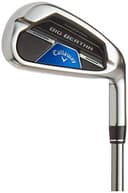
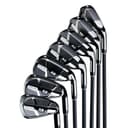
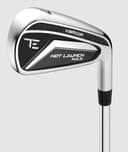
The Callaway REVA set solves this by including both an approach wedge and a sand wedge. The Tour Edge set does not, so budget for a wedge alongside it. Our wedges page covers what to add.
4. Hybrid irons are a real option, not a gimmick
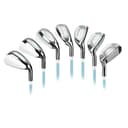
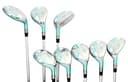
Two sets here replace some or all of the irons with hybrid heads. This is not a compromise product for people who cannot play — it is a genuine engineering answer to a genuine problem. Weight sits lower and further back in a hybrid head, which launches the ball higher for the same swing speed.
The trade is control on shorter shots. A hybrid pitching wedge is harder to hit a precise ninety yards with than a real one. If your problem is height and distance on the long clubs, hybrids solve it. If your problem is your short game, they do not.
Do you actually need new irons?
Possibly not, and it is worth ruling out three cheaper explanations first.
Your grips. Old, hardened grips make you squeeze, and squeezing locks your wrists and costs you speed. A full re-grip costs a fraction of an iron set and is the single best value change in golf. See our grips roundup.
Your ball. A firm, high-compression ball built for a fast swing genuinely does travel shorter for a moderate one. Our ball picks and our soft-versus-distance explainer cover the difference.
Your strike. If your good iron shots are good and your bad ones are thin or fat, that is contact, not equipment. Our iron guide explains the one setup idea that fixes most of it, and how to stop topping it covers the specific miss.
New irons are the right answer when your strike is reasonably consistent and the ball still will not climb, or when the set you have is genuinely the wrong length for you. Our upgrade guide lays out the honest signals.
Iron set or complete set?
If you are starting from nothing, do not buy irons. Buy a complete set: it costs less than irons alone from a premium brand, and it contains the driver, wood, hybrid, putter and bag you would otherwise be shopping for separately. Our women’s complete sets roundup is the right page for that.
Buy irons on their own when you already have a bag you like and the irons are the part letting you down — which, in a package set, is usually the case within two or three seasons. The rest of a starter set ages more gracefully than the irons do, because you use the irons far more.
What the numbers on the irons mean
Briefly, because it is the question we are asked most. A lower number means a longer club with less loft on the face, so the ball goes further and lower: a 5-iron flies further than a 9-iron. A pitching wedge (PW) sits just past the 9-iron, an approach or gap wedge (AW or GW) sits below that, and a sand wedge (SW) below that again.
A set listed as “4-PW” therefore contains seven clubs: 4, 5, 6, 7, 8, 9 and PW. A set listed as “6-PW, AW, SW” contains eight. Our clubs explained guide has the full table, including roughly how far each one goes.
A note on left-handed sets
Left-handed women have the thinnest equipment market in golf, and it is not close. Of the sets here, the Tour Edge Hot Launch Max is offered in a left-handed version and the others are listed right-handed. If you are a left-handed woman, buy when you find the right set rather than waiting for a sale — stock does not come back reliably. Our left-handed sets page covers the complete sets that are genuinely available.