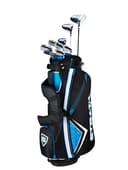
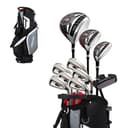
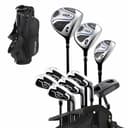
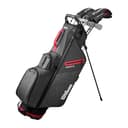
How we picked these left-handed sets
Each set was chosen from its published listing specification and checked for a genuine left-handed configuration currently offered for sale. We have not swung these clubs and we do not claim to have. For left-handed golfers, two criteria matter more than they do for right-handers.
1. Availability that is not theoretical
A set that exists on a manufacturer’s website but never appears in stock is no use to you. We weighted heavily towards sets that are consistently available in left-handed rather than appearing occasionally in a single length. That is why two value brands sit high on this list — not because their components beat the premium sets, but because they are reliably there.
2. More than one length offered
Right-handed buyers can usually pick short, regular or tall. Left-handed buyers often get one option. The Precise M5 is the exception here, offered in regular, tall (+1”) and short (−1”), and that alone makes it the right answer for any lefty who is not close to average height.
3. Completeness, same as any beginner set
Driver, fairway wood, hybrid, irons, putter and a bag, in one box. Every set here qualifies. What none of them includes is a sand wedge — that gap is universal in package sets and covered in our wedges roundup.
Should a left-hander learn to play right-handed?
This question gets asked constantly and it deserves a straight answer: no, not for equipment reasons. Learn to swing the way that feels natural.
The historical argument for lefties playing right-handed was purely practical — left-handed clubs were genuinely hard to find, so a generation of left-handed golfers simply learned the other way round. That constraint has largely gone at the beginner end. Every set on this page is real and buyable today, and the price difference against the right-handed equivalents is essentially nil.
There is a genuine complication, though, and it is worth knowing. Golf swing handedness does not always follow writing handedness. Plenty of people who write left-handed swing more naturally right-handed, because in golf the leadhand does the guiding — the top hand on the grip. If you have played hockey, baseball or cricket, swing an imaginary club and see which side feels natural. That is the side to buy for, regardless of which hand holds your pen.
The same logic explains a detail that confuses every new golfer: a “left-hand glove” is worn by a right-handed player. Our gloves guide explains which hand it goes on and why, so you do not order the wrong one.
What is genuinely harder as a left-handed golfer
Three practical things, all solvable.
Trying clubs before buying. Pro shops and demo days carry far fewer left-handed demo clubs, which makes hitting before buying harder. That pushes more lefties towards buying online, which makes getting the length right from a chart more important. Measure carefully.
Buying secondhand. The used market is thinner, prices are less competitive, and the specific model you want may take months to appear. Our used versus new guide covers what to check when something does turn up.
Upgrading one club at a time.Individual left-handed clubs — a particular wedge loft, a particular hybrid — are stocked inconsistently. When you find the one you want in left-handed, buy it rather than waiting for a sale.
Nothing on that list has anything to do with your golf swing. Left-handed golfers are not at a competitive disadvantage; they are at a retail one.
Getting the length right when you cannot try before you buy
Most left-handed sets are sold in a single “regular” length built for roughly 5’7” to 6’1”. If you fall outside that, seek out the sets offering tall or short configurations rather than accepting a poor fit.
The simple check: stand naturally with your arms hanging, and have someone measure from your wrist crease to the floor. Combined with your height, that wrist-to-floor measurement is what club fitters use, and every major set brand publishes a length chart against it. If you are between sizes, choose the shorter option — a slightly short club is easy to play, a long one is not.
Beyond that, everything in our guide to choosing golf clubs applies identically to left-handed golfers. Forgiveness, flex and fit are the same three questions; only the mirror image of the clubhead changes.