How we picked these putters
We compare published specifications — head style, length, face construction, grip size — against what a developing putting stroke needs. We have not rolled putts with these on a stimped green and we are not going to invent a number that says we did. Three things decided the order.
1. Forgiveness on an off-center strike
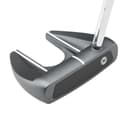
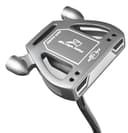
The technical measure is moment of inertia: how strongly a head resists twisting. Big fanged mallets like the Odyssey DFX and the Pinemeadow PGX rate highly on this by design, which in practice means a putt struck towards the toe still starts roughly on your intended line and rolls roughly the intended distance. That is a genuine, repeatable advantage for a beginner and the single biggest reason we lead with mallets.
2. A face that helps the ball roll
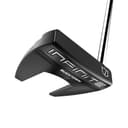
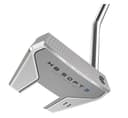
A putt that skids before it rolls wanders offline. Milled faces (the Cleveland HB Soft 2, the Wilson Infinite) and insert faces (the Odyssey) both address this in different ways — milling for consistency of contact, inserts for a softer feel that quiets a heavy hit. Either is fine; a bare, unfinished stamped face is the one to avoid, and none of our picks has one.
3. Grip size, which nobody mentions
An oversized grip reduces how much your hands and wrists can do during the stroke. For a nervous beginner whose hands are the problem, that is a real help, and it is why both the Odyssey and the Cleveland ship with one fitted. If a putter you like comes with a thin grip, an oversized replacement is a cheap and worthwhile change.
What length putter do you need?
Most putters are sold at 33, 34 or 35 inches, and 34 is the default for a reason: it suits roughly average height in a normal putting posture. The rough guide is straightforward.
- Under about 5’8”— look for 33 inches.
- About 5’8” to 6’0”— 34 inches is the safe default.
- Over about 6’0”— 35 inches, which is what the Odyssey, Cleveland and Wilson picks here are listed at.
Better still, do the practical test: take your normal putting stance with your arms hanging naturally, and the putter should reach your hands without you reaching down or standing up. If you are between sizes, go shorter — a putter can be gripped down, but it cannot be lengthened.
Mallet or blade? An honest answer
Blades look right. There is no getting around it: a classic blade putter is a beautiful object, and most people who have watched golf for a while instinctively want one. If that is you, the Wilson Infinite Bucktown gives you the look with a milled face from a real brand, and there is nothing wrong with buying it.
But if you are optimizing for scores rather than looks, take the mallet. The forgiveness advantage is real and it shows up on exactly the putts beginners hit — the six-footer struck slightly off the toe that a blade sends two feet past the hole and a mallet leaves inches away. This is the same forgiveness-first logic that runs through our iron recommendations and our complete set picks: as a beginner, buy the club that helps most when you miss.
Do you need to spend money on a putter at all?
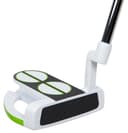
Genuinely, no. Putting is the part of golf where equipment matters least and technique matters most. A twenty-dollar difference in putter price buys you almost nothing that practice would not buy you for free. The Ray Cook is on this page precisely to make that point — it is a properly weighted mallet from a recognized brand for less than a round of golf costs.
Where we would spend a little more is on feel, because feel is the thing that makes you want to practice. If a putter sounds harsh and clicky at impact you will use it less, and using it less is the only thing that reliably makes you worse. That is the argument for the Cleveland HB Soft 2, and it is an argument about motivation rather than physics — which we think is worth being honest about.
If the money is going anywhere, we would put it here instead: a putting mat for the house costs less than the gap between the cheapest and dearest putter on this page, and it buys you the repetitions that actually lower a putting score.
One more piece of housekeeping: your putter counts towards the 14-club limit like everything else, and you may only carry one at a time on the course. If you are still deciding what else belongs in the bag, our guide to choosing golf clubs walks through the whole set.
Keep reading on forgiveness
Our top pick here is examined on its own in the Odyssey DFX putter review, including the length check to do before you order. And if you want the same forgiveness-first logic applied to every club in the bag, read the easiest golf clubs to hit.