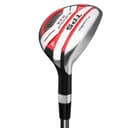
How we picked these hybrids
Every pick was chosen from its published listing specification — loft, shaft flex, shaft material, head design — against a beginner’s actual problem, which is getting the ball airborne from the fairway. We have not hit these on a launch monitor and we will not pretend otherwise. Three criteria set the order.
1. Loft, because loft is difficulty
This is the whole decision. A 19-degree hybrid replaces a 3-iron and needs speed to work. A 25-degree hybrid replaces a 5-iron, launches almost by itself, and will go further for most beginners than the stronger club would — because a ball that never gets airborne does not travel. If you are choosing between two lofts, take the higher one.
2. Shaft flex matched to a normal swing
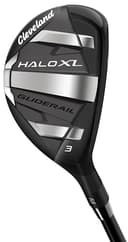
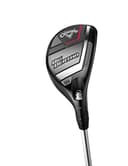
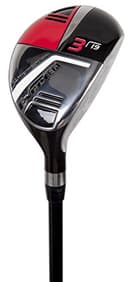
Regular flex is the correct default for the great majority of adult beginners, and it is what the Cleveland, Tour Edge, Callaway and Pinemeadow picks here are listed in. Stiff is for golfers who already generate real speed; senior flex is for slower, smoother swings, and we cover those in our senior clubs guide.
3. Price honesty
The Cleveland is the best club here and costs roughly four times the PowerBilt. That gap is real but it is not four times the golf, and we have said so on each card. If money is the constraint, the cheap option is a legitimate answer.
Which hybrid loft replaces which iron?
Hybrids are usually sold either by loft in degrees or by an iron-equivalent number, and the two do not always agree between brands. The rough conversion is consistent enough to shop by.
- 18–19 degrees— replaces a 2- or 3-iron. Long, demanding, and not where a beginner should start.
- 21–22 degrees— replaces a 3- or 4-iron. The most popular hybrid loft and a sensible first purchase.
- 24–25 degrees— replaces a 4- or 5-iron. The easiest to hit, and the one we would recommend to a genuine beginner.
- 27 degrees and up— replaces a 6-iron or higher. Rare, but excellent for slow swing speeds.
A useful rule: whatever your longest comfortable iron is, buy the hybrid that replaces the club one number longer. If you are fine with a 6-iron and hopeless with a 5, buy a 24- or 25-degree hybrid.
Hybrid, fairway wood, or driver?
These three overlap more than the marketing suggests, and beginners often own all of them without knowing what each is for.
A driveris a tee club only — almost nobody hits one off the ground. A fairway wood is longer-shafted with a bigger head, so it goes further but demands better contact; we cover those in our fairway woods roundup. A hybrid has the shortest shaft and the smallest head of the three, which makes it the most controllable and the most reliable from an awkward lie.
If you only add one long club to a package set, a hybrid is the safer buy, because it works from the tee, the fairway and the light rough. If you are still deciding whether the driver belongs in your bag at all, our driver versus hybrid guide gives the honest answer.
How to actually hit a hybrid
The short version is below; the long version, with the setup checklist, the rough and tee variations and a first-session practice plan, is in how to hit a hybrid.
The most common beginner mistake with a hybrid is trying to help the ball into the air by scooping at it. Hybrids do not need that — the low center of gravity is doing the launching for you. Play the ball roughly in the middle of your stance, slightly forward of an iron position but nowhere near where you would tee a driver, and swing it like a normal iron shot with a shallow, sweeping motion.
The other thing worth knowing is that a hybrid is genuinely excellent out of light rough, where the rounded sole cuts through grass that would tangle a long iron completely. That capability alone is worth several shots a round to a beginner who is not yet finding many fairways. If the reason you are in the rough is a persistent left-to-right curve, our guide on how to fix a slice deals with the cause rather than the symptom.
Finally, remember that every hybrid you add displaces something else under the 14-club limit. That is usually a good trade: swapping an unused 4-iron for a hybrid costs you nothing and gains you a club you will actually use.