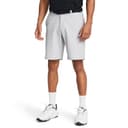
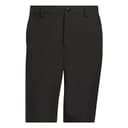
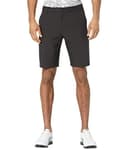
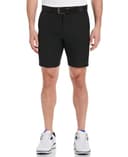
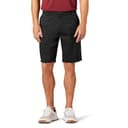
How we picked these shorts
We have not worn these for a season and there are no durability claims on this page we could not support. What we compared is what each listing publishes — cut, inseam, fabric, pocket style, sun rating — against the dress codes golf clubs actually enforce and the conditions you play in. Three criteria drove the picks.
1. Does it pass a dress code?
Four of the five here are flat-front, plain-colored, non-cargo shorts, which will pass anywhere. The fifth has cargo pockets and is included because it is genuinely the cheapest way to be respectably dressed on a public course — but we have flagged the limitation on the pick itself rather than burying it.
2. Fabric that works in heat
You are outdoors for four and a half hours, usually in the middle of the day, walking or sitting in a cart. A moisture-wicking technical fabric is genuinely more comfortable than cotton for that, and it dries after a rain shower rather than staying heavy. One of our picks adds UPF 50 sun protection, which is a real benefit in a sport with almost no shade.
3. Stretch, because you are swinging
A golf swing involves a deep rotation and a fairly athletic finish. Rigid woven shorts restrict that, and you will feel it by the back nine. Every pick here uses a stretch fabric or a stretch waistband.
What golf dress codes actually say
Codes vary, and the sensible move for any club you have not played is to check their website or ring the pro shop — they are used to the question and nobody thinks less of you for asking. That said, the pattern is remarkably consistent.
Public and municipal courses are generally relaxed. A collared shirt and any tidy shorts will be fine. Cargo pockets are a non-issue.
Semi-private and resort courses usually specify a collared shirt and golf or tailored shorts, and often explicitly exclude denim, gym shorts and cargo pockets.
Private clubsare the strictest and the most likely to specify length, shirt tucking, and no cargo pockets in writing. If you are somebody’s guest at a private club, wear the flat-front pair.
Our what to wear golfing guidecovers the whole outfit — shirts, shoes, hats and the weather layers — rather than just the shorts.
Inseam length, explained
The inseam is the measurement from the crotch seam to the hem, and it is the number that decides how the shorts sit on you. It is worth understanding because it varies more than you would expect between models.
A 10-inch inseam lands at or just above the knee on most men. It is the traditional golf length and it is what dress codes were written around. A 9-inch sits slightly higher and reads as modern rather than sloppy. An 8.5-inch or shorter is fashionable, increasingly common among younger players, and the length most likely to raise an eyebrow at a traditional club.
None of these is wrong. But if you are buying one pair for a course you have not visited, buy the 10-inch.
Which comes with a catch worth knowing before you order our top pick: Under Armour publishes two different Matchplay shorts, one at 10 inches and one at 9, and the listing title names neither length. Our Under Armour Matchplay shorts review sets out what the maker publishes for each version — including which one carries a UPF rating — and how to check before you buy.
Why last season’s model is the smart buy
Golf apparel is one of the very few categories in this sport where the previous-year model is functionally identical to the current one. A pair of shorts from last season has the same fabric, the same cut and the same construction, in a colorway that has been discounted because it is no longer on the front page of a catalog.
This is why one of our picks is a previous-season model at roughly half its original price. The only cost is limited colors and sizes. If you find your size in a color you can live with, it is the best value in golf clothing — the same logic our used versus new guide applies to clubs, only with none of the wear risk.
How many pairs do you need?
Two, if you play regularly. One if you are starting out.
The argument for two is simple laundry logistics: if you play Saturday and Sunday of the same weekend, one pair is not enough. Beyond that, more shorts is a wardrobe decision rather than a golf one, and the money is better spent on golf shoes, which affect comfort over eighteen holes far more than shorts do.
One genuine addition worth considering if you play in real heat: a second pair in a light color. Dark shorts absorb heat, and on a thirty-degree afternoon that is not a trivial difference.