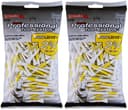
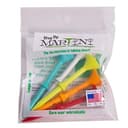
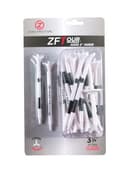
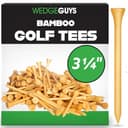
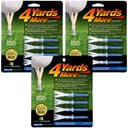
How we picked these tees
Tees are simple enough that the specification tells you nearly everything, and what we compared was published length, material, count and design against how a beginner actually plays. We have not conducted our own tee testing and we are explicitly not repeating any manufacturer’s distance claim as fact — including the one in the name of our longest-lasting pick, which we recommend on durability alone.
1. The right length for the club
This decided most of the ordering. A 3¼-inch tee is a driver tee; a 2¾-inch tee is the versatile middle that works for drivers teed lower and for fairway woods; a shorter tee is for irons on par threes. If you buy one length, buy 2¾.
2. Realistic quantity
Beginners break and lose an extraordinary number of tees, mostly by leaving them on the tee box. A pack of five premium tees is a lovely idea and an expensive reality. Bulk packs scored higher for that reason.
3. Consistency of tee height
The one place a tee design genuinely helps a beginner. A step-up tee physically stops at the same depth every time, which removes a variable from your driver setup. That is a small, real advantage, and it is not a performance claim we need a laboratory to verify — it is just a shape.
What length golf tee do you need?
- 3¼ inch— for the driver. Large modern heads need this to tee the ball high enough to catch on the upswing.
- 2¾ inch— the all-rounder. Works for drivers teed lower, fairway woods and hybrids. If you own one length, own this one.
- 2⅛ inch and shorter— for irons on par threes, where you want the ball barely off the ground.
- 4 inch and longer— specialty lengths, rarely useful unless you tee very high on purpose.
The practical rule for a driver: at address, about half the golf ball should sit above the top edge of the clubhead. Set that up once at a range with a tee you can see, note where it sits, and then push every tee to that same depth.
Wood, plastic or bamboo?
Woodis the default. Cheap in bulk, biodegradable, and it breaks — which sounds like a flaw but keeps the price at essentially nothing. Most golfers use wooden tees and never think about it again.
Plasticlasts far longer and enables designs wood cannot do — prongs, steps, flexible tops. The trade is environmental: many courses would rather not have plastic fragments in the turf, and some ask you not to use them. It is worth checking locally.
Bamboo is the sensible middle. Stronger than standard wood, so it breaks less often, but still biodegradable. It costs slightly more than wood in bulk and is the choice we would make if we were being deliberate about it.
One thing none of these materials does is add distance in a way you will notice. Low-friction designs reduce the contact area between tee and ball, and the physics of that is real, but the effect is small and swamped by strike quality for any beginner. Buy tees on length and durability; treat any distance claim as marketing.
Tees and the Rules of Golf
Two things worth knowing, both simple. A tee must be no longer than four inches to conform, which every tee on this page comfortably satisfies. And you may only use a tee on the teeing area — teeing the ball up in the fairway is not allowed, however tempting it looks.
You are also allowed to tee the ball anywhere within the teeing area, which is two club-lengths deep behind the markers. Beginners nearly always tee up right on the line between the markers; moving back a little and choosing the flattest piece of ground is free and helps. Our rules guide covers the rest of what you need for a first round.
A cheap habit that actually helps
Carry more tees than you think you need, in a pocket rather than deep in the bag. Running out of tees mid-round is a genuinely common beginner experience, usually on the ninth hole, and borrowing one from a stranger is a fine introduction to golf etiquette but avoidable.
The other habit: pick up your tee after every drive. It saves you money, keeps the course tidy, and stops you from being the person who bought two hundred tees in March and had eleven left in June. If you are building the rest of your first bag, our gloves roundup and balls roundup cover the other two things you will get through faster than expected.
The length on the packet is the easy part; the height you push it to is what changes your ball flight. What size golf tee do I need covers both - the two lengths worth carrying, and the half-ball-above-the-crown reference point for a driver.