What Size Golf Clubs Do I Need?
Height gets you close. Wrist-to-floor gets you right. Here is the measurement, the bands it falls into, and what to do when the set you want is only sold in one length.
How this is funded: we earn a commission if you buy through our links, at no extra cost to you. It never changes which product we recommend, and we’ll tell you when we’d skip one. Full disclosure.
Short answer: if you are between about five foot eight and six foot one, standard men’s length is right. Roughly five foot three to five foot eight, standard women’s length is right. Outside those bands, buy a set that is listed in a petite, tall or +1 inch build rather than buying standard and hoping.
That is the ninety-percent answer, and most golfers can stop there. The rest of this page is for the other ten percent - the people at the edges of those bands, the people with long or short arms for their height, and the people who already own clubs and suspect the length is why nothing works.
1. The measurement that beats height: wrist-to-floor
Height is a proxy. What a club actually has to fit is the distance from your hands to the ground when you are standing in a golf posture, and that depends on arm length as much as on how tall you are. Two six-foot golfers, one with long arms and one with short ones, can need club lengths a full inch apart.
Wrist-to-floor captures both at once. Take it like this:
- Stand up straight on a hard floor in flat shoes - not golf shoes, not bare feet.
- Let your arms hang naturally at your sides. Do not reach down, do not shrug up, do not lock your elbows.
- Have someone measure from the crease on the underside of your wrist - where your hand folds - straight down to the floor.
- Take it twice and average the two. A half-inch of sloppiness changes the answer.
Read that number next to your height. If both say “standard”, buy standard with confidence. If height says tall and wrist-to-floor is on the short side, you have long arms for your height and standard length is probably fine. If both say long, you need a longer build, and our best golf clubs for tall men page lists the sets that actually come in one.
2. What petite, regular and tall builds actually change
A “tall” or “+1 inch” set is not a different club. It is the same heads on shafts that are about an inch longer, usually with a small lie-angle allowance to match. A petite or −1 inch set is the same thing in the other direction. That is the whole modification, and it is enough, because length is what dictates posture.
Two consequences worth knowing. First, a longer shaft plays slightly softer and a shorter one slightly stiffer, so a tall build in regular flex feels a touch more flexible than a standard build in the same flex - rarely enough to matter at beginner swing speeds, but it is why length and flex get discussed together. Second, length changes swing weight: a longer club feels heavier in the head even at the same total weight, which is part of why extra-long drivers are harder to control.
The Rules of Golf set conditions on equipment and cap the number of clubs you carry at fourteen, both in Rule 4 - worth a glance if you are mixing a tall-build set with clubs bought separately and may end up over the limit.
3. Reading your own clubs for a length problem
If you already own clubs, you do not need a fitting bay to find out whether they fit. Three tests, all free.
The sole test. Set a mid-iron behind a ball on flat ground, in the posture you would actually play from. Look at the sole. If the toe is off the ground, the club is effectively too short for you, or too upright. If the heel is off the ground, it is too long or too flat.
The strike test. Spray a little foot powder or a face-tape strip on your 7-iron and hit five balls. Marks clustered toward the heel point at clubs that are too short for your posture; marks toward the toe point at the opposite. Centre strikes mean the length is not your problem and you can stop reading.
The posture test. Film yourself at address from the side on a phone. Your arms should hang roughly under your shoulders with a small, comfortable knee flex. If you are bent at the waist like you are reaching into a low cupboard, the clubs are short. If you are standing bolt upright with your hands high, they are long.
4. What to look for on a listing before you buy
This is where most beginners get caught, because the size information is either buried or absent. Three things to check:
Does the listing state a size at all?A set sold as a single “regular” configuration is at least telling you what you are buying. A set with no length information is a set built for average height, whether it says so or not.
Does it offer more than one? Petite, regular and tall options on the same listing are the strongest signal that the maker takes sizing seriously - and the picks below are chosen on exactly that basis.
Does the handedness you need come in the size you need? These are separate choices and they do not always both exist. Left-handed buyers outside standard height routinely find that the tall configuration of a set is listed right-handed only, so check before you decide rather than after.
Three sets that let you choose a size
Picked on one criterion the rest of the market mostly ignores: the listing publishes a size or length choice rather than selling one length to everybody. All three are from our best golf clubs for beginners and budget setroundups. Prices are live and carry the date they were checked; the specs come from each product’s own listing, read on the date shown.
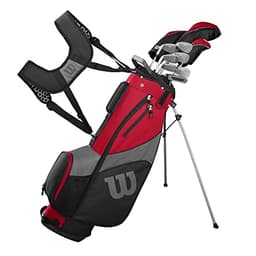
Wilson Profile SGI Complete Set
The Strata's main rival, and it earns the comparison. Wilson builds the Profile SGI around 'super game improvement' — maximum help for a slower, still-developing swing — and offers it in flex and length options the Strata doesn't.
- What it is
- Super game-improvement complete set, sold in flex and length options
- Who it’s for
- Anyone outside average height or swing speed who wants both matched, not just length
Price as of October 10, 2026. #ad How we’re funded
Specs read from the product listing, on July 23, 2026.
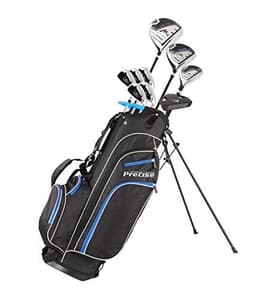
Precise M3 Men's Complete Set (Regular)
The budget set that takes sizing seriously. The M3 is listed in petite, regular and tall versions, so a taller beginner is not forced to stoop over clubs built for someone eight inches shorter.
- What it is
- Complete men's set listed in petite, regular and tall
- Who it’s for
- Taller or shorter beginners on the smallest sensible budget
Price as of October 10, 2026. #ad How we’re funded
Specs read from the product listing, on August 11, 2026.
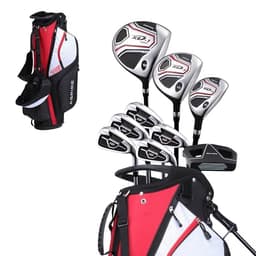
Aspire XD1 Men's Complete Set (Regular)
The cheapest full bag we are comfortable recommending. You are not getting Callaway engineering, but you are getting every club a beginner needs, in one delivery, for less than the cost of a driver on its own.
- What it is
- Complete men's package set, stated regular length
- Who it’s for
- The cheapest full bag that still states the size you are buying
Price as of October 10, 2026. #ad How we’re funded
Specs read from the product listing, on August 11, 2026.
| Pick | What it is | Who it’s for |
|---|---|---|
| Wilson Profile SGI Complete Set | Super game-improvement complete set, sold in flex and length options | Anyone outside average height or swing speed who wants both matched, not just length |
| Precise M3 Men's Complete Set (Regular) | Complete men's set listed in petite, regular and tall | Taller or shorter beginners on the smallest sensible budget |
| Aspire XD1 Men's Complete Set (Regular) | Complete men's package set, stated regular length | The cheapest full bag that still states the size you are buying |
5. When to pay somebody instead
A tape measure and a size option on a listing will get a beginner a long way, and for a first set that is usually the right place to stop. Three situations change that.
You are outside the bands by a lot.Over about six foot four or under about five foot, a single +1 or −1 inch step does not cover the gap, and a fitter who can build to a number is the better answer.
You already own clubs you otherwise like. Extending or trimming an existing set, and bending the lie to match, costs per club but keeps the heads you have. That is often cheaper than replacing a set you only bought last season.
Your strike pattern will not settle. If the heel marks persist after you have checked posture and length, something else is going on and a half-hour with a fitter or a coach will find it faster than more shopping. Our guide to whether golf club fittings are worth it covers what the appointment actually measures, and are golf lessons worth it covers the other half of that decision.
One final reassurance, because sizing anxiety stops more people buying their first set than it should. Inside the standard bands, length is not a close call - standard clubs fit most adults properly, and the difference between a well-fitted set and a standard one at beginner swing speeds is smaller than the difference between playing and not playing. Measure, buy the size the listing offers, and go hit balls.
Frequently asked questions
What size golf clubs do I need?
For most adults between about five foot eight and six foot one, standard men's length is correct, and standard women's length covers roughly five foot three to five foot eight. Outside those bands, look for a set listed in a petite, tall or +1 inch build. The better measurement than height is wrist-to-floor: stand up straight in flat shoes with your arms hanging and measure from the crease of your wrist to the ground.
How do I measure wrist-to-floor for golf clubs?
Stand up straight on a hard floor in flat shoes, shoulders relaxed, arms hanging naturally at your sides - do not stretch down or shrug up. Have someone measure from the crease on the underside of your wrist to the floor. Take it twice and use the average. That number, read alongside your height, is what tells you whether you need standard, shorter or longer clubs.
Does height matter for golf clubs?
It matters, but it is not the whole answer, because arm length varies independently of height. Two golfers both six foot tall can need club lengths an inch apart if one has long arms and the other short ones. Height narrows the choice to a band; wrist-to-floor picks within it.
What happens if your golf clubs are too short?
You have to make up the missing length somewhere, so you stoop more, drop your hands and swing on a flatter plane. The usual symptoms are thin shots, strike marks toward the heel of the face and a ball that starts right of target. It also makes the club sit toe-up at address, which pushes the ball sideways even on a clean strike.
What happens if your golf clubs are too long?
You stand too upright and too far from the ball, the club sits heel-up, and you tend to strike toward the toe. Too-long clubs also feel heavier to swing because the weight sits further from your hands, which usually costs clubhead speed rather than adding it.
Can golf clubs be shortened or lengthened?
Yes, both. A fitter trims the butt end to shorten a club or cuts in an extension to lengthen it, then re-grips it - and in either case the work is charged per club, so a whole bag adds up. Shortening also makes a club play slightly stiffer and lengthening slightly softer, which is worth knowing before you change more than about an inch.
Do junior golf clubs go by height or age?
Reputable junior sets are sold in age bands, but height is what actually matters. If a child is notably tall or short for their age, size up or down a band rather than trusting the number on the box - and expect to re-buy, because a growing junior outgrows a set faster than they wear it out.
Sources
- USGA — Rule 4: The Player's Equipment — The official Rule limiting a player to 14 clubs and governing conforming equipment (accessed July 23, 2026)
- USGA — Rules Hub: Clubs — USGA overview of the 14-club limit and the freedom to carry any conforming club types (accessed July 23, 2026)
Keep reading
Best Golf Clubs for Tall Men
The sets and iron sets actually listed in a tall (+1 inch) build, with live prices.
See the tall setsWhat Size Golf Grip Do I Need?
The second measurement on the club, the one you can change yourself for very little money.
Read the guideAre Golf Club Fittings Worth It?
What a paid fitting measures that a tape measure cannot, and when it is worth the money.
Read the guideMen's vs Women's Golf Clubs
Length is one of the four things that genuinely differ between the two builds. Here are the others.
Read the comparisonHow to Choose Golf Clubs
Where sizing sits in the order of decisions, next to flex, forgiveness and budget.
Read the guideBest Junior Golf Clubs
Sizing a growing child, and why the age band on the box is a starting point rather than an answer.
See the junior sets