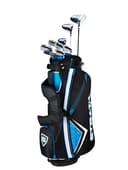
How we picked these sets
We do not own test units and we have not hit these on a launch monitor. What we did was compare what each listing actually publishes — club count, stated contents, length and flex options, handedness — against the four things that decide whether a cheap set is usable, and we have said plainly where each one falls short.
1. It has to be genuinely complete
The most common budget-set trap is a box that looks full and is missing the club you need on the second hole. A usable starter bag needs a driver, at least one fairway wood or hybrid, irons from about a 6 down to a pitching wedge, and a putter. Anything advertised as a “set” with fewer clubs than that is selling you a partial bag and letting you discover the gap on the course.
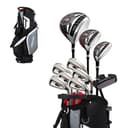
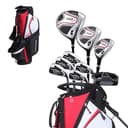
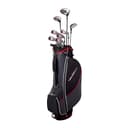
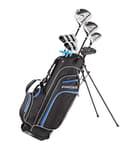
All five sets here clear that bar. Only one — the Precise M3 — omits a sand wedge, and we have flagged it.
2. It has to be offered in a length that fits you
This is the specification that separates a cheap set worth buying from a cheap set worth avoiding, and almost nobody talks about it. Clubs that are two inches too short for you build a stoop into your posture from your very first swing, and that habit outlasts the clubs by years.
Three of the sets here publish size options. The Precise M3 is the strongest on this point, listed in petite, regular and tall. If you are outside roughly 5'8" to 6'0", that matters more than any other line on this page. Our guide to choosing clubs explains how to work out where you sit.
3. The forgiving clubs have to be the ones you use most
Budget manufacturers save money somewhere, and the sensible place to save it is in the clubs a beginner barely uses. A cheap 3-wood is not a problem, because most new golfers do not hit a 3-wood well with any equipment. A cheap 7-iron is a problem, because that is the club you will hit fifteen times a round.
4. The bag has to be usable
Not good — usable. It needs a stand so you are not laying it flat in wet grass, two straps so the weight sits on both shoulders, and enough dividers that the clubs are not one tangled bundle. Every set here includes a stand bag; none of the bags is one you would keep after you upgrade.
What a budget set actually costs you
Four things, in descending order of how much you will notice them.
Shafts. This is the real difference. Premium sets use shafts with a name on them, made to tight weight and flex tolerances so every club in the bag feels the same. Budget sets use unbranded shafts with looser tolerances, which is why a cheap 7-iron and a cheap 8-iron can feel like they came from different sets. You will not notice this in your first season. You will notice it in your third.
Grips. Cheap grips harden and go slick faster. The good news is that this is the one budget compromise you can fix for very little money — see our grips roundup for what a re-grip costs and when it is worth doing.
Resale. A used Strata sells. A used value-brand set essentially does not. If you expect to trade up in two years, factor that in: the more expensive set can be the cheaper one to own.
Finish. Paint chips, cosmetic wear, headcovers that fray. This affects nothing about how the club performs and everything about how you feel pulling it out of the bag.
Notice what is not on that list: forgiveness. Budget beginner sets are built with oversized heads, wide soles and cavity-back irons for the same reason expensive ones are — those features are cheap to manufacture and they genuinely help. You are not buying less forgiveness. You are buying less consistency.
How much should you actually spend?
We will not quote figures that go stale, so here is the framework instead. There are three honest price bands for a complete beginner set, and the live prices on this page will tell you where today’s market sits in each.
The bottom band gets you a full bag from a value house brand — Precise, Aspire and the like. Everything works, nothing impresses, and the total cost is less than a single premium driver. This is the right band if you are not yet sure golf is for you.
The middle band gets you a recognizable name on the bag — Wilson or Callaway — and a meaningful step up in shaft consistency and resale. This is the right band if you have played a few rounds on borrowed clubs and already know you enjoy it.
Above that, you are into sets with real fitting options and components you would keep. Our main beginner sets roundup covers that territory, and our cost guide lays out what a complete first-year budget looks like once you add balls, shoes and green fees.
Cheap new clubs or good used clubs?
This is the genuinely difficult question, and the answer depends on one thing: whether you know what you are looking at.
A used set of two-generation-old name-brand clubs will usually outperform a new budget set at the same money. Iron design changes slowly, so a seven-year-old game-improvement iron is very nearly as forgiving as this year’s. That is a real argument and we are not going to talk you out of it.
The catch is everything you cannot see. Used clubs come with unknown shaft flex, unknown length, grips of unknown age, and no way to tell whether that iron was re-shafted badly. A beginner cannot evaluate any of that, which is how people end up with a bargain set of stiff-shafted blades that makes the game much harder.
Our honest rule: buy used if you have someone knowledgeable with you, or if the seller is a shop that states flex and length. Buy new budget if you are on your own. The full argument is in our used versus new guide.
What to spend the money you saved on
A cheap set frees up a few hundred dollars, and there is a much better use for it than better clubs.
A lesson or three. Nothing on this page will improve your golf as much as one hour with a teaching professional in your first month, before your habits set. This is not a close call.
Balls you can afford to lose. You will lose a lot of them at first, and playing a ball you are frightened to lose makes you swing worse. Our beginner ball picks cover the cheap end honestly.
A glove and shoes. A glove stops blisters. Shoes with grip stop you sliding, which is worth more shots than any club upgrade.
Range time. Buckets of balls are cheap and the driving range is where beginners actually improve. Our range guide covers how to practice so the time counts.
When to stop buying budget
There is a clear signal, and it is not a score. It is consistency: when you can find the middle of the clubface often enough that you notice one club in the bag behaving differently from the others, your equipment has become the variable. Until then it is not.
For most golfers that is somewhere in the second or third season. Our upgrade guide lists the honest signals and, more usefully, the far more common signs that your clubs are fine and something else is the problem.