Three wheels or four, and why it is a real decision
This is not marketing. The two layouts behave differently, and the difference shows up on specific holes rather than on a spec sheet.
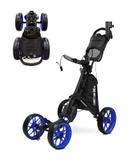
Four wheels are steadier across a slope.A four-wheel cart will not tip when you let go of the handle on a hill, and it tracks straight on a sidehill lie where a three-wheeler wants to lean downhill. If your course is hilly — or if you have ever watched a cart set off on its own toward a bunker — that stability is worth more than any accessory. It is the reason the CaddyTek leads this page.
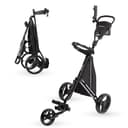
Three wheels pivot better and weigh less. A single front wheel lets you swing the cart around a green and through a gate without a three-point turn, and the frame is lighter to lift in and out of a car. Both of the cheaper picks here are three-wheelers for that reason.
There is no right answer, and our 3-wheel versus 4-wheel push cart page is the full version of this argument. The short one: hilly and you want to let go of the handle, buy four. Flat, tight greens and a small car, buy three.
Folded size matters more than weight
This is the specification most buyers ignore and then regret, and it is why the KVV earns its place.
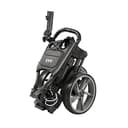
Your car boot already has a golf bag in it. A cart that will not fit alongside the bag is a cart you meant to bring. KVV built this one around folded size and advertises the smallest fold in its class, which is exactly the right thing to optimise for if you share a car or drive something small. It is also very light to lift, which matters more than it sounds after eighteen holes.
What a light frame costs you: it flexes more under a heavy staff bag, and its smaller wheels work harder in soft wet ground. If you carry a full tour-weight bag, take the CaddyTek. If your bag is a lightweight stand bag — and at this stage it probably is — the KVV is the easier cart to actually own. Our best golf bag for a push cart page covers the other half of that pairing, and stand bag versus cart bag explains which bag format belongs on a cart at all.
One honest gap: the Precise Cruiser’s listing publishes neither a folded size nor a weight. We are not going to estimate either. If the boot is your constraint, that missing figure is itself a reason to prefer the KVV, whose fold is the thing it sells itself on.
What the two carts above this line actually give you
Both of our overall picks sit above $200, and both publish enough detail to show exactly where the money goes. This is the clearest way to decide whether to save or spend.
The Bag Boy Nitronpublishes real figures, which almost nothing under $200 does: a folded size of 19 x 13.5 x 22 inches, a weight of 16.7 lbs, three foam tires that the maker says “never go flat or need air”, and a frame tested to over 10,000 opens. Its opening mechanism is the selling point — Bag Boy’s own wording is that it “pops open in seconds with Nitro-Piston technology”, with “zero effort”. It also carries a handle-mounted parking brake, a powder-coated aluminium frame with stainless fasteners and bearings, and a published two-year limited warranty on manual push carts bought on or after 4 May 2026 (one year before that). Its MSRP is published as $319.95.
The Clicgear Model 4.5 publishes a folded size of 13 x 15 x 24 inches, an internally routed brake cable, a front-wheel hand brake, independent handlebar adjustments, a silicone bag-strap system and a console with a sound-amplifying phone holder and a three-ball holder, at a published MSRP of $339.00. Note what Clicgear does notpublish: the cart’s weight, its wheel diameter, its open dimensions, a maximum bag weight or its frame material.
The Clicgear detail most likely to cost you money is its warranty, because it depends on where you buy. Clicgear publishes a six-year frame and two-year parts warranty for carts bought from Clicgear.com (for purchases after 21 January 2026), and a three-year frame and one-year parts warranty “when purchased from a different website or retailer”. Buying anywhere else halves the frame cover. Our Clicgear 4.5 review, Bag Boy Nitron review and head-to-head comparison go through both in full.
The summary: above this line you are buying published, verifiable build quality, a better brake, a better fold and a warranty worth reading. Below it you are buying the same weight relief with none of those guarantees. For a first cart — and especially if you are still deciding whether you prefer walking to riding — that is a sensible trade.
Compatibility: the one thing to check before you order
Two small details that cause most of the complaints about cheap carts, neither of which is the cart’s fault.
Your bag has to sit on it properly.A stand bag with legs can foul the upper saddle on some carts, and a heavy cart bag can overwhelm a light frame. Clicgear states its 4.5 “accommodates most stand bags”; the carts on this page make no such published claim, which is not the same as saying they will not work. Measure your bag’s base, and if you are buying a bag at the same time read how to choose a golf bag first.
Accessory threads are not universal.Clicgear publishes an explicit warning that legacy accessories made for the umbrella-holder screw thread on its older handles “are not compatible with the Model 4.5 due to the upgraded metric screw thread”. Assume nothing transfers between brands or generations. One advantage of the CaddyTek here is that the umbrella holder, drink holder and console come with it, so there is nothing to match.
Who should spend nothing
If you ride a buggy every round, buy none of these. A push cart solves a walking problem, and if you are not walking there is nothing to solve — our walking versus riding page is the honest comparison, and a cart bag is the gear that actually helps a rider.
And if you walk but carry a very light bag happily, you may not want a cart at all. Plenty of golfers prefer the simplicity of a carry bag on a flat course. The test is how you feel on the fifteenth tee rather than the first. If that is where your round falls apart, the Precise Cruiser is the cheapest way to find out within one round whether a cart is for you — then upgrade to one of the two above this line if the answer is yes. The full field with no price cap is at best golf push carts.