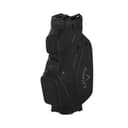
How we picked these bags
We do not own these bags and have not lived with them for a season, so nothing on this page claims durability we could not know. What we compared is what each listing publishes about construction — divider count and length, pocket layout, cart-strap accommodation, cooler provision — against how a bag is actually used on a cart. Three criteria drove the picks.
1. A real cart-strap pass-through
The first filter, for the reason above. Every bag here is designed around being strapped to a cart rather than adapted to it.
2. Full-length dividers, not just a divided top
This is the specification that separates a good bag from a cheap one, and the wording in listings is deliberately slippery. A bag can advertise a “14-way top” while the dividers stop three inches down, at which point all fourteen shafts tangle in the same cavity below.
Full-length individual dividersmeans each club runs in its own sleeve to the base. The benefits are real and daily: clubs come out without dragging three others with them, grips do not wear against each other, and the bag does not rattle on every cart path. Look for the words “full length” explicitly.
3. Pocket placement over pocket count
Eleven pockets is a marketing number. What matters is whether the ones you use — balls, glove, rangefinder, phone — are on the side that faces you when the bag is strapped down. This is where OGIO’s luggage background shows and why it earned a place here.
Cart bag or stand bag?
Answer one question: do you walk or ride? Not “do you intend to walk” — what you actually did last season.
If you ride most rounds, buy a cart bag. It will be heavier, better organized, more durable and better shaped for the cart, and the weight never matters because you never carry it.
If you walk most rounds, buy a stand bag — the ones on our golf bags page. A cart bag on your shoulder for eighteen holes is genuinely miserable, and no amount of padding fixes eight or nine pounds of empty bag.
If you genuinely do both, a good stand bag is the better compromise, because a stand bag on a cart is inconvenient while a cart bag on your back is unbearable. Our stand bag versus cart bag comparison works through the whole decision.
Do you need fourteen dividers?
Only if you carry fourteen clubs, which most beginners do not. The 14-way top matches the maximum the Rules of Golf permit, so it is the only configuration where every club gets its own slot with none shared.
If you play a package set with ten or eleven clubs, a 14-way bag is not wasted — the clubs simply sit further apart, which is if anything better. But it is not worth paying a premium for the divider count alone. Full-length dividers on a 9-way top beat a shallow 14-way top every time.
The cooler pocket, and whether it matters
Several bags here include an insulated pocket, and it is a more useful feature than it sounds if you play in heat. Four and a half hours in the sun with warm water is unpleasant, and cart drinks service is unreliable on a busy course.
The useful distinction is between an insulated pocket (a lined pocket, always present) and a removable cooler (a separate insulated bag that lifts out and can be washed). Removable is better because it can be cleaned, and anything that has held a leaking drinks can for a summer needs cleaning.
What a cart bag should weigh
Between about five and eight pounds empty, and heavier is generally better built. This is the opposite of stand-bag logic, where every ounce counts. On a cart, the weight is carried by the cart, so a heavier bag simply means more material, better zips and more structure.
The one caveat: you still have to lift it in and out of a car boot and onto the cart. If lifting is difficult, that is a genuine reason to look at the lighter end of the range — and the same practical thinking runs through our senior clubs page.
Cart bags are built around a riding cart’s strap position. If you push rather than ride, the calculation changes - best golf bag for a push cart explains why a stand or hybrid bag is usually the better buy there.