Stand, hybrid or cart bag: what each one is for
Golf bags come in three broad types and the names describe what they were designed around, not what they are capable of.
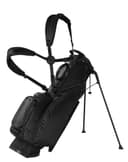
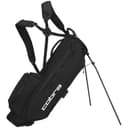
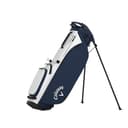
A stand bag has retractable legs and a dual shoulder strap. It is the walking bag, it is the lightest of the three, and it is what most push-cart owners should buy - because the push cart is a convenience rather than a commitment, and a stand bag lets you walk any round you want without a second bag. The legs fold flat against the bag in a cart bracket and are simply out of the way.
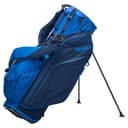
A hybrid bag is the deliberate compromise: built to sit securely on a cart and still be carried. This is the honest best answer for the push-cart golfer who has not yet decided how they will get around, and it is why the OGIO Woode Hybrid is the top pick. You give up a little weight against a pure stand bag and gain structure and storage.
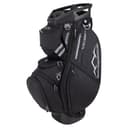
A cart bagis built for a riding cart. It has no legs, more structure, a 14-way top so every club gets its own full-length slot, and - crucially - a channel down the back for the cart strap to pass through without crossing your pockets. It is heavier than you want to carry any distance. On a push cart it works fine; it is just more bag than most walkers need, and the strap channel is designed for a riding cart’s strap position rather than a push cart’s.
The strap channel, which is the whole argument
If you take one specification away from this page, take this one. A cart strap crosses the bag horizontally. If the bag has no channel for it, the strap crosses your pockets - and the pocket it crosses is usually the big one holding your rain jacket, which you now cannot open without unhooking the bag.
Sun Mountain designs around that channel rather than treating it as an afterthought, which is the real difference between a proper cart bag and a heavy stand bag with no legs. On a stand bag, the equivalent check is simpler: look at where the pockets sit relative to the middle of the bag, and if the main pockets are high and low rather than across the middle, a strap will not block them.
This is also the check to make with a bag you already own before you buy anything. Put it in the cart, do the strap up, and try to get your glove, a ball and a rain jacket out. If you can, you do not need a new bag, and you should spend the money on a better cart instead.
Four more things to check before you buy
Base shape. Push-cart brackets are built around round and oval bases. Most bags are one of the two and will sit fine; very wide-based cart bags occasionally perch rather than seat, which makes the whole thing feel top-heavy on a slope. If a bag leans backwards in the bracket, that is the base, not the cart.
Dividers, and how far down they go.“Full-length dividers” means each club runs in its own sleeve to the base of the bag, so shafts cannot tangle and grips do not wear against each other. On a push cart this matters more than on a shoulder, because the bag vibrates continuously for four miles instead of swinging. A 14-way top matches the fourteen clubs the Rules of Golf allow you to carry - Rule 4.1b sets that limit - which is the only divider count where nothing is left over.
Pocket placement, not pocket count.Six well-placed pockets beat eleven you cannot reach from behind the cart handle. OGIO’s whole advantage here is layout rather than volume.
Weight, for the days the cart stays home. This is the quiet one. You will play rounds without the cart - a quick nine, a course that bans them, a trip where the cart will not fit in the car. A bag you cannot carry turns those rounds into rounds you do not play. If that is a real risk for you, the Callaway Hyperlite Zero is the answer: among the lightest stand bags Callaway makes, and the trade is simply fewer pockets.
Do you need a different bag at all?
Often, no - and we would rather say so than sell you one. If you already own a stand bag and you have just bought a push cart, do the strap test above before anything else. Stand bags and push carts are a natural pairing; the combination is what most walking golfers on any course are using.
The cases where a new bag genuinely helps are narrower than the market implies:
- Your current bag is a carry bag with no dividers and your clubs are already rubbing. On a cart, that gets worse rather than better.
- The strap sits across the only pocket you use, and no amount of re-threading fixes it.
- You have moved from carrying to pushing permanently, and you would now rather have the storage than the low weight.
- You ride a motorised cart about half the time, in which case a proper cart bag with a pass-through earns its keep.
And if the push cart itself is the thing you have not bought yet, buy that first. Taking forty pounds off your shoulder is the change that makes walking sustainable, and even the budget carts do that job - our push cart roundup covers them, and walking vs riding golf makes the case for walking in the first place. For the full bag-buying picture rather than the push-cart slice of it, start with how to choose a golf bag.