3-Wheel vs 4-Wheel Golf Push Cart
A real trade-off, not a marketing one. Three wheels pivot and pack smaller; four wheels sit still on a hill and cost less for the same build quality. Here is how to pick the side that fits your course.
How this is funded: we earn a commission if you buy through our links, at no extra cost to you. It never changes which product we recommend, and we’ll tell you when we’d skip one. Full disclosure.
Short answer: buy three wheels if you turn a lot, push one-handed, or have a small trunk. Buy four wheels if your course has real slopes, if you want to let go of the handle without watching the cart, or if you are shopping at the budget or mid price point and want the most cart for the money.
This is one of the few equipment arguments in golf that is genuinely about physics rather than marketing. The wheel count changes the shape of the cart’s base, and the shape of the base decides how it steers and whether it stays where you put it. Everything else - brakes, fold mechanism, accessory mounts - is available on both.
1. The geometry, which is the whole argument
A three-wheel cart has one wheel at the front and two at the back, so the ground contact points form a triangle. A four-wheel cart forms a rectangle. That single difference produces every other difference between them.
A triangle pivots. The single front wheel turns around a point, so the cart changes direction with a nudge and you can steer it one-handed while you walk - which is most of why three-wheel carts feel nicer to push on flat ground. A triangle is also lighter and packs smaller, because there is one less wheel to carry and fold around.
A rectangle resists. Four contact points mean the cart sits level, tracks straight, and - the part that matters - does not want to tilt or roll when you take your hands off it on a cross-slope. The trade is that it needs a slightly wider arc to turn, which you will notice picking your way between bunkers and barely notice anywhere else.
It is worth being clear that this is a real engineering trade and not a manufactured one. The specification note we keep on our own four-wheel pick puts it the same way: three pivots better and is lighter, four is steadier across a slope and will not tip when you let go on a hill. Both halves of that sentence are true, which is exactly why both types are still sold.
2. Your course decides this more than your preferences do
If you play one course most of the time, walk a hole in your head before you shop - because terrain beats every other consideration here.
Hilly or heavily contoured: four wheels. The scenario that sells four-wheel carts is standing on a slope beside a green, letting go of the handle to read a putt, and having the cart stay exactly where you left it. On a three-wheel cart on the same slope you are either setting the brake every time or watching it out of the corner of your eye. Over eighteen holes that is a lot of small irritations, and occasionally a cart on its side with your clubs underneath it.
Flat parkland or links: three wheels. With no meaningful cross-slopes, the stability advantage mostly stops mattering and the steering advantage is what you feel all day. This is the majority of municipal golf, which is why three-wheel carts dominate the market.
Soft or wet ground: a wash, with a caveat. Neither geometry wins outright, but wheel width and tire type matter a lot more than wheel count once the turf is soft. Wider tires float; narrow hard tires cut in and leave a line you will be asked not to leave. If you play a course that goes soft in winter, prioritize the tires over the wheel count.
One pace-of-play note, because walkers worry about it more than they need to. The USGA’s own pace guidance is about habits - being ready to play when it is your turn, roughly twenty seconds over the shot, playing ready golf where it is safe. Neither cart type makes you slow. Walking with a cart keeps up perfectly well, and walking vs riding golf works through why riding is often not the faster option it appears to be.
3. The fold, and the test nobody runs before buying
Here is the failure mode that turns either type of cart into a garage ornament: it does not fit in your car, or it takes too long to open.
Folded size beats weight. If your trunk already contains a golf bag, the question is whether the cart fits alongside it. Three-wheel carts generally pack smaller and some are engineered specifically around folded dimensions. Measure your trunk, find the published folded dimensions, and compare the two numbers before you compare anything else.
How it opens decides whether you keep using it. A cart that needs four steps and two hands in a parking lot in the rain gets left at home by August. One-motion and one-click mechanisms exist on both three- and four-wheel carts, and on a cart you will use weekly it is worth more than almost any other feature.
Check what is already attached. Four-wheel carts at the value end tend to arrive with the scorecard holder, cup holder and umbrella mount included, where three-wheel carts more often sell those separately. Add the accessory cost before you compare prices, or you will compare the wrong two numbers.
4. Price: what each geometry buys at each level
We do not print prices in prose - the live numbers on the cards below are the only ones true when you read this, and cart prices move. But the shape of the market is stable and worth knowing.
At the budget end, three wheels win on price. The cheapest carts of all are three-wheel, and they do the one job that matters: they take the weight off your shoulder. If you are not yet sure you will stick with walking, buy the cheapest cart that folds and find out.
In the middle, four wheels often give you more cart. This is the genuinely useful pricing insight. A mid-priced four-wheel aluminum cart tends to arrive with a one-click fold and the accessories attached, where the same money in three-wheel buys a more basic frame - because the compact engineering that makes a good three-wheel cart fold small carries a premium.
At the top, the best-built carts are mostly three-wheel. If you want one cart for the next decade and frame rigidity is the thing you care about, the premium end of the market is three-wheel territory. A flexible frame lets the bag rock as you push, and that rocking is what eventually loosens the joints on cheaper carts.
One of each, plus the cheapest way to find out
Three picks mapped to the three answers this page arrives at, all from our push cart roundup: the four-wheel value pick, the best-built three-wheel, and the budget three-wheel to buy if you are still deciding whether you like walking with a cart at all. Prices are live and carry the date they were checked; the specs come from each product’s own listing, read on the date shown.
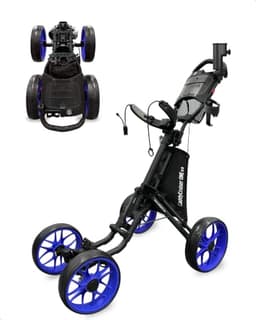
CaddyTek CaddyCruiser ONE V8 4-Wheel Push Cart
Four wheels, one-click fold, and everything you actually use already attached. This is the value pick that most people should buy before they consider spending twice as much.
- What it is
- 4-wheel aluminum folding cart, one-click fold
- Who it’s for
- Hilly courses, and anyone who wants to let go of the handle on a slope
Price as of October 15, 2026. #ad How we’re funded
Specs read from the product listing, on August 11, 2026.
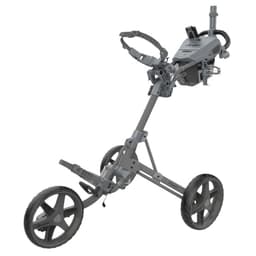
Clicgear Model 4.5 Golf Push Cart
The cart you see most often on a walking course, and for a reason: it is built like hardware rather than like a toy. If you want one cart for the next decade, this is the honest answer.
- What it is
- Premium 3-wheel foldable cart, rigid frame
- Who it’s for
- Flat courses and weekly walkers who want one cart for the next decade
Price as of October 15, 2026. #ad How we’re funded
Specs read from the product listing, on August 11, 2026.
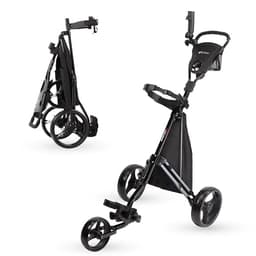
Precise Cruiser 3-Wheel Golf Push Cart
Under a hundred dollars, and it does the one job that matters: it takes forty pounds off your shoulder. Buy it to find out whether you like walking with a cart, then upgrade if you do.
- What it is
- Budget 3-wheel folding cart
- Who it’s for
- Finding out whether you like walking with a cart, for the least money
Price as of October 15, 2026. #ad How we’re funded
Specs read from the product listing, on August 11, 2026.
| Pick | What it is | Who it’s for |
|---|---|---|
| CaddyTek CaddyCruiser ONE V8 4-Wheel Push Cart | 4-wheel aluminum folding cart, one-click fold | Hilly courses, and anyone who wants to let go of the handle on a slope |
| Clicgear Model 4.5 Golf Push Cart | Premium 3-wheel foldable cart, rigid frame | Flat courses and weekly walkers who want one cart for the next decade |
| Precise Cruiser 3-Wheel Golf Push Cart | Budget 3-wheel folding cart | Finding out whether you like walking with a cart, for the least money |
5. What the wheel count does not change
Worth saying plainly, because a lot of cart marketing implies otherwise. The wheel count has no effect on:
- Whether your bag fits. Both types hold a bag in upper and lower brackets with a strap over the top. What matters is the bag, not the cart - best golf bag for a push cart has the strap test to run on the bag you already own.
- How tiring the round is. Both remove essentially all of the weight from your shoulder, which is the entire physical benefit. A four-wheel cart is not meaningfully easier to push on the flat.
- Brakes. Both types have them and you should use them. A brake on a four-wheel cart is not redundant, and a brake on a three-wheel cart is not a substitute for picking somewhere sensible to park it.
- Whether the course allows it. Push-cart restrictions, where they exist, are about turf conditions rather than wheel count. Call the pro shop if you are unsure - it is a thirty-second question.
So the decision really is just the geometry and the fold. Pick the geometry from your course, check the folded size against your car, make sure it opens in one motion, and then buy the best-built cart you can afford within that. Walking is how most of the game’s 48.1 million participants actually play it, and a cart is what makes it comfortable rather than an endurance event. If you still have the bag question open, start with how to choose a golf bag; if you are weighing walking against riding at all, that comparison is here.
Frequently asked questions
Is a 3-wheel or 4-wheel golf push cart better?
Neither is better overall - they fail in different places. A three-wheel cart steers with one hand, pivots tightly and generally folds smaller, which suits a walker who turns a lot and has limited trunk space. A four-wheel cart sits level and stays put on a slope, and at the same price usually buys a better build, which suits hilly courses and anyone who wants to let go of the handle without watching the cart.
Do 4-wheel golf push carts tip over?
They are considerably harder to tip than three-wheel carts, which is their main argument. A three-wheel cart has a single front wheel, so its stable base is a triangle and letting go on a cross-slope can let it roll or tilt. Four wheels give a rectangular base that resists both. No cart is immune on steep ground - set the brake rather than trusting the geometry.
Are 3-wheel push carts easier to steer?
Yes, and it is the clearest difference between the two in normal use. A single front wheel pivots around a point, so the cart changes direction with a nudge and you can push it one-handed while walking. A four-wheel cart tracks straight and needs a slightly wider arc, which is barely noticeable in the open and more noticeable around a green or between bunkers.
Which folds smaller, a 3-wheel or 4-wheel cart?
Usually the three-wheel, because there is one fewer wheel to pack and the frames are designed around a compact fold. Folded dimensions matter more than weight for most buyers - a cart that will not fit in your trunk alongside your bag ends up as a thing you meant to bring. Check published folded dimensions against your actual car before buying either type.
Is a 4-wheel push cart heavier?
Generally a little, though the gap is smaller than the wheel count suggests because frame material matters more than the extra wheel. Aluminum four-wheel carts are competitive on weight with three-wheel carts of similar quality. If you lift the cart in and out of a car boot every round, weigh that difference against the stability you gain.
Which type of push cart is better value?
At the budget and mid price points, four-wheel carts often give you more cart for the money - a one-click fold and the usual accessories already attached - because the three-wheel market carries a premium for the compact engineering. At the top end, the best-built carts are mostly three-wheel. Decide the geometry on your course first, then shop within it.
Do I need a push cart at all if I walk?
You do not need one, but it is the single purchase that makes walking sustainable. A carry bag on one shoulder for four hours is what makes most beginners give up walking, not the distance, and even the cheapest cart removes that entirely. Budget carts cost less than a decent pair of golf shoes.
Sources
- USGA — Tips and Suggestions for Improving Pace of Play — USGA practical pace-of-play guidance, including the ~20-second shot suggestion (accessed July 23, 2026)
- National Golf Foundation — Golf Participation in the U.S. (2025) — 48.1M total participants, a record 3M+ beginners (≈75% adults, 35% female) (accessed July 23, 2026)
Keep reading
Best Golf Push Carts
The full roundup with live prices - three-wheel, four-wheel, premium and budget, ranked.
See the push cartsBest Golf Bag for a Push Cart
Once the cart is chosen: which bag you can still reach into with a strap across it.
See the bagsWalking vs Riding Golf
The decision above this one. Cost per round, pace of play, and how far you actually walk.
Read the comparisonBest Golf Shoes for Walking
The other half of walking comfortably - cushioning and waterproofing over four miles.
See the shoesStand Bag vs Cart Bag
The bag-type comparison, for when you are deciding how you will get around at all.
Read the comparisonBest Golf Cart Bags
If you ride a motorized cart as often as you push, this is the roundup to read.
See the cart bags