Clicgear 4.5 vs Bag Boy Nitron
The two premium three-wheel carts most walkers end up choosing between. One opens itself, the other folds smaller and warranties longer - and only one of them will tell you what it weighs.
How this is funded: we earn a commission if you buy through our links, at no extra cost to you. It never changes which product we recommend, and we’ll tell you when we’d skip one. Full disclosure.
These two carts cost within a few dollars of each other and they are not two versions of the same purchase. The Nitron is the cart that is easier to use; the Clicgear is the cart that is easier to live with. One of them pops itself open in a parking lot and tells you exactly what it weighs. The other folds into a noticeably smaller block and, bought from the right place, carries three times the frame warranty.
Everything below comes from what the two makers publish — Clicgear’s feature list and warranty terms and Bag Boy’s specification page, all read on November 3, 2026 — plus live Amazon listings confirmed as real buyable offers on the same date. We own neither cart and we have pushed neither around a golf course, so there is no durability verdict here and no star rating. Where a maker does not publish a figure, this page says so rather than filling the gap. Our methodology page spells out what that means.
The published figures, side by side
Start with the three numbers that exist, because they do most of the work.
Folded size.Clicgear publishes 13 x 15 x 24 inches. Bag Boy publishes 19 x 13.5 x 22 inches. Multiply those out and the Clicgear is about 4,680 cubic inches folded against the Nitron’s roughly 5,640 — the Clicgear block is a fifth smaller. Just as important, it is a different SHAPE: the Clicgear is narrow and tall, the Nitron is wide and flat. A sedan trunk with a golf bag already in it usually has a tall gap rather than a wide one, which favors the Clicgear; a flat load floor behind an SUV seat favors the Nitron. This is a measure-your-own-car decision and not a winner-takes-all one.
Weight.Bag Boy publishes 16.7 lbs. Clicgear publishes nothing. Not a rounded figure, not a weight without wheels — no mass anywhere on the maker’s page. We are not going to supply one: third-party figures for this cart circulate and disagree, and a number we cannot trace to Clicgear is a number we will not print. What we can say is what the absence means. If lifting a cart into a high trunk or over a tailgate is a genuine constraint for you — a bad back, a tall SUV, a parking garage with a step — then one of these carts answers the question and the other asks you to find out after delivery.
Warranty.This is where the gap is widest, and it is the figure most buyers never look at. Bag Boy publishes a 2-year limited warranty on manual push carts for orders placed on or after May 4, 2026, running from the purchase date. Clicgear publishes two different warranties for the same cart depending on where you bought it: 6 years on the frame and 2 years on parts from Clicgear’s own site (for purchases after January 21, 2026), and 3 years on the frame and 1 year on parts “when purchased from a different website or retailer”.
Read those together and the ranking flips depending on your checkout page. Clicgear bought direct beats Bag Boy comfortably on frame coverage and matches it on parts. Clicgear bought on a marketplace beats Bag Boy on the frame by a year and LOSES to it on parts by a year. If you want the long warranty, you have to buy it from the maker — and buying direct also registers the cart automatically, where buying anywhere else leaves registration to you.
The opening, which is the Nitron’s whole argument
Bag Boy’s pitch for the Nitron is one mechanism: “patented Nitro-Piston technology that pops the cart open in seconds with zero effort”. Strip the branding and it is a gas strut, the same component that holds up a car hatchback. The strut stores energy when the cart is folded and releases it when the latch comes off, so the frame extends itself instead of you extending it.
The reason that is worth paying for is not the seconds. It is that a cart which takes four deliberate steps and two hands to assemble is a cart you stop taking. That is the real failure mode of push carts — not breaking, but sitting in the garage while you carry the bag again. Bag Boy also publishes a claim of being “tested to over 10,000 opens”, which is a manufacturer’s durability claim rather than a specification; nothing on the page says what the test was.
Clicgear publishes nothing about an assisted opening on the Model 4.5, so treat it as a conventional fold: competent, quick once learned, and done with your hands rather than by a spring. Two honest footnotes on the other side of the ledger, though. First, a gas strut is a wear part — it is the one component on the Nitron doing work on every single use, and a strut that has lost pressure turns the headline feature into a cart that needs two hands like any other. Second, Bag Boy publishes nothing at all about the CLOSING motion, and folding is the half you do in a parking lot while somebody waits for your space.
Brakes, handles and the details you only notice later
Both carts publish a brake and they are not the same brake.
Clicgear publishes a front-wheel engaged hand brake with an internally routed cable. Braking the front wheel of a three-wheel cart holds the end that wants to run away downhill, and a cable routed inside the frame is the kind of detail you appreciate in year three rather than week one: an exposed cable is what snags on a bag strap, gets stood on in a trunk, and eventually kinks.
Bag Boy publishes a handle-mounted parking brake, described as keeping the cart in place on hills. Brake POSITION matters more than brake type on a cart you push one-handed: a brake at the handle is one you will actually use, where a foot lever down by the axle is one you stop bothering with. Both of these are good answers to the same problem.
On handles, Clicgear publishes independent handlebar adjustments— height and angle set separately rather than in one locked arc. Bag Boy publishes no handle-height adjustment range at all, which our Nitron reviewflagged as that cart’s biggest unanswered question. Neither maker publishes a range in inches, so if you are much taller or much shorter than average, you know the Clicgear adjusts and you do not know how far — which still beats not knowing whether it adjusts at all.
Neither cart publishes a wheel diameter. Wheel size decides how a cart handles wet turf and the curb at a cart path, and it is the one spec both of these makers leave out. Bag Boy at least publishes the tire MATERIAL — three foam tires that it says “never go flat or need air”, which is a real advantage for a cart that sits in a garage from November to March, with the trade that foam rolls slightly harder through long grass than an inflated tire.
How each one carries your bag
Both publish a strap system and they work differently enough to matter.
Clicgear publishes a silicone bag strap system with an adjustable upper saddleand a lower saddle, and says the cart “accommodates most stand bags”. Silicone keeps its grip as it ages where rubber and plastic go hard and loose, and an adjustable upper saddle lets you set the cradle to your bag’s actual girth instead of cinching a strap tighter to compensate.
Bag Boy publishes conventional upper and lower straps plus Top-Lok, which it describes as “a patented bag-to-cart attachment system” where a Top-Lok bag “will securely lock into any Bag Boy push cart” — a bracket on the bag drops into a bracket on the cart and no straps are needed. The honest limit, which nobody states clearly: Top-Lok only does anything if your bag has the matching bracket. Any other bag rides on the conventional straps exactly as it would on any cart. So Top-Lok is a reason to pair the Nitron with a Bag Boy bag, not a feature you get for free.
Our guide to bags for push carts covers which stand bags sit on a cart without fighting it, and stand bag vs cart bag covers the decision underneath that one.
Storage, consoles and accessories
Close on paper, different in character.
Clicgear publishes a command center console— in its own list, a “sound-amplifying phone holder, magnetic and hook & loop storage pads, charging cord access, 3 ball holder” — plus a storage bag, a mesh basket, an adjustable drink holder that “holds anything from a skinny can to a wide bottle”, and an umbrella mount and bracket. Bag Boy publishes a deep scorecard console, a large hanging accessory bag, built-in drink and phone holders, a magnetic plate on the handlebar for a wedge while you putt, and an included detachable umbrella holder with integrated storage.
Both are generous. The real difference is the ecosystem: Clicgear sells the widest accessory range in the category — seats, coolers, umbrella holders, sand bottles — and that is a genuine part of what you are buying. With one trap, which Clicgear states plainly: legacy accessories built for the old umbrella-holder screw thread “are not compatible with the Model 4.5 due to the upgraded metric screw thread used on this cart”. Upgrading from an older Clicgear and planning to move your accessories across? Check each fitting first. First cart? Ignore this entirely.
The one question that decides it
Ignore the feature lists for a second and answer this: what is the part of owning a push cart that will annoy you?
If it is the parking lot— wrestling a frame open in the rain while your group walks to the first tee — buy the Nitron. The gas strut is the answer to exactly that, and the published 16.7 lbs tells you what you are lifting before you commit.
If it is the trunk, or the next ten years— a cart that has to live in a small space, or a cart you want to buy once — buy the Clicgear, and buy it direct so the frame carries 6 years rather than 3. The smaller fold and the longer warranty are the same argument from two directions.
If you cannot tell which annoyance is yours yet, that is a real answer too, and it points at neither of these. Buy the budget three-wheel cart on our push cart roundup, walk a season, and find out whether you are a walker at all — which is the question our walking vs riding page is actually about. Spending at this level before you know is the mistake our upgrade-order guide exists to prevent.
The two carts, and the cheap way to find out if you need either
The first two are the exact carts whose published figures this page quotes — they are here because they are the comparison, not because of a ranking we did not perform. The third is for the reader who has not yet established that they walk. All three were re-checked as live buyable listings on November 3, 2026, and every price below is live and carries the date it was checked.
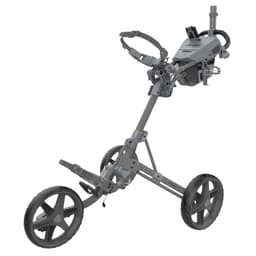
Clicgear Model 4.5 Golf Push Cart
The cart you see most often on a walking course, and for a reason: it is built like hardware rather than like a toy. If you want one cart for the next decade, this is the honest answer.
- What it is
- 3-wheel cart, folds to 13 x 15 x 24 in, front-wheel hand brake, weight not published
- Who it’s for
- The reader whose constraint is storage space, or who wants to buy one cart for a decade
Price as of November 21, 2026. #ad How we’re funded
Specs read from the product listing, on November 3, 2026.
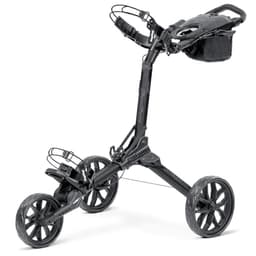
Bag Boy Nitron Golf Push Cart
The one to buy if you will use it every week. The Nitron's gas-strut opening means the cart unfolds itself in one motion, which sounds like a gimmick until you have wrestled a cheap cart in a parking lot in the rain.
- What it is
- 3-wheel cart, 16.7 lbs, folds to 19 x 13.5 x 22 in, gas-strut auto-open
- Who it’s for
- The reader who wants the cart to set itself up, and wants to know the lift in advance
Price as of November 21, 2026. #ad How we’re funded
Specs read from the product listing, on August 11, 2026.
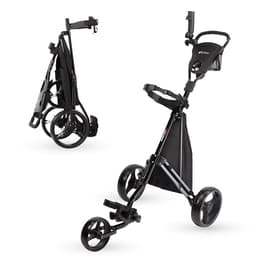
Precise Cruiser 3-Wheel Golf Push Cart
Under a hundred dollars, and it does the one job that matters: it takes forty pounds off your shoulder. Buy it to find out whether you like walking with a cart, then upgrade if you do.
- What it is
- Budget 3-wheel folding push cart
- Who it’s for
- Anyone still testing whether they will actually walk their rounds
Price as of November 21, 2026. #ad How we’re funded
Specs read from the product listing, on August 11, 2026.
| Pick | What it is | Who it’s for |
|---|---|---|
| Clicgear Model 4.5 Golf Push Cart | 3-wheel cart, folds to 13 x 15 x 24 in, front-wheel hand brake, weight not published | The reader whose constraint is storage space, or who wants to buy one cart for a decade |
| Bag Boy Nitron Golf Push Cart | 3-wheel cart, 16.7 lbs, folds to 19 x 13.5 x 22 in, gas-strut auto-open | The reader who wants the cart to set itself up, and wants to know the lift in advance |
| Precise Cruiser 3-Wheel Golf Push Cart | Budget 3-wheel folding push cart | Anyone still testing whether they will actually walk their rounds |
What neither cart will do
Worth saying, because the price of both invites the wrong expectation. A push cart is not a performance product. It will not add a yard or save a stroke, and no cart at any price changes how you strike a golf ball.
What it changes is what your legs and shoulders have left by the 16th tee, and that is a bigger deal over four hours than it sounds. Carrying a bag is fine for nine holes and a tax on eighteen; by the 14th it is quietly taking something off your swing and you will not notice until you look at your card. Both of these carts remove that completely. Pick the one whose published figures answer the question you actually have, and spend the difference on a lesson or on balls you will lose.
Frequently asked questions
Clicgear 4.5 or Bag Boy Nitron - which should I buy?
Buy the Nitron if the annoying part of owning a cart is setting it up: a gas strut pops it open in one motion, and Bag Boy publishes a 16.7 lb weight so you know the lift before you buy. Buy the Clicgear 4.5 if the annoying part is storing it, or if you intend to keep the cart for a decade: it folds to a published 13 x 15 x 24 inches and carries up to 6 years of frame warranty when bought direct from Clicgear.
Which cart folds smaller?
The Clicgear, on the published figures. Clicgear states 13 x 15 x 24 inches, which works out at about 4,680 cubic inches; Bag Boy states 19 x 13.5 x 22 inches, about 5,640. The Clicgear block is roughly a fifth smaller and a different shape - narrower and taller, where the Nitron is wider and flatter. Measure the space left in your trunk after the golf bag goes in and compare both.
How much do they weigh?
Bag Boy publishes 16.7 lbs for the Nitron. Clicgear publishes no weight at all for the Model 4.5 - not on the product page, not in the feature list - so we cannot give you a figure, and we will not print a third-party number we cannot trace to the maker. If lifting the cart into a high trunk matters to you, that absence is itself the answer: buy the one that tells you.
Which has the better warranty?
The Clicgear, but only if you buy it from Clicgear. Clicgear publishes 6 years on the frame and 2 years on parts for purchases from its own site made after January 21, 2026, and 3 years on the frame and 1 year on parts when the cart is bought from a different website or retailer. Bag Boy publishes a 2-year limited warranty on manual push carts for orders placed on or after May 4, 2026. So: Clicgear direct wins clearly, and Clicgear from a marketplace is a closer call.
Does either cart open automatically?
The Nitron does, in one motion - Bag Boy calls it Nitro-Piston technology and describes it as popping the cart open in seconds with zero effort, which mechanically is a gas strut extending the frame when you release the latch. Clicgear publishes nothing about an assisted opening for the 4.5, so treat it as a conventional fold. Note that Bag Boy publishes nothing about the closing motion on the Nitron either, and neither maker publishes open dimensions.
Which one holds my bag better?
They take different approaches and both publish them. Clicgear publishes a silicone bag strap system with an adjustable upper saddle and a lower saddle, and says the cart accommodates most stand bags. Bag Boy publishes conventional upper and lower straps plus Top-Lok, a bracket system that locks a Top-Lok-equipped Bag Boy bag to the cart with no straps - which only does anything if your bag has the matching bracket.
Should a beginner buy either of these?
Probably not yet. Both sit at the top of the category on price, and in a first season you do not know whether you will walk, ride, or play twice a year. A budget three-wheel cart answers that question for a fraction of the money, and if you wear it out you have learned you are a walker. Early money does more good in a lesson than in a cart.
Sources
- Clicgear -- Model 4.5 Push Cart (product specification) — The maker's own feature list for the cart. Published: a folded size of 13 x 15 x 24 in; a 'command center console with: sound-amplifying phone holder, magnetic and hook & loop storage pads, charging cord access, 3 ball holder'; a 'storage bag and mesh basket'; an 'adjustable drink holder that holds anything from a skinny can to a wide bottle'; an 'internally routed brake cable'; a 'silicone bag strap system'; an 'adjustable upper saddle' and a 'lower saddle'; a 'front-wheel engaged hand brake'; 'independent handlebar adjustments'; an 'umbrella mount & bracket'; and that it 'accommodates most stand bags'. Clicgear also publishes this compatibility warning verbatim: 'Legacy accessories designed to fit the umbrella holder screw thread on the cart handle are not compatible with the Model 4.5 due to the upgraded metric screw thread used on this cart.' MSRP is published as $339.00, in Slate, Black, Navy, White and Pink. NOT published anywhere on the page: the cart's WEIGHT, its wheel diameter, its open dimensions, a maximum bag weight, the frame material, or any figure for the brake (accessed November 3, 2026)
- Clicgear -- Clicgear Warranty (terms by where you bought the cart) — Clicgear's published warranty, which differs by retailer and is the single most consequential thing on this page for anyone about to buy on Amazon. Verbatim: 'Clicgear guarantees Clicgear carts to be free of any manufacturing or material defects from the date of purchase in the following terms'. 'When purchased from Clicgear.com*' -- '6-Year Warranty - Cart Frame' and '2-Year Warranty - Parts'. 'When purchased from a different website or retailer' -- '3-Year Warranty - Cart Frame' and '1-Year Warranty - Parts'. The asterisk reads: 'Only purchases made after January 21, 2026, are eligible for the extended warranty period. Purchases made on Clicgear.com before January 21, 2026, are subject to the standard 3-year cart frame and 1-year parts warranty.' The page also states the warranty 'does not cover normal wear or damage that occurs due to abuse, accident, neglect, or failure to follow the instructions/warnings in the user guide', that ordering direct 'automatically registers your cart for warranty', and that purchases made elsewhere must be registered by the owner (accessed November 3, 2026)
- Bag Boy -- Nitron Auto-Open Golf Push Cart (product specification) — The maker's own page for the cart. Published figures: folded size 19 x 13.5 x 22 in; weight 16.7 lbs; three wheels with foam tires that the page says 'never go flat or need air'. Opening mechanism, verbatim: 'Pops open in seconds with Nitro-Piston technology' and 'patented Nitro-Piston technology that pops the cart open in seconds with zero effort'. Also published: a handle-mounted parking brake described as keeping the cart in place on hills, a powder-coated aluminum frame with stainless steel fasteners and bearings, 'tested to over 10,000 opens', a deep scorecard console, a large hanging accessory bag, built-in drink and phone holders, a magnetic iron plate on the handlebar, a detachable umbrella holder with integrated storage, and Top-Lok compatibility. Warranty: 2-year limited for manual push carts on orders placed on or after May 4, 2026 (1-year limited before that), beginning on the original purchase date. MSRP $319.95. NOT published anywhere on the page: open dimensions, wheel diameter, handle-height adjustment range, the closing mechanism, or any tire width (accessed October 27, 2026)
- Bag Boy -- Revolver FX bag announcement (Top-Lok wording) — Bag Boy's own description of what Top-Lok is, in its own words: a Top-Lok bag 'will securely lock into any Bag Boy push cart' 'thanks to Top-Lok technology, a patented bag-to-cart attachment system'. The page names Bag Boy push carts as the compatible carts and does NOT state whether straps are still needed for a bag without a Top-Lok bracket -- which is why this site says plainly that a non-Top-Lok bag rides on the conventional straps rather than claiming the system works with any bag (accessed October 27, 2026)
Keep reading
Clicgear Model 4.5 Review
The full read on the Clicgear: every figure it publishes, the weight it does not, and the warranty clause that decides where you buy.
Read the reviewBag Boy Nitron Review
The full read on the Nitron: 16.7 lbs, a gas strut, and the three figures Bag Boy leaves out.
Read the reviewBest Golf Push Carts
Five carts with live prices, including the budget pick we would rather sell a first-season golfer.
See the push carts3-Wheel vs 4-Wheel Push Cart
Both carts here are three-wheel. This is the choice underneath that.
Read the comparisonBest Golf Bag for a Push Cart
Which stand bags sit on a cart without fighting it - including what Top-Lok needs.
See the bagsWalking vs Riding Golf
Whether you are actually a walker, which decides whether either cart applies.
Read the guide