What $200 actually buys in a golf bag
Golf bags do not follow the usual budget-gear pattern, where the cheap end is a compromise and the money buys polish. The useful features arrive early and the money buys lightness.
Everything on this page has the two specs that matter most: a divider top that keeps your clubs apart and enough storage for a full round. Three of the four publish a 14-way top with full-length dividers, which a few years ago was a premium feature. What you cannot get at this price is a bag that is genuinely nice to carry for four miles — the stand bags built around a light frame and a dual strap, like the two we rank at the top of our main golf bag roundup, sit above this ceiling and the gap is not small.
So the honest shape of this price band: if you ride, $200 is plenty and arguably more than you need. If you walk every round, you are better off spending more on a carry bag than buying the heaviest thing you can afford here. If you do not know yet — which is most first-season golfers — the hybrid on this page is the pick, because it is designed to sit on a cart and still be carried.
The three specs worth reading, and the one that is noise
Bag listings publish a lot. Most of it does not change your round.
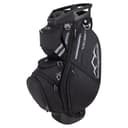
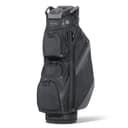
1. The divider top, and whether the dividers run full length. This is the spec. A 14-way top matches the 14-club limit in the Rules of Golf exactly — one slot per club, none shared. But the number on the listing is only half of it: dividers that stop a few inches down do nothing, because the shafts twist together below them and the grips wear against each other on every cart ride. “Full-length individual dividers” is the phrase to look for, and the Sun Mountain C130 and the Datrek DG Lite III both publish it. If you own a package set with nine or ten clubs in it, a 14-way top is still worth having, because the clubs you add over the next two seasons — starting, almost always, with a second wedge— go somewhere.
2. The cart-strap channel.The one feature that separates a real cart bag from a heavy stand bag, and the one most buyers have never heard of. A cart bag with a strap pass-through has a channel molded into its back so the cart’s strap crosses behind the bag instead of over its pockets. Without it, the strap lands across the pocket you keep your balls in and you spend the round unhooking the bag to get at your own gear. The C130 is designed around this; it is the single clearest reason it is the pick here.
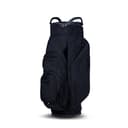
3. Pocket placement, not pocket count.Eleven pockets you cannot reach from the cart seat are worse than six you can. This is where OGIO earns its place — the brand comes from luggage rather than golf, and the Woode layout is thought through rather than merely numerous. The Datrek goes the other way and wins on sheer provision: seven zippered pockets, an insulated cooler pocket and a rubberized putter well. Our guide to what actually goes in a golf bag is a better way to size your storage than counting zips on a listing.
And the spec to ignore at this price: the published weight.Not because weight does not matter — it matters enormously if you walk — but because every bag in this band is a riding bag or a hybrid, and none of these listings publishes a figure we can quote. If you are buying a bag to carry, the weight is the headline spec and you should be shopping above this ceiling, where makers publish it and compete on it.
Cart bag, stand bag or hybrid: decide this first
Three of these four are cart bags. That is not an accident of our shortlist — it is what $200 buys well.
A cart bag is built to sit on a riding cart or a push cart and never be carried. It has no legs, it holds more, its top is usually a 14-way, and it is heavy. If you ride every round or you push a trolley, this is simply the correct bag and the extra storage is free weight you never feel.
A stand baghas retractable legs and a dual strap and is meant to be carried. The good ones are light, and light is expensive — which is why the dedicated carry bags we recommend are above this page’s line.
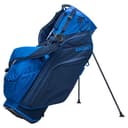
A hybrid splits the difference: legs and a carry strap, but built to ride securely too. The OGIO Woode Hybrid is here for exactly the golfer who has not decided, and that is a legitimate place to be after three rounds. Our stand bag versus cart bag comparison works the choice through properly, and how to choose a golf bag covers the rest of the decision.
One warning if you push rather than ride. Push-cart makers are specific about what their frames hold: Clicgear publishes that its Model 4.5 “accommodates most stand bags”, and Bag Boy’s own wording for its Top-Lok system is that a Top-Lok bag “will securely lock into any Bag Boy push cart” through “a patented bag-to-cart attachment system”. A bag without that bracket rides on the conventional straps instead, which is fine — but check your cart’s own page before you assume a wide 14-way cart bag will sit on it. Our best golf bag for a push cart page is built around exactly this problem, and the push cart roundup covers the frames.
What you give up under $200
Worth being plain about, because the step up from here is real rather than cosmetic.
Carrying comfort. This is the whole of it. Above this line you are buying a lighter frame, a better-balanced dual strap and a hip pad that makes a four-mile walk pleasant. None of these four is unpleasant on a cart; the hybrid is the only one you would want on your back for eighteen holes, and even it is more bag than a committed walker needs.
Fabric and zip life.The Datrek gives you the Sun Mountain’s feature list for less, and the trade is in materials over several seasons. That is a fair trade for a golfer two seasons in, and a bad one for someone who plays a hundred rounds a year.
Colorway availability. Not a joke at this price. Value-tier bags go out of stock by color unpredictably, so if a specific finish matters to you, buy when you see it.
What you do not give up: the clubs arriving safely. A full-length 14-way top does the same job at $188 as it does at $400. The dividers are not where the money goes, and that is the whole argument for this band.
Who should spend nothing
If you bought a complete beginner set in the last year, you already own a bag, and it is probably fine for now.
Package-set bags are genuinely basic — thin fabric, a four- or five-way top, a strap that is adequate rather than good. But they carry clubs, and the first season of golf has better places for $200 than a second bag. A lesson or two, a glove that fits and a box of balls you are not scared to lose will all do more for your scores than storage will. The honest trigger for buying a bag is specific: your set has grown past the top you own, the strap has failed, or you have started riding and your carry bag will not sit on a cart.
Spend moreif you walk every round. Buy the lightest carry bag you can justify instead of the heaviest cart bag you can afford — our main bag roundup ranks those, and the cart bag roundup covers the premium end of this one.
Spend here if you ride, push, or genuinely do not know yet. The C130 is the pick, the Woode Cart is the cheap way in, and the balls, bags and gear hub has the rest of what goes inside it.