What the expensive balls actually have that these do not
This is the question under the whole page, and it has a real answer rather than a marketing one. The short version: a cover material and an extra layer.
Callaway’s own golf ball buying guide — one of the rare manufacturer pages that defines the terms instead of just selling against them — puts it plainly. Covers come in two broad families: “Surlyn covers are durable and cut-resistant, typically made from an ionomer resin... often found on 2 piece golf balls. They offer low spin rates to produce extra distance,” while “Urethane covers are softer than Surlyn, offering a better feel and more control.” Every ball on this page is a two-piece design in that first family. The tour balls are in the second.
For scale on what that costs: an authorized Titleist dealer listed the Pro V1 at $57.99 when we checked on November 7, 2026, describing it only as having “multi-layer construction” and noting that “the urethane covers found in premium models provide superior greenside spin”. So the premium you are not paying is roughly $33 a dozen, and the thing you are not buying is greenside spin — the ability to land a wedge shot and have it stop quickly instead of running on.
Here is why that is the right trade for most golfers reading this. Greenside spin is generated by a descending strike with a lofted club at speed. If you are still learning to make solid contact, you are not producing the conditions that urethane rewards; the cover is a feature you have bought and cannot access yet. And the same guide notes the other half of it: “the more pieces a golf ball has, the higher the compression. Higher compression golf balls are designed for players with faster swing speeds.” A tour ball asks for speed you may not have. If you want the longer version of that argument, our Pro V1 alternatives page works through it product by product.
The arithmetic nobody does before buying golf balls
A beginner loses golf balls. Not occasionally — routinely, in water, in trees, in long grass. Three to six a round is normal in a first season and nothing to be embarrassed about.
Run that against price. At the budget end of this page you are losing under a dollar a ball. At $57.99 a dozen you are losing nearly five dollars a ball, which is roughly twenty dollars of golf balls per round on top of your green fee. That is not a small difference, and it has a second cost that is worse than the money: expensive balls make people swing scared. A golfer protecting a $5 ball aims away from water, clubs down off the tee and makes defensive swings. That habit costs more strokes than any cover material will ever save.
So the honest rule is: buy the cheapest ball you are happy to hit confidently, and buy enough of them. When you stop losing balls, revisit the question. Our what golf ball should I use guide is the long-form version, and soft versus distance golf balls covers the one real choice you do have at this price.
Soft or distance, at under $25
Both are on this page, and the difference is genuine even inside a two-piece budget ball.
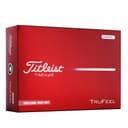
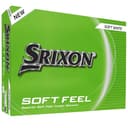
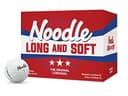
Soft, low-compression balls.The TruFeel, the Srixon Soft Feel and the TaylorMade Noodle sit here. Callaway’s guide defines the term usefully: “The compression rate refers to how much the golf ball compresses upon impact” and “the lower the compression rate, the easier to compress.” A ball that compresses easily at a moderate swing speed feels softer off the face and tends to launch higher. For most beginners, this is the family to be in.
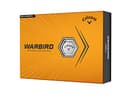
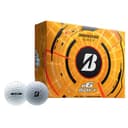
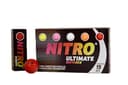
Distance balls.The Warbird, the Nitro and the firmer end of the category live here — two-piece, low-spin, built to go forward. Less spin means a slightly straighter flight, because sidespin is what curves a ball. If your miss is a big slice, that is a real, if modest, benefit, which is why the Bridgestone e6 is on this page with a slice-specific award.
What you should not do is buy on feel claims alone. Callaway’s own guide recommends a method rather than a spec sheet: “you should always test a golf ball by starting from the green and working your way back to the tee.” At under $25 you can afford to buy two different sleeves and find out which one you putt better with. That is the only ball test that means anything, and it is one you can actually run.
Pack size is the hidden spec
Two of the six picks here are 15-ball packs rather than twelve, and ignoring that makes the comparison nonsense. Fifteen balls at $19 is a materially lower cost per ball than twelve at $19, and when you are losing them, cost per ball is the only number that matters.
A related honesty note: colored balls are not a gimmick for a beginner. If you are losing balls in rough and leaves, a high-visibility or multi-colored pack is genuinely easier to find, and a ball you find is a ball you did not lose. The budget pick on this page is multi-colored for exactly that reason, and we would rather tell you that than pretend it is a performance feature.
One thing we will not do is tell you a compression number for any of these. No maker on this page publishes a per-model compression figure, and Callaway’s own guide publishes none either. Where you see a precise compression number quoted for a budget ball, somebody has either measured it independently or invented it, and you usually cannot tell which.
When to spend more than $25
Three honest triggers. Until one of them applies, stay on this page.
You have stopped losing balls. If you can finish a round with the ball you started on, the economics have changed and a better ball becomes a reasonable purchase.
You can hold a green with a wedge. This is the specific skill urethane rewards. If your pitch shots already land and stop, a urethane ball will reward you; if they land and run, it will not.
You have a genuinely fast swing. Higher-compression, multi-layer balls are built for speed. If you are driving the ball a long way already, you are leaving something on the table with a soft two-piece ball.
If none of those is you yet — and for most people reading a page about balls under $25, none of them is — the Titleist TruFeel is the pick, and a 15-pack of something cheap is the smart second purchase. Our best golf balls for beginners page ranks this category on fit rather than on price, and the balls, bags and gear hub covers the rest of what goes in the bag.