The three words on a Callaway box that actually matter
Callaway publishes a buying guide of its own, and it is unusually useful because it defines the terms rather than only selling against them. Three of them decide your purchase.
Compression.In Callaway’s own words, “the compression rate refers to how much the golf ball compresses upon impact” and “the lower the compression rate, the easier to compress”. That is the whole beginner argument for a soft ball: a ball you can actually squash converts more of a modest swing into ball speed. The guide also ties compression to construction — “the more pieces a golf ball has, the higher the compression. Higher compression golf balls are designed for players with faster swing speeds.” Which is a polite way of saying the tour-level ball in the premium box is the wrong ball for most people reading this.
Pieces.The same guide splits the market into “2 piece limited performance” and “multi-layer for performance from tee to green”, and notes that multi-layer balls “are often preferred by low handicap players looking for specific flight characteristics off the tee”. All three balls on this page are two-piece, by design. You are not missing out; you are skipping a layer built for a shot you are not yet playing.
Cover.Callaway is explicit here too. “Surlyn covers are durable and cut-resistant, typically made from an ionomer resin... They offer low spin rates to produce extra distance.” Urethane covers, by contrast, “are softer than Surlyn, offering a better feel and more control”. Low spin is the quiet reason a cheap ball often scores better for a new golfer: spin is what turns a slightly open face into a slice, and a ball that spins less curves less. Our soft versus distance golf balls page takes that trade apart in full.
Supersoft or Supersoft Max?
These two are close enough in price to make the question real, and the answer is about swing speed rather than skill.
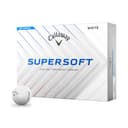
The Supersoft is the standard-size, low-compression, low-spin ball that has been the sensible default for new golfers for years. It is very soft off the putter, it flies straight, and it is the ball we point most beginners at on best golf balls for beginners.
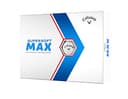
The Supersoft Max changes two things. Its compression is lower again, and it is built to a larger diameter than a standard ball. The larger diameter is not a gimmick and it is not a loophole: the Rules of Golf set a minimumball diameter, not a maximum, so an oversized ball is entirely conforming. A bigger ball sits up more in the grass and presents more of itself to the face, which makes the middle easier to find. The cost is feel — it is a genuinely different sensation off the putter, and some golfers never get used to it.
The honest test is the one shot nobody thinks to try: putt with both. You will hit forty or more full shots in a round and thirty-odd putts, and the ball that feels wrong on the green will annoy you far more often than the one that launches half a degree lower. If your swing speed is slow enough that you struggle to get the ball airborne at all, take the Max anyway and learn the feel. Our best golf balls for slow swing speed page is the longer version of that argument, across brands.
Where the Warbird fits, and who should ignore it
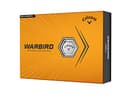
The Warbird is a two-piece distance ball with a large core and a durable ionomer cover, and it is on this page for one reason: it is the cheapest way to have a major-brand ball in your bag.
Cover durability is an underrated spec if you are still losing and scuffing balls. A ball that comes back scarred from the first cart path is effectively a one-hole ball at any price, and the Rules will not let you swap it out of sympathy: Rule 4.2c(2) permits a mid-hole substitution only when a ball “is cut or cracked and this damage happened during the hole being played — but not if it is only scratched or scraped or its paint is only damaged or discoloured”. A tough cover is therefore worth real money to a high handicapper, which is why the Warbird also leads our best distance golf balls roundup.
Who should ignore it: anyone whose main complaint is feel. The Warbird is firmer than either Supersoft off the putter and it has almost no greenside spin, so it will not check up on a green. If you are at the stage of trying to land a wedge near a flag, the Supersoft is the better ball and the premium urethane tier is the honest next step — our Pro V1 alternatives page covers what that tier actually buys you.
One Rule that quietly saves you money
You do not have to play the same ball all round, and you do not have to play your own.
Rule 4.2a(1) says that in making each stroke a player “must use a ball that conforms to the requirements in the Equipment Rules”, and adds that a player “may get a conforming ball to play from anyone else, including another player on the course”. There is no one-ball condition in a casual round. So you can carry Supersofts for the course and Warbirds for the forced carry over water, and borrow a sleeve from your playing partner on the ninth tee without penalty.
Two things you must not do. You must not play a ball whose performance has been deliberately altered — Rule 4.2a(2) names scuffing, heating, or applying any substance other than in cleaning it, and the penalty is disqualification. And if a ball breaks into pieces after a stroke, Rule 4.2b gives you no penalty and the stroke does not count, which is a detail worth knowing before you argue about it on the tee.
For the rest of what applies to a casual round, our golf rules for beginners page is the plain-language version.
What is not on this page, and why
Callaway makes a urethane-covered tour ball, and it is not here. Our registry carries three Callaway balls, all two-piece, all in the value band — and we do not add a product to a page just to make the page look complete. If the tour tier is what you are shopping for, say so plainly and start at what golf ball should I use, which walks the whole ladder.
There is also no compression figure anywhere on this page, no dimple count and no spin number. Callaway’s guide publishes none per model, and neither does any listing we can read. What the guide does give is a method worth copying, in its own words: “you should always test a golf ball by starting from the green and working your way back to the tee.” Buy one dozen, putt with them first, and decide from there — that single sentence is better advice than any number we could have printed.
Related reading if you are cross-shopping: our Supersoft review, Supersoft vs Titleist TruFeel and Supersoft vs Srixon Soft Feel all put the top pick here up against the ball it is most often compared to.