What Golf Ball Should I Use?
A soft two-piece ball, and stop thinking about it until you stop losing them. Here is what compression, piece count and cover material actually mean - in the makers' own words - and when each one starts to matter.
How this is funded: we earn a commission if you buy through our links, at no extra cost to you. It never changes which product we recommend, and we’ll tell you when we’d skip one. Full disclosure.
Use a soft, low-compression two-piece ball, buy it in the biggest box you can find, and stop thinking about golf balls until you are no longer losing several a round. The Callaway Supersoft is the default. If you are losing a sleeve every nine holes, the TaylorMade Noodle in a fifteen-ball box is the smarter answer.
That recommendation is deliberately boring, and the reasoning behind it is the actually useful part of this page. There is a version of this question that has a precise answer involving spin rates and launch windows, and there is the version almost everybody asking it actually has, which is “am I losing shots by playing the wrong ball?” For most golfers the answer to the second question is no - and the money is better spent on more golf.
So the plan here is: explain the three specifications that genuinely exist, using the manufacturers’ own definitions rather than ours, say honestly when each one starts to matter, and then name four balls for the four real versions of this question.
1. Compression, and the chart that does not exist
Compression is the specification people most want a number for, so start with what it means. Callaway’s own buying guide defines it simply: “The compression rate refers to how much the golf ball compresses upon impact”, and “the lower the compression rate, the easier to compress”.
That is the whole concept. A ball has to deform against the clubface to launch properly, and a low-compression ball deforms more easily - which is why it suits a slower swing. The same guide ties it to construction and swing speed in one sentence: “the more pieces a golf ball has, the higher the compression. Higher compression golf balls are designed for players with faster swing speeds.”
Now the part you will not find elsewhere. There is no authoritative golf ball compression chart, because most makers do not publish a compression number for individual models. We went looking specifically - the maker pages for several of the most popular soft balls on the market give marketing language like “ultra-low compression” and no figure at all, and Callaway’s own guide explains the concept without listing a single per-model number. Some makers’ sites could not even be read by our tooling, which tells you how much of this information is designed for browsing rather than comparing.
The charts that circulate online are third-party measurements of varying rigor, taken on different equipment at different temperatures, and they disagree with each other. They are not published specifications. Treat compression as three buckets - low, mid, high - put yourself in the low bucket if your swing is moderate or you struggle to get the ball up, and do not chase a number to the decimal point.
2. Piece count: what the extra layers are actually for
A golf ball is a core with a cover on it. Everything above two pieces is a maker adding a layer to make the ball behave differently at different swing speeds - firm when a driver hits it hard, soft when a wedge brushes it.
Callaway’s guide labels the two ends plainly: “2 piece limited performance” versus “Multi-layer for performance from tee to green”, and adds that “Multi-layer golf balls are often preferred by low handicap players looking for specific flight characteristics off the tee”.
Read that last clause carefully, because it is the honest version of the whole category. Multi-layer balls are preferred by low handicap players looking for specific flight characteristics. If you do not yet have a repeatable flight to characterize, there is nothing for the extra layers to do. The layer that adds greenside spin only pays out if you are landing wedges on greens on purpose.
Which is why a two-piece ball is not a compromise for a beginner - it is the correct product. “Limited performance” means limited at the top end, and the top end is not where you are playing.
3. Cover material: the one spec you can feel immediately
Two cover materials dominate, and the difference between them is the most perceptible thing on this page.
Surlyn. Callaway describes these covers as “durable and cut-resistant, typically made from an ionomer resin...often found on 2 piece golf balls”, which “offer low spin rates to produce extra distance”. Low spin is doing you a favor in two ways while you learn: it is longer off the tee, and less sidespin means a slice or hook curves less violently.
Urethane. These are “softer than Surlyn, offering a better feel and more control”. That is real, and it is where the premium ball money goes - a urethane cover is what lets a wedge shot check up rather than run out. It is also softer, so it scuffs faster, and it costs multiples more per ball.
The practical rule: Surlyn until you can control where the ball lands. A urethane ball lost in a pond performs exactly as well as a Surlyn ball lost in the same pond, for four times the price.
4. How to actually test a ball (the method nobody uses)
Most golfers evaluate a new ball by hitting a driver with it, which is close to the least informative thing you can do - driver distance differences between balls in the same category are small and swamped by strike quality.
Callaway’s guide gives the right method, and it is worth quoting because it inverts the instinct: “you should always test a golf ball by starting from the green and working your way back to the tee.”
So: putt with it first. Then chip. Then half-wedges. The differences in feel are largest and most perceptible at the short end, and the short end is where more of your strokes happen anyway. If a ball feels dead off the putter face, you will not enjoy playing it no matter what it does off a tee.
One cheap way to run this honestly: buy a sleeve of three of two candidates rather than two dozen boxes, and play them on the same nine holes on the same day. And do it when you are no longer losing them - a test you cannot finish because the ball is in a lake is not a test. Our guide to breaking 100 covers how to get to that point, and it has nothing to do with equipment.
Four balls for the four honest versions of this question
Each pick answers a different form of “what ball should I use” rather than ranking the same ball four ways. All four are from our beginner ball roundup and high-handicapper roundup, and all four were re-checked as live and in stock on October 13, 2026 before being listed here. Prices are live and carry the date they were checked.
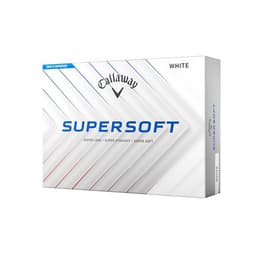
Callaway Supersoft Golf Balls
The default beginner ball, and rightly so: soft, low-spin, straight-flying and cheap enough that losing a few in the trees does not hurt. Start here.
- What it is
- Low-compression, low-spin two-piece ball
- Who it’s for
- The default - most golfers asking this question, most of the time
Price as of October 15, 2026. #ad How we’re funded
Specs read from the product listing, on July 23, 2026.
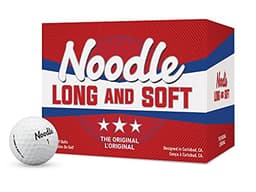
TaylorMade Noodle Long & Soft Golf Balls
Sold in a 15-ball box for the price others charge for 12 — the cheapest sensible ball here from a major brand. When you are losing balls learning, the Noodle is the frugal, guilt-free choice.
- What it is
- Soft distance ball, 15-ball pack
- Who it’s for
- Anyone still losing a sleeve every nine holes - cost per ball wins
Price as of October 15, 2026. #ad How we’re funded
Specs read from the product listing, on July 23, 2026.
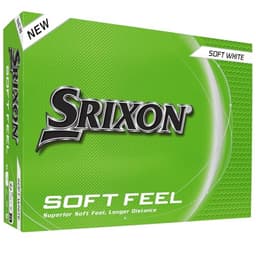
Srixon Soft Feel Golf Balls
A perennial 'best soft ball for the money' pick. The Soft Feel launches high and flies straight, and Srixon often sells it in value packs that stretch a beginner's budget further.
- What it is
- Soft, high-launch two-piece ball
- Who it’s for
- Slower swings and anyone whose shots never climb high enough to carry
Price as of October 15, 2026. #ad How we’re funded
Specs read from the product listing, on July 23, 2026.
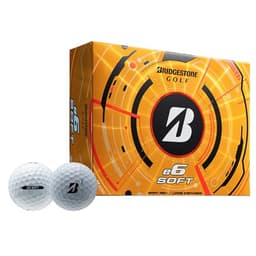
Bridgestone e6 Soft Golf Balls
A straight-flying, low-side-spin ball from a serious ball maker. The e6 is designed to reduce hooks and slices, so it flatters a beginner's crooked shots while feeling a touch more premium.
- What it is
- Low-side-spin, straight-flight ball
- Who it’s for
- Golfers fighting a slice or hook who want the curve reduced in the air
Price as of October 15, 2026. #ad How we’re funded
Specs read from the product listing, on July 23, 2026.
| Pick | What it is | Who it’s for |
|---|---|---|
| Callaway Supersoft Golf Balls | Low-compression, low-spin two-piece ball | The default - most golfers asking this question, most of the time |
| TaylorMade Noodle Long & Soft Golf Balls | Soft distance ball, 15-ball pack | Anyone still losing a sleeve every nine holes - cost per ball wins |
| Srixon Soft Feel Golf Balls | Soft, high-launch two-piece ball | Slower swings and anyone whose shots never climb high enough to carry |
| Bridgestone e6 Soft Golf Balls | Low-side-spin, straight-flight ball | Golfers fighting a slice or hook who want the curve reduced in the air |
5. When the ball starts to matter
Two conditions, and you will know when you meet them.
You are losing one ball a round or fewer. Until then, the arithmetic settles it: a premium ball you lose on the third hole was a worse purchase than a cheap ball you finished the round with, whatever its spin profile.
You are landing approach shots where you aimed.The premium ball’s real advantage is a wedge shot that stops near where it pitches. If your approach shots are not yet finishing on the green on purpose, there is nothing for that feature to improve.
When both are true, a urethane-covered multi-layer ball is one of the cheapest genuine upgrades in golf - a few dollars a round for a real gain in control around the green. Until both are true, you are buying a feature you cannot use.
And one piece of housekeeping worth more than any of this: play the same ball. Not the same model as somebody else - the same model as you played last week. A bag containing six different balls means every chip and every putt is a slightly unfamiliar feel, and consistency of feel is worth more to a developing player than any specification on this page.
If you want the ranked picks rather than the reasoning, our best golf balls for beginners roundup is the place to go, and soft vs distance golf balls takes apart the two marketing labels you will see on every box.
Frequently asked questions
What golf ball should I use as a beginner?
A soft, low-compression two-piece ball, bought in the largest box you can find. While you are still losing several balls a round, cost per ball matters more than any performance characteristic - and a soft two-piece ball is also genuinely the easiest ball for a slower swing to get airborne. The Callaway Supersoft is our default pick.
What does golf ball compression mean?
Callaway's own buying guide defines it as how much the ball deforms when you hit it: 'The compression rate refers to how much the golf ball compresses upon impact', and 'the lower the compression rate, the easier to compress'. The guide also links it to construction and swing speed - 'the more pieces a golf ball has, the higher the compression. Higher compression golf balls are designed for players with faster swing speeds.'
Is there a golf ball compression chart?
Not an authoritative one, and that is worth knowing before you go looking. Most manufacturers do not publish a compression number for individual models at all - we checked the maker pages for several popular balls and found marketing language like 'ultra-low compression' but no figures. The charts circulating online are third-party measurements of varying rigor, not published specifications. Use low/mid/high as a category and ignore the decimal points.
Does the golf ball matter for a high handicapper?
Less than almost anything else you could change, until two things are true: you stop losing more than a ball or two a round, and you start hitting approach shots that land where you aimed. Before that, a premium ball's advantages are real but unreachable. After that, the ball is one of the cheapest genuine upgrades available.
What is the difference between a 2-piece and a multi-layer golf ball?
Callaway's guide frames it as '2 piece limited performance' versus 'Multi-layer for performance from tee to green', and notes that 'Multi-layer golf balls are often preferred by low handicap players looking for specific flight characteristics off the tee'. A two-piece ball is a core plus a cover and is built for distance and durability; extra layers let a maker tune spin separately off the driver and off a wedge.
Surlyn or urethane cover - which should I buy?
Surlyn while you are learning. Callaway's guide describes Surlyn covers as 'durable and cut-resistant, typically made from an ionomer resin...often found on 2 piece golf balls', offering 'low spin rates to produce extra distance'. Urethane covers are 'softer than Surlyn, offering a better feel and more control' - genuinely better around the green, but softer, more expensive and more easily scuffed.
How should I test which golf ball suits me?
Callaway's guide gives the right method and it is not what most golfers do: 'you should always test a golf ball by starting from the green and working your way back to the tee.' Putt and chip with a sleeve of each before you judge them off a driver, because feel around the green is where the difference is largest and easiest to perceive.
Do golf balls have to be approved by the rules?
Yes - Rule 4 covers the player's equipment, and the Equipment Rules behind it set the conditions a conforming ball must meet. In practice every ball sold by a mainstream manufacturer conforms, so it is not something a recreational golfer needs to police. It only becomes relevant with novelty or practice balls.
Sources
- Callaway -- Golf Ball Buying Guide — The maker's own buying guide, which is the rare manufacturer page that defines the terms rather than only selling against them. On compression: 'The compression rate refers to how much the golf ball compresses upon impact', 'The lower the compression rate, the easier to compress', and 'the more pieces a golf ball has, the higher the compression. Higher compression golf balls are designed for players with faster swing speeds.' On construction: '2 piece limited performance' versus 'Multi-layer for performance from tee to green', and 'Multi-layer golf balls are often preferred by low handicap players looking for specific flight characteristics off the tee.' On covers: 'Surlyn covers are durable and cut-resistant, typically made from an ionomer resin...often found on 2 piece golf balls. They offer low spin rates to produce extra distance', while 'Urethane covers are softer than Surlyn, offering a better feel and more control.' On method: 'you should always test a golf ball by starting from the green and working your way back to the tee.' The guide publishes NO per-model compression numbers (accessed October 13, 2026)
- USGA — Rule 4: The Player's Equipment — The official Rule limiting a player to 14 clubs and governing conforming equipment (accessed July 23, 2026)
Keep reading
Best Golf Balls for Beginners
The full roundup with live prices - the soft, low-compression balls worth losing.
See the ballsSoft vs Distance Golf Balls
The two marketing categories, compared head to head - and whether the labels mean anything.
Read the comparisonCallaway Supersoft vs Titleist TruFeel
The two soft beginner balls most people end up choosing between, side by side.
Read the comparisonBest Golf Balls for High Handicappers
If you are losing balls and fighting a slice, the distance-ball case is made here.
See the ballsBest Golf Balls for Seniors
The slower-swing-speed version of this question, with the picks that suit it.
See the ballsCallaway Supersoft Review
A closer look at the ball this guide recommends first, and who should skip it.
Read the review