Why $500 is the honest line for an iron set
Iron sets run from about $180 to well over $1,200, and the money does not buy what most people assume. Here is what actually changes as you climb.
Under about $250you are buying a cast cavity-back set with a basic graphite or steel shaft and no published loft chart. The heads are forgiving — forgiveness is cheap to engineer, because it is mostly a matter of moving mass to the perimeter of a big head — and the set will get a beginner round a golf course perfectly well. What you do not get is consistency between clubs or a shaft matched to anything in particular.
Between $250 and $500 you get real brand engineering: named face technologies, published set contents, a shaft the maker chose on purpose, and in some cases a published flex. This is the band where a set stops being a placeholder and starts being something you keep for several seasons. Everything on this page sits here.
Above $500 you are buying the current-generation head from a major brand, a premium stock shaft, and tighter manufacturing tolerances. Those are real, and our best irons for beginners page covers the sets worth it. They are also, bluntly, the three things a golfer who cannot yet find the center of the face will not be able to feel.
One number worth keeping in view: the National Golf Foundation’s participation work shows how much of modern golf happens at ranges, in simulators and on short courses rather than on a full regulation round. If most of your iron contact is on a range mat, a $900 set is not spending money on your scores — it is spending money on mat contact.
The three specs that actually decide an iron set
Iron listings publish a lot of adjectives and very few numbers. These are the three things worth checking, and we rank on them because they are the ones that exist.
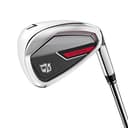
1. What is actually in the box.“Iron set” means anything from five clubs to nine, and the difference is hundreds of dollars of clubs. The Wilson Dynapower set publishes 5-PW plus a gap wedge, which is seven clubs and genuinely complete. The Majek K6 publishes 4-PW plus a sand wedge, which is eight. A set that stops at a pitching wedge leaves you buying a sand wedge separately, and you should price that in before comparing two sets.
2. Shaft material and flex.Steel is heavier, more stable and gives more feedback; graphite is lighter, kinder on the hands and helps a slower swing get the ball up. Neither is better. What matters is matching the flex to your speed, and this is where cheap sets get vague — several listings in this band publish no flex at all. The ones here that do, we name. Our steel versus graphite guide and regular versus stiff shaft guide cover the choice properly.
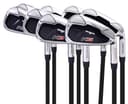
3. Conventional irons, hybrid irons, or a mix. This is the biggest fork on this page and almost nobody explains it. A conventional iron set gives you iron-shaped heads all the way through. An all-hybrid setreplaces every iron with a hybrid-style head — wider sole, lower center of gravity, shorter shaft — which is dramatically easier to get airborne, especially in the long irons that frighten most golfers. Two picks here are all-hybrid sets and one is a mix. If you have never been able to hit a 4-iron, that is the fork to take, and our hybrids page explains why the shape works.
And the spec we deliberately do not rank on: distance. No maker in this price band publishes a carry figure for any club, and the ones circulating online are either robot-tested at a swing speed you do not have or simply invented. If you see a budget iron set scored for distance, that number came from nowhere.
How many irons do you actually need?
The USGA limits you to 14 clubs in your bag during a round, and within that limit you can carry any conforming club types you like. That is the only rule, and it is worth doing the arithmetic before you buy an eight-club iron set.
A typical bag is a driver, a fairway wood, a hybrid, a putter and a wedge or two. That is five or six clubs before you add a single iron, which leaves room for eight or nine — so a full set fits. But almost no developing golfer benefits from carrying a 3-iron and a 4-iron they cannot hit. A bag of nine clubs you can all use beats fourteen including three that only come out by mistake.
The practical version: buy the set that covers 5-iron through pitching wedge properly, and fill the long end with a hybrid rather than a long iron. Our what clubs do I need page works through a sensible bag from scratch, and how many clubs in a bag covers the limit itself.
Fit matters more than the badge at this price
Two sets at the same price, and the one that fits you will beat the one that does not by a margin no technology closes. Three things to get right.
Length.A set that is an inch too long for you teaches you to stand too far from the ball, and a set an inch too short teaches you to crouch. Both become habits. The measurement that matters is fingertip-to-floor rather than height, because arm length varies independently — what size golf clubs do I need has the method.
Flex.A shaft too stiff for your speed stays closed and the ball goes low and right; too soft and it goes high and left. Senior A flex, which two picks here publish, is a moderate-speed flex rather than an age statement — plenty of younger golfers with smooth tempos are better served by it than by regular.
Men’s or ladies build. These are different lengths, different flexes and different lie angles, not a color change. The A9 ladies set on this page is genuinely cheaper than the A9 senior set, and we have deliberately not called it the budget pick for that reason: it is only the right answer if a ladies build is the right build for you. Our best women’s golf irons page handles that properly, and men’s versus women’s clubs explains what actually differs.
Should you buy irons alone, or a complete set?
Worth settling, because it is the most expensive mistake available on this page.
If you own no clubs at all, do not buy an iron set. You cannot play golf with irons: you will still need a driver or a fairway wood, a putter and a bag, and buying those separately will cost more than a complete package set that includes them. Start with a complete set, or at the lower end a budget complete set.
If you own a package set and have played a season, irons are exactly the right upgrade and this is the right page. Irons are the clubs you hit most from the fairway, the stock irons in a package set are its weakest component, and a set in this band will outlast several more seasons. Our when to upgrade page gives the signals to watch for, and beginner to intermediate covers the whole-bag version of the same step.
One honest alternative we do not sell and therefore have no reason to hide: a used set of last-generation irons from a major brand often lands in this same price band with better components. Used versus new golf clubs sets out the trade, including the parts of it that go badly.
When to spend more than $500
Three triggers. Until one applies, stay on this page.
You strike the center of the face most of the time. Premium irons reward a repeatable strike with control you can actually use. They do very little for a strike that wanders across the face, which is what forgiveness is for.
You have been fitted, or you intend to be. Above $500 the shaft becomes a real variable rather than a default, and a fitted shaft in a mid-priced head beats a stock shaft in an expensive one.
You are breaking 90 consistently. At that point your misses are small enough that the differences between iron sets start showing up in your scores. Our irons for mid handicappers page is the next step, and game improvement versus players irons explains the design trade you will be making.
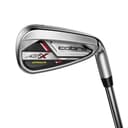
For everyone else, the Cobra Air-X 2 is the pick, and the Precise A9 is a genuinely sensible set if this is your first standalone irons purchase. The golf clubs by type hub has the rest of the bag.