How we picked these iron sets
Every set here was assessed from its published listing specification — piece count, shaft material and flex, head construction — against what a mid handicapper actually needs. We do not own launch monitors or test units and we do not claim distance numbers we have not seen measured. Three criteria drove the ranking.
1. Set composition, especially the wedges
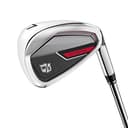
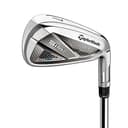
The most common gap in an amateur bag is between the pitching wedge and the sand wedge, and the easiest way to avoid it is to buy a set that already includes a gap or approach wedge. Both the Wilson Dynapower (5-PW plus GW) and the TaylorMade SIM2 Max (5-PW plus AW) do. A set that stops at the pitching wedge means another purchase — see our wedges roundup for what that costs.
2. Forgiveness that has not been traded away for looks
There is a temptation at this stage to buy something that looks like what better players use. Resist it. A mid handicapper who moves into a compact “players” iron loses more from the mishits than they gain from the control. Our game-improvement versus players irons comparison lays out exactly what that trade costs.
3. Steel or graphite matched to swing speed
Steel shafts give more feedback and are the traditional mid-handicap choice; graphite is lighter and launches higher, which suits moderate swing speeds. There is no correct answer, only a correct match. We have noted which each set ships with.
When are new irons actually the problem?
Honestly, less often than the golf industry suggests. If you are shooting in the 90s, the shots costing you the most are almost certainly three-putts, chunked chips and penalty strokes off the tee — none of which a new iron set fixes. Before spending several hundred dollars here, it is worth reading our guide on when to upgrade your golf clubs, which is deliberately unhelpful to our own commercial interests.
There are three situations where new irons genuinely earn their money. The first is if you are still playing the irons that came in a beginner package set — those shafts are the cheapest component in the box and they are usually the limiting factor by the time you break 100. The second is if your distance gaps are inconsistent, meaning your 7-iron and 8-iron go the same distance. The third is if your set is missing clubs, which is the cheapest problem to fix.
What changes between beginner and mid-handicap irons?
Less than the marketing implies, and it is worth being specific about what actually differs.
Sole width narrows slightly. Super-game-improvement irons have very wide soles that resist digging. Mid-handicap sets narrow that a little, which makes them marginally less forgiving on a fat strike but noticeably better from firm ground and tight lies.
Offset reduces. Offset sets the face behind the shaft to help square the club and fight a slice. Beginner irons have plenty of it; mid-handicap sets have less, which suits a golfer whose ball flight has straightened out. If yours has not, our slice guide is the cheaper fix.
Shafts get better. This is the real upgrade and the one nobody talks about. A proper branded shaft in a consistent flex is what makes your distances repeat, and it is the single biggest difference between a package-set iron and a real one.
New, or previous-generation?
Irons are the club category where buying last year’s model makes the most sense. Driver technology moves — face materials, adjustability, aerodynamic shaping — but an iron is a lump of steel with the weight arranged thoughtfully, and the arrangement has not fundamentally changed in years. The TaylorMade SIM2 Max set on this page is a superseded model, and that is exactly why it is affordable.
The trade is availability: superseded sets appear and disappear, often in only one shaft and flex. If you find the right combination in stock, that is the time to buy. And if the budget is the constraint, our guide to used versus new golf clubs covers what is safe to buy secondhand — irons, as it happens, are near the top of that list.