How to Hit a Hybrid
The most forgiving long club a beginner can carry - as long as you stop swinging at it like a fairway wood. Hit it like a 7-iron and it works.
How this is funded: we earn a commission if you buy through our links, at no extra cost to you. It never changes which product we recommend, and we’ll tell you when we’d skip one. Full disclosure.
A hybrid is the club that fixes the top of a beginner’s bag, and the club most beginners hit badly for the first month — because it looks like a small fairway wood and gets swung like one.
It is not a small fairway wood. It is a long iron with a fat, hollow head and a low center of gravity, and the strike it wants is an iron strike: ball first, a shallow bruise of turf afterward. Make that one change and the club does what the box promises.
Why a hybrid is easier, in published numbers
This is worth seeing on paper, because it explains the swing rather than just asserting it. Take the Cleveland Launcher XL Halo family, which our hybrid roundup leads with. The maker publishes a standard build length of 40.0 inches for the 21-degree 4-hybrid and 39.5 inches for the 24-degree 5-hybrid. The maker's page for the matching Launcher XL driver publishes a standard build length of 45.75 inches. That is nearly six inches less club to control, and shaft length is the single biggest reason long clubs are hard.
The heads are small, too: the same spec table lists 132cc for the 4-hybrid and 118cc for the 5-hybrid, against 460cc for the driver. A compact head sits closer to the ground, which is why it works from a lie where a fairway wood’s big sole rides over the top of the ball. The maker’s own wording for the sole design is that three rails “help keep the face straight through impact”, and for the stepped crown that it “drops the center of gravity for high-launching shots”.
Those are design claims from a manufacturer, not test results, and we have not measured them. What is not a claim is the geometry: shorter shaft, smaller head, more loft than a 3-wood. That combination is why the hybrid is the easiest long club in the game, and hybrid vs fairway wood works through the full trade.
The one swing thought
Ball first, then grass. If you remember nothing else, remember that.
Nearly every bad hybrid shot comes from trying to help the ball into the air. The club looks like it needs a sweep, so golfers position the ball forward, lean back through impact and try to lift it. The lead shoulder drops, the clubhead reaches the bottom of its arc behind the ball, and the result is either a fat shot that goes forty yards or a thin one that scuttles along the ground.
The club has between 18 and 27 degrees of loft depending on the number. It does not need help. Strike down into the back of the ball the way you would with a 7-iron and the loft launches it for you — the same logic our iron guide applies to the middle of the bag.
Setup, in order
- Ball position: just forward of center, about where a 6-iron or 7-iron sits. Not up by your lead heel.
- Stance width: a touch narrower than a driver, a touch wider than a mid-iron.
- Hands: level with the ball, no forward press and no lean back.
- Weight: even between the feet, and it stays there through the backswing.
- Distance from the ball: let the shorter shaft set it. Most beginners stand too far away because they are used to a wood.
Then swing at about 80 percent of full. A hybrid is not a distance club you muscle; it is a control club you time. If you are checking whether your ball position is where you believe it is, a stick on the ground settles it in seconds — alignment sticks are the cheapest honest feedback in golf.
Out of the rough, where the hybrid earns its place
This is the shot that justifies carrying one. From light or medium rough a fairway wood rides over the ball and a long iron gets grabbed by grass at the hosel; a hybrid’s compact head cuts through better than either.
Three adjustments. Move the ball back another half-ball so the strike is a little steeper. Grip slightly firmer, because grass will try to twist the face closed. And expect a flier or a dead one — the grass between the face and the ball kills spin, so the shot either runs further than you planned or comes up short with no bite. Plan for the ball to finish short of a green rather than on it.
From deep rough, take a wedge and get out. A hybrid is a long club with a long swing, and the honest comparison is the one our breaking 100 guide keeps coming back to: the shot that advances the ball beats the heroic one almost every time.
Off the tee
A hybrid off the tee is one of the most underrated shots in beginner golf. Tee it very low — the ball barely above the grass, far lower than a driver tee — and play it from your normal fairway position or a shade forward. Do not tee it high and sweep at it; the club is built for a slightly descending strike and a high tee invites the thin shot.
Used that way it becomes the club for a tight hole, a hole with trouble down one side, or the first tee when your hands are shaking. You give up distance to a driver and you take the big miss out of play, which is a trade a beginner should make happily. Our driver vs hybrid comparison looks at how often that trade is worth making.
Which loft, and which number
Hybrid numbers map to loft, and the Cleveland spec table above is a good reference for the convention: 18 degrees for a 3-hybrid, 21 for a 4-hybrid, 24 for a 5-hybrid, 27 for a 6-hybrid. Lie angles run from 60.5 to 62.0 degrees across the same four heads, and length drops half an inch per number as the loft climbs.
For a beginner, higher is easier. A 21-degree or 24-degree hybrid is a far more useful club than an 18-degree one, because it launches on a mediocre strike and still carries. Buy the one that replaces the longest iron you genuinely cannot hit — for most new golfers that is the 4-iron or 5-iron, not the 3-iron, because the 3-iron was never going to get used.
Three hybrids worth learning on
All three sit in our hybrid roundup, ordered here by loft, because loft is the lever that decides how easy a hybrid is to launch. Specs are quoted only where the listing publishes them, and prices are live and carry the date they were checked.
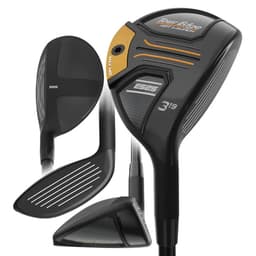
Tour Edge Hot Launch E525 5-Hybrid (25°)
The best value hybrid here, and arguably the easier club for a true beginner. Twenty-five degrees is a lot of loft, which means the ball goes up almost regardless of how well you hit it. Tour Edge builds forgiving clubs for people who are not tour players, and it shows.
- What it is
- 5-hybrid, 25 degrees, UST Helium Black regular-flex shaft
- Who it’s for
- Most beginners - the highest loft of the three, which is the easiest to get airborne off grass.
Price as of October 21, 2026. #ad How we’re funded
Specs read from the product listing, on August 11, 2026.
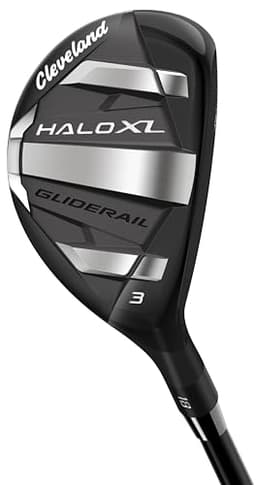
Cleveland Launcher Halo XL Hybrid (21°)
The hybrid we would tell a beginner to buy first. Cleveland's Halo line is built around getting the ball up in the air from bad lies, which is exactly the problem a long iron creates and a hybrid solves. Twenty-one degrees replaces a 3- or 4-iron and is far easier to hit than either.
- What it is
- 4-hybrid, 21 degrees, regular-flex graphite (40.0 in standard build)
- Who it’s for
- Golfers replacing a 4-iron who want the family with real published specs behind it.
Price as of October 21, 2026. #ad How we’re funded
Specs read from the product listing, on August 11, 2026.
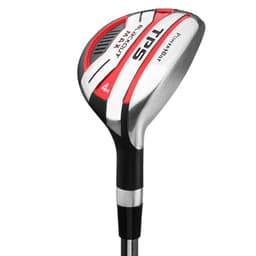
PowerBilt TPS Blackout Max #4 Hybrid
The cheapest club on this page, and there is a place for that. If you are borrowing clubs, playing five times a year, or simply want a rescue club in the bag without a real purchase decision, this does the job. Nobody should pretend it is more than that.
- What it is
- 4-hybrid, regular flex (the listing publishes no exact loft)
- Who it’s for
- Anyone who wants to find out whether a hybrid suits them before spending real money.
Price as of October 21, 2026. #ad How we’re funded
Specs read from the product listing, on August 11, 2026.
| Pick | What it is | Who it’s for |
|---|---|---|
| Tour Edge Hot Launch E525 5-Hybrid (25°) | 5-hybrid, 25 degrees, UST Helium Black regular-flex shaft | Most beginners - the highest loft of the three, which is the easiest to get airborne off grass. |
| Cleveland Launcher Halo XL Hybrid (21°) | 4-hybrid, 21 degrees, regular-flex graphite (40.0 in standard build) | Golfers replacing a 4-iron who want the family with real published specs behind it. |
| PowerBilt TPS Blackout Max #4 Hybrid | 4-hybrid, regular flex (the listing publishes no exact loft) | Anyone who wants to find out whether a hybrid suits them before spending real money. |
The three faults, and what causes each
Thin, low shots that run along the ground. Ball too far forward, or you are trying to lift it. Move the ball back to a 7-iron position and commit to hitting down.
Fat shots that take turf before the ball. Weight hanging back on the trail foot. Keep the weight even and let the chest turn through to the target.
A big curve right.Usually effort. At this shaft length the face does not square itself up if you swing out of your shoes, and the resulting miss looks exactly like a slice — our slice guide covers the real fix, and if you want a club that fights it for you, the anti-slice clubs page is honest about how much a club can do.
How far does a hybrid go?
We do not publish distance charts, and we are not going to start here. The honest answer varies enormously with swing speed and strike quality, and a made-up average does one thing reliably: it makes you swing harder at a club that punishes effort.
What is worth knowing is the shape of the answer. A hybrid should go further than the iron it replaced and not as far as the fairway wood it replaced, and it should be far more consistent than either. That consistency is the point. A 4-hybrid you can hit the same distance seven times out of ten is worth more on a scorecard than a 3-wood with a longer best shot and three duffs in the same ten.
If you want real numbers, measure them. A rangefinder on a range with marked targets, or a launch monitorif you practice indoors, gives you your distance rather than a magazine’s. Hit ten, throw away the best and the worst, and use the middle. That is the number to club with.
A first-session practice plan
Twenty balls is enough to learn this club, and the order matters more than the count.
- Five off a low tee. A tee removes the lie from the equation, so you can feel the strike without the ground punishing a small error.
- Five off the mat or grass at half speed. Ball just forward of center, swinging at what feels like half effort. You are looking for the sound of ball-then-turf, not distance.
- Five at 80 percent. Same setup, more speed, same thought. If the strike falls apart, go back to half.
- Five from a bad lie on purpose. Tread the ball down into light rough and hit it. This is the shot you will face on the course, and it is the one nobody practices.
Do that twice and the club stops being frightening. If you are practicing at home rather than at a range, our at-home practice guide covers what a net and a mat can and cannot give you — a hybrid off a thin mat is hard on both the club and your wrists.
The set-building answer
The Rules let you carry any 14 conforming clubs you like, in any combination — the governing bodies set the number, not the mix. So there is no orthodoxy to respect here. If a hybrid replaces your 4-iron, your 5-iron and your 3-wood, carry three wedges and a hybrid and never apologize for it.
Our order of difficulty for the long end of the bag, easiest first: 7-wood, hybrid, 5-wood, 3-wood. A hybrid sits near the top of that list and costs less than most fairway woods, which is why it is the first long club we would tell a beginner to buy. What clubs do I need works through all fourteen slots, and golf club numbers explained covers why a 4-hybrid and a 4-iron are not interchangeable despite the matching number.
Friendly guidance, not coaching. Tee & Tempo is written by a golf enthusiast, not a teaching pro. Our picks come from published specs and honest buyer-fit reasoning — we compare the numbers so you don’t have to, but we haven’t hit every club ourselves. When in doubt, hitting a few at a shop or a lesson beats any article.
Frequently asked questions
How do you hit a hybrid?
Hit it like a 7-iron, not like a fairway wood. Play the ball just forward of center, stand with your weight even and your hands level with the ball, swing at around 80 percent effort, and strike the ball first with a shallow brush of turf after it. The one thought that fixes most hybrid shots is 'ball first, then grass' - a hybrid is built to be struck slightly descending, which is the opposite of the sweeping strike a fairway wood wants.
Where should the ball be in your stance with a hybrid?
About where a 6-iron or 7-iron sits: one ball back from the middle-forward position, clearly behind where you would play a driver. Too far forward and you catch it thin because the clubhead is already climbing; too far back and you dig and lose the loft the club exists to give you.
Do you hit a hybrid like an iron or like a fairway wood?
Like an iron. That is the whole trick, and it is why golfers who already sweep a fairway wood often struggle with a hybrid at first. The head is smaller and the shaft is shorter than any wood - the maker's spec table for the Cleveland Launcher XL Halo lists 40.0 inches for the 21-degree head against 45.75 inches for the matching Launcher XL driver - so the swing is a mid-iron swing with a slightly shallower bottom.
Is a hybrid easier to hit than a 3 wood?
For most beginners, yes, and for reasons you can read off a spec sheet rather than a marketing page. The shaft is shorter, the head is smaller and sits closer to the ground, and the loft is usually higher. All three make the strike easier to repeat. The trade is a little carry distance from a perfect lie, which is a trade worth making if your fairway-wood contact is hit-and-miss.
Can you hit a hybrid out of the rough?
Yes, and it is the long club that handles rough best. The head is compact enough that grass does not grab it the way it grabs a fairway wood, and our top pick's maker describes three rails along the sole that 'help keep the face straight through impact' in any lie. Play the ball a fraction further back, grip a touch firmer, expect less roll, and take the shot that advances the ball rather than the shot that reaches the green.
Can you hit a hybrid off the tee?
It is one of the most useful tee clubs a beginner owns. Tee it very low, so the ball sits barely above the grass, and play it where you would on the fairway or a shade forward. On a tight hole it takes the big miss out of play, which is worth more strokes than the distance you give up to a driver.
What loft hybrid should a beginner buy?
Higher than you think. Hybrid numbers map to loft: the Cleveland family above publishes 18 degrees for the 3-hybrid, 21 for the 4-hybrid, 24 for the 5-hybrid and 27 for the 6-hybrid. A 21-degree or 24-degree head is far easier to launch than an 18, and a beginner gets more usable shots out of the higher loft. If in doubt, buy the loft that replaces your 4-iron or 5-iron rather than your 3-iron.
How many hybrids should I carry?
One is enough to start, two is common, and the Rules put no restriction on the mix - you may carry any 14 conforming clubs in any combination. The usual beginner setup is one hybrid replacing the longest iron in the set, which is the club most new golfers cannot hit at all. Our what-clubs-do-I-need guide works through the full fourteen.
Sources
- Cleveland Golf -- Launcher XL Halo Hybrid (product specification) — The maker's own published detail for the hybrid family our top pick comes from. Lofts and head sizes by number: 3H 18.0 degrees / 143cc, 4H 21.0 degrees / 132cc, 5H 24.0 degrees / 118cc, 6H 27.0 degrees / 108cc, with lie angles from 60.5 to 62.0 degrees. Standard build lengths: 3H 40.5 in, 4H 40.0 in, 5H 39.5 in, 6H 39.0 in (an Accuracy Build is listed 0.5 in shorter). Published MOI is 2,961 g-cm2, which the page calls 'our most ever in a Cleveland Golf Hybrid'. Technology wording, verbatim: GLIDERAIL -- 'Three rails along the sole of the club help keep the face straight through impact'; HIBORE CROWN STEP -- 'Our stepped crown drops the center of gravity for high-launching shots'; ACTION MASS CB -- 'An 8g weight placed inside the end of the grip delivers better balance for more control without extra effort'. Stock shafts listed as Project X Cypher 60 HYB and Cypher 40 HYB, grip Golf Pride Tour Velvet 360. The page publishes no carry-distance or spin figures (accessed October 20, 2026)
- Cleveland Golf -- Launcher XL Driver (product specification) — The maker's published detail for the driver family: 'Adjust your loft from 9 to 12 degrees to optimize your launch angle, distance, and shot shape. Loft can be adjusted at 0.5 deg increments with 12 positions in all', with the sleeve's primary settings marked at 9.0, 10.5, 12.0 and 10.5 Flat; a 460cc head; a 45.75 in standard build length; and a published MOI of 5,200 g-cm2, which the page calls 'our most ever in a Cleveland Golf driver'. The page publishes no spin-rate or ball-speed figures (accessed October 6, 2026)
- USGA — Rules Hub: Clubs — USGA overview of the 14-club limit and the freedom to carry any conforming club types (accessed July 23, 2026)
Keep reading
Best Hybrids for Beginners
Five hybrids with live prices, ranked on forgiveness and how easily each launches.
See the hybridsHybrid vs Fairway Wood
Head size, shaft length and rough performance - which club deserves the slot.
Read the comparisonHow to Hit a 3 Wood
The harder club a hybrid usually replaces, and the opposite strike.
Read the guideDriver vs Hybrid for Beginners
Control against raw distance, one club further up the bag.
Read the comparisonHow to Hit Irons
The strike a hybrid borrows - ball first, shallow turf after.
Read the guideWhat Clubs Do I Need?
How to spend your 14 slots, and where a hybrid earns one.
Read the guide