How to Practice Golf at Home
Most of what a beginner needs to practise does not require a ball, a net or a ceiling you can swing under. Here is what genuinely improves indoors, what needs real space, and the published dimensions before you buy anything.
How this is funded: we earn a commission if you buy through our links, at no extra cost to you. It never changes which product we recommend, and we’ll tell you when we’d skip one. Full disclosure.
Here is the honest framing that makes home practice worth doing. You cannot learn to hit a driver 240 yards in a spare room, and you do not need to. The things that cost a beginner the most shots — three-putting, a slice born in the setup, a takeaway that starts wrong, a transition that rushes — are all learnable indoors, and three of the four do not need a ball to be struck at all.
So this guide splits into what works in any room, what needs a mat and a net and real measured space, and the small amount of kit worth buying. The space figures below are the makers’ own published numbers, because the single most common home-practice mistake is buying a net for a garage that cannot hold a backswing.
What works in any room, with no equipment
Putting, from inside six feet. These are the putts that decide your score and they are the ones a flat indoor surface replicates most honestly. Pick a target the size of a coin, stroke fifty putts, and pay attention to whether the ball starts on your line rather than whether it goes in. Putting basics covers the stroke itself.
Setup and alignment, in front of a mirror.Stance width, posture, where the ball sits relative to your feet, and whether your shoulders actually point where you think they do. A mirror turns an invisible fault into an obvious one, and misalignment is the quiet cause of a great many slices — see how to fix a slice.
Grip, checked cold. Hold the club, look at your hands, compare them with the grip guide, adjust, repeat. Thirty seconds a day for a week will change your grip permanently, and no range session does that as efficiently.
The first two feet of the takeaway, in slow motion. Most swing problems are already present before the club reaches hip height. Slow rehearsal, with no ball and no intention to hit anything, builds the movement without the panic of a ball in the way.
Tempo swings, where nothing can be broken. A weighted or whippy trainer gives instant feedback when you snatch the transition. If you have no trainer and no space, swinging a towel with a knot in the end does a surprising amount of the same work.
What needs real space, and exactly how much
If you want to hit actual balls indoors, measure before you buy. Garmin publishes a minimum for indoor use of its launch monitor that doubles as a sensible general rule: a space at least 15 feet long by 8 feet wide by 8 feet high, with the mat at least two feet square and the ball at least eight feet from the net or screen. Garmin also notes the monitor should sit six to eight feet behind the ball, near the same height as the ball.
Height is the constraint that catches people. Do not measure your ceiling and compare it with your own height — stand in your stance with your longest club and take it to the top of the backswing, then measure the highest point the clubhead reaches. A typical eight-foot garage ceiling is marginal for a driver and comfortable for a wedge, which is why indoor practice sensibly means short clubs.
Depth matters for safety rather than comfort. A ball hit into a net too close rebounds hard and at unpredictable angles. Err generous, and if the numbers do not work, practise chipping into the net instead of full swings — a chipping net needs a fraction of the room.
If the floor is concrete, the mat specification stops being cosmetic. A thin turf mat on concrete transmits the shock of every fat shot into your wrists and elbows, and that is the most common home-practice injury there is. Look for published backing and thickness rather than a marketing word: the Country Club Elite listing, for instance, publishes one inch of pile over five-eighths of an inch of high-density foam, 1-3/4 inches in total, and states that it accepts a real wooden tee.
A twenty-minute session that is actually worth doing
- Five minutes of putting from three feet, then six. Count how many start on line, not how many drop.
- Five minutes of setup work in the mirror: posture, ball position, shoulder alignment, with one club.
- Five minutes of slow takeaways, pausing at hip height to check the clubface.
- Five minutes of tempo swings, counting a rhythm out loud so the transition stops being a lunge.
Four of those sessions a week will do more for a beginner’s first season than one long bucket of balls, because nothing in it rewards swinging harder. Range practice is where you test it with real shots; home is where you build the parts.
The four things worth buying
In the order we would buy them, and every one is from a roundup on this site — training aids, putting mats, nets and hitting mats. Specs are read from each product’s own listing and prices are live with the date they were checked.
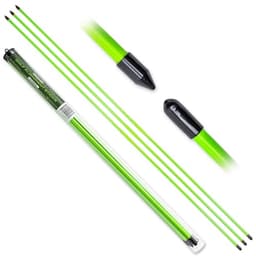
GoSports Golf Alignment Training Sticks (3-Pack, 48")
The cheapest and most useful thing on this page. Two sticks on the ground tell you where you are actually aiming, and most beginners discover they have been aimed thirty yards right of the target for years.
- What it is
- 48-inch alignment rods, 3-pack
- Who it’s for
- Everyone, first - the cheapest way to practise alignment and ball position indoors or out.
Price as of October 16, 2026. #ad How we’re funded
Specs read from the product listing, on August 11, 2026.
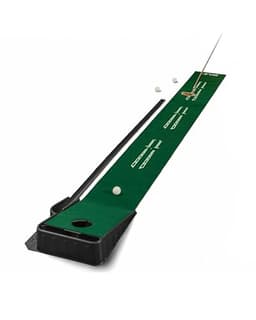
SKLZ Accelerator Pro Indoor Putting Green (9 ft)
The safe default, and the ball return is the reason. A mat you have to walk to after every putt gets used for about four minutes; a mat that rolls the ball back to your feet gets used until the kettle boils. Add alignment guides at three, five and seven feet -- the range that actually decides a beginner's score -- and this is the one to buy first.
- What it is
- 9 ft x 16.25 in, continuous ball return, guides at 3, 5 and 7 ft
- Who it’s for
- Anyone with a hallway: the short putts that decide scores, with the ball coming back to you.
Specs read from the product listing, on August 28, 2026.
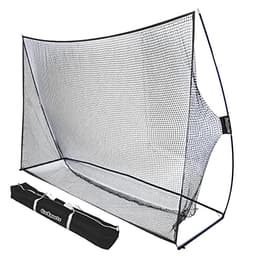
GoSports 10 ft x 7 ft Golf Practice Hitting Net
The safe default. Ten feet wide by seven tall is the size that catches a beginner's genuinely bad shots, not just their good ones, and GoSports is the brand most people end up with for a reason. If you buy one net without thinking about it, buy this one.
- What it is
- 10 ft x 7 ft full-swing net, indoor or outdoor
- Who it’s for
- Garages and gardens that genuinely clear 15 ft of depth and 8 ft of height.
Price as of October 16, 2026. #ad How we’re funded
Specs read from the product listing, on August 22, 2026.
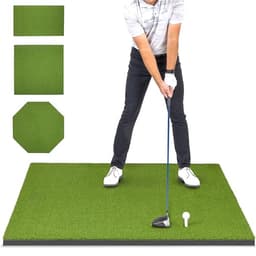
GoSports Elite Golf Hitting Mat (5 x 4 ft)
The safe default, because five feet by four is big enough to stand on. A mat you stand beside puts your feet below the ball and quietly changes every strike you make; a mat you stand on does not. If you are pairing a mat with a net in a garage, this is the shape to buy.
- What it is
- 5 x 4 ft stance mat, 15 mm artificial turf, 3 rubber tees included
- Who it’s for
- Hitting off concrete or a hard floor, where thin mats punish fat shots and wrists.
Price as of October 16, 2026. #ad How we’re funded
Specs read from the product listing, on August 26, 2026.
| Pick | What it is | Who it’s for |
|---|---|---|
| GoSports Golf Alignment Training Sticks (3-Pack, 48") | 48-inch alignment rods, 3-pack | Everyone, first - the cheapest way to practise alignment and ball position indoors or out. |
| SKLZ Accelerator Pro Indoor Putting Green (9 ft) | 9 ft x 16.25 in, continuous ball return, guides at 3, 5 and 7 ft | Anyone with a hallway: the short putts that decide scores, with the ball coming back to you. |
| GoSports 10 ft x 7 ft Golf Practice Hitting Net | 10 ft x 7 ft full-swing net, indoor or outdoor | Garages and gardens that genuinely clear 15 ft of depth and 8 ft of height. |
| GoSports Elite Golf Hitting Mat (5 x 4 ft) | 5 x 4 ft stance mat, 15 mm artificial turf, 3 rubber tees included | Hitting off concrete or a hard floor, where thin mats punish fat shots and wrists. |
What home practice cannot do
It cannot teach you distance control with a full swing, because you never see the ball finish. It cannot teach you to judge wind, slope or a lie that is not flat. And it cannot teach you to hit a shot that matters, which is a skill of its own and the reason your first few rounds will feel nothing like your practice.
That is an argument for mixing it rather than skipping it. Build the parts at home, test them at the range, then play. If you would rather spend the equipment money on instruction, are golf lessons worth it makes the honest case, and the answer for most beginners is that two or three lessons beat any gadget. If you want to measure what you are doing, launch monitorsstart cheaper than people expect — and simulator vs launch monitor explains which one you are actually shopping for.
Friendly guidance, not coaching. Tee & Tempo is written by a golf enthusiast, not a teaching pro. Our picks come from published specs and honest buyer-fit reasoning — we compare the numbers so you don’t have to, but we haven’t hit every club ourselves. When in doubt, hitting a few at a shop or a lesson beats any article.
Frequently asked questions
How can I practice golf at home without a net?
Put far more than you think you should, and rehearse the parts of the swing that do not need a ball: grip, setup and alignment, slow-motion takeaways to halfway back, and tempo swings with a weighted or whippy trainer in a space where nothing can be hit. Mirror work on your setup and a towel under the arms for connection both cost nothing and fix real faults.
How much space do you need to hit balls indoors?
More than most garages have. Garmin's published minimum for indoor use of its launch monitor is a space at least 15 feet long by 8 feet wide by 8 feet high, with the ball at least 8 feet from the net or screen. Ceiling height is the usual dealbreaker - measure it with a club in your hands, in your stance, at the top of your backswing, before you buy a net.
Can you practice golf in a garage?
Putting and chipping, yes. Full swings only if the ceiling clears your backswing with real margin and you have the depth for the ball to travel safely into a net. A standard eight-foot garage ceiling is marginal for a driver and usually fine for a wedge, which is why the honest indoor practice plan is short clubs and short shots.
Does putting on carpet help?
It helps your stroke and your start line, not your speed control. Household carpet is slower and less true than a green, so distances do not transfer. A dedicated putting mat fixes part of that: the SKLZ Accelerator Pro publishes a 9 ft by 16.25 in true-roll surface with alignment guides at 3, 5 and 7 feet and a continuous ball return.
What is the best thing to practise indoors?
Putting from inside six feet, because those are the putts that decide scores and the ones a mat replicates most honestly. After that, setup and alignment in front of a mirror, and slow-motion rehearsal of the first two feet of the takeaway. All three transfer directly to the course and none of them needs a ball to be struck.
Can you use a hitting mat on a concrete floor?
Only a mat built for it. A thin turf mat on concrete sends the shock of every fat shot straight into your wrists and elbows, which is the most common injury in home practice. Look for published foam backing and total thickness - the Country Club Elite listing, for example, publishes 1 inch of pile over 5/8 inch of high-density foam for 1-3/4 inches total.
How long should a home practice session be?
Twenty minutes, several times a week, beats two hours on a Sunday. Short sessions keep the quality high, and quality is the whole point of practice that is not measured by a scoreboard. Finish while you are still hitting it well rather than grinding until it falls apart.
Do swing trainers actually work?
The tempo and sequencing ones earn their place because they give immediate feedback you cannot ignore - a whippy shaft tells you instantly when you have rushed the transition. Alignment sticks do more per dollar than anything else in golf. What no trainer does is replace hitting real shots at a real target, so treat them as supplements to range sessions rather than substitutes.
Sources
- Garmin — Tips for Indoor or Outdoor Approach R10 Placement (support) — Garmin's published minimum indoor hitting space: 'Your space must be at least 15 feet long by 8 feet wide by 8 feet high', the mat at least 2 ft by 2 ft, and the ball at least 8 ft from the impact screen or net, with the device on the ground 6 to 8 ft behind the ball and its red line aligned to the target. Also: the device should sit near the same height as the ball and can be raised on a flat object, and 'use the tripod stand that came with the Approach R10. Using other mounts, or attempting to attach it to a wall, could result in inaccurate readings or error messages' (accessed September 22, 2026)
- SKLZ — Accelerator Pro (product specification) — The maker's published spec: 9 ft x 16.25 in, continuous ball return, alignment guides at 3, 5 and 7 ft, true-roll surface with an up-slope at the cup (accessed August 28, 2026)
- Indoor Golf Outlet -- Real Feel Country Club Elite Golf Mat (specification) — Dealer listing publishing the Country Club Elite build: 1 in pile height turf, 5/8 in high-density foam backing, 1-3/4 in total thickness, and that the mat accepts a real wooden tee (accessed August 26, 2026)
Keep reading
Best Golf Practice Nets
Five nets with live prices, and the space each one needs before you commit.
See the netsBest Golf Hitting Mats
Including what to look for if the mat is going on concrete rather than grass.
See the matsBest Putting Mats
The published lengths, return mechanisms and true-roll surfaces compared.
See the matsBest Golf Training Aids
Alignment sticks, tempo trainers and impact bags - what each one actually teaches.
See the aidsDriving Range Tips for Beginners
How to practise where you can hit full shots, so the home work has something to feed.
Read the guidePutting Basics for Beginners
The stroke to groove on the mat: grip, eye line, and why short putts are the whole game.
Read the guide