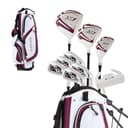
How we picked these sets
We own none of these clubs and we have not measured a shot with any of them — our methodology page sets out exactly what we do instead. What follows is what each listing publishes, matched against the three things that actually change a round for a golfer with a slower swing.
1. Length, which outranks everything else
Height, not gender and not age, decides the right shaft length. Most women’s sets are listed in regular and petite, and petite sizing typically shortens each club by about an inch. That matters more for consistent contact than any component upgrade at this price, and choosing between the two is the single most consequential decision in buying a women’s package set.
A rough rule that holds up: under about 5′4″, look hard at petite; over about 5′7″, check whether a tall configuration is listed separately. In between, regular. If you are already playing clubs that feel long — the ball toes out, you stand further back than feels natural — that is a length problem, not a swing problem, and our guide to whether a club fitting is worth it explains when paying someone to measure you makes sense.
2. Launch, which is what a slower swing actually loses
As swing speed drops, the first thing to go is height, and the first clubs to stop working are the long irons. A hybrid replaces a long iron because the weight sits lower and further back in the head, which launches the ball higher for the same swing. That is the single biggest equipment help available to a slower swing, and it is available in two doses.
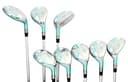
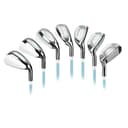
The moderate version is a mixed set: hybrid heads where long irons would be, normal irons where irons still work. If the 5- and 6-irons in your bag never get airborne, that is the fix. The full version is an all-hybrid set, every iron replaced by a hybrid head down to the sand wedge. It is an unusual bag and it looks it, but for a golfer who genuinely struggles to get the ball up, nothing else is close.
The honest trade-off with all-hybrid: you give up precision, and around the green a hybrid sand wedge is genuinely worse than a real one. Most golfers who buy a set like that eventually add a proper wedge back in, which our guide to wedges covers.
3. Carry or ride, which decides the bag
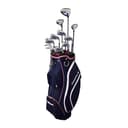
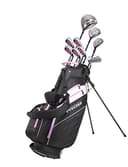
A cart bag has a flat, non-collapsing base and a single strap: better organized and much heavier. A carry bag has legs and dual straps, which distribute the load across both shoulders. If your course is a cart course, the cart bag is the better set — the clubs are the same, and you are no longer carrying anything.
If you walk, look specifically for dual carrying straps, which is the difference between enjoying a walking round and regretting it. And if you want to walk without carrying, a push cart is the option most beginners never consider and the one most likely to keep a senior golfer walking eighteen holes. Our guide to choosing a golf bag walks through the whole decision.
Why not a men’s senior set?
Because it is the wrong direction. The flex ladder runs, from softest to stiffest: ladies, senior (sometimes marked A), regular, stiff. A men’s senior-flex shaft is stiffer than a ladies shaft, and men’s clubs are longer and usually heavier. Buying a men’s senior set to “get the senior benefit” gives a senior woman a club that is harder to launch and harder to control.
Where men’s senior sets genuinely help is for taller golfers who find women’s clubs too short even in a tall configuration — length wins over flex badge in that specific case. Our best golf clubs for seniors page covers those sets, and men’s vs women’s golf clubs explains exactly what differs between the two beyond the paint.
What to spend, and where
A complete women’s set is the right first purchase for almost everyone reading this, for the same reason it is right for any beginner: one delivery, every club, and a price well below buying individually. The budget sets here are legitimate — the components are basic, but a first-season golfer will not be limited by them, and if golf does not stick you have not lost much.
Where the money is worth spending is sizing and the bag, not the badge. A correctly sized budget set beats a premium set that is an inch too long, every time. If you already own clubs and only the irons are the weak link, replacing that block alone is the cheaper route — our best women’s golf irons page ranks five sets including the all-hybrid and mixed options, and complete set vs buying individually does the arithmetic.
Three cheap changes that help more than new clubs
Softer golf balls. A low-compression ball deforms more easily at slower swing speeds, which is how you get distance without swinging harder. This is the cheapest meaningful gain available, and our golf balls for slower swings page names the softest ones we track.
Fresh grips. Rubber hardens with age whether you play or not, and a hard grip makes you squeeze, and squeezing costs you speed. Soft polymer grips are tackier and absorb more shock, which is real relief for arthritic or sore hands — what size golf grip do I need covers the size question too.
Tee it higher, and play forward tees. Neither costs anything. Playing the correct tees is the single biggest difference between enjoying a round and grinding through one, and what counts as a good score puts the numbers in perspective.
The bottom line
Shop the women’s aisle, not the senior aisle. Get the length right before anything else, choose hybrids over long irons if the ball is not getting up, and let the way you travel the course decide between a cart bag and dual carry straps. Do those three things and any set on this page is a sound purchase — and the money you save by skipping the badge is better spent on a lesson and softer balls.