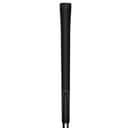
Why a slipping grip costs you strokes
Worth being clear about the mechanism, because the problem is not that the club flies out of your hands.
A golfer who feels the club move in their hands grips harder. That is automatic and almost impossible to resist. And grip pressure is the single most destructive variable in a golf swing: tight hands mean tight forearms, tight forearms mean a slow, tense release, and a slow release means the clubface arrives open. Open face plus a steep, tense swing is the recipe for a slice. So the real cost of a worn or slippery grip is not a club flying into a bush; it is twenty yards of lost distance and a ball that curves right, caused entirely by your hands trying to keep hold of something.
The second cost is that it is invisible. Nobody diagnoses a slice as a grip problem. They buy a draw-biased driver instead — see best clubs for a slice— and get a partial fix for ten times the money. If your grips are three years old, shiny, and your hands sweat, re-gripping is the cheapest swing improvement available to you. Our how to grip a golf club guide covers the pressure point properly, and how to fix a slice covers the rest of the fault.
The three grip materials, and what each does when wet
This is the whole decision, and the listings do publish the material even when they publish nothing else.
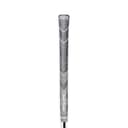
Cord.Woven cotton fibers set into the rubber compound, which gives a rough, slightly abrasive surface. Cord is the traditional answer to wet hands because a fiber texture gives your skin something to key into rather than relying on rubber tackiness, which is what moisture destroys. The trade is comfort: cord is harsh, it can chafe a bare hand, and in cold weather it feels like holding a wire brush. The MCC Plus4 is a hybrid — its published build is a cord upper hand with a rubber lower hand, which is deliberately the best of both, because the upper hand is the one that does the holding.
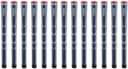
Firm rubber. The default material in golf, and a firmer rubber compound with a deep surface pattern handles moisture much better than a soft tacky one. The logic is drainage rather than chemistry: deeper channels give water somewhere to go. The Tour Velvet is the classic version of this and the most-used grip in golf; the Cross-Line 2 is the budget version with a firmer, more aggressive pattern.
Soft polymer.The Winn Dri-Tac family sits here, and it is the interesting case. Soft polymer grips are tacky and cushioned — genuinely the most comfortable material in golf, and the standard recommendation for sore or arthritic hands — and the material is designed to stay tacky when damp. The honest caveat is that soft polymer wears faster than rubber or cord, so you are buying comfort and damp performance at the cost of replacing them sooner.
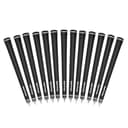
And the real decision rule, which cuts through all of it: buy one grip first.Grip feel is intensely personal and completely unpredictable from a description. Two of the five picks here are single grips for exactly this reason — put one on a 7-iron, play nine holes, and then buy twelve more of whichever you preferred. A full-bag bundle you dislike is an expensive mistake. Our main grip roundup ranks the category without the moisture lens, and Tour Velvet vs Winn Dri-Tac is the rubber-versus-polymer head-to-head in full.
Grip size, which matters more than material
A grip that is too small for your hand will slip no matter what it is made of, because your fingers wrap too far round and you end up holding it in your fingertips.
Three of the picks here publish a size — two midsize, one standard — and that is a spec worth taking seriously. The rough guide is glove size and hand length: larger hands want midsize or jumbo, smaller hands want standard. Getting it right does two things at once: it lets you hold the club more lightly, and lighter hands are faster hands.
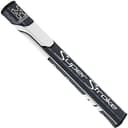
There is also a putter-specific case, which is why the oversized putter grip is on this page. An oversized, non-tapered putter grip is designed to reduce wrist action by filling your palms, which is the most common putting fault among beginners. It also happens to be the easiest grip in the bag to hold when your hands are damp, simply because there is more of it. Our what size golf grip do I need page has the measurement, and putting basics covers the fault the oversized grip is addressing.
What the Rules let you do for free
This is the section to read before buying anything, because the Rules of Golf are unusually generous here.
Rule 4.3a(5) covers gloves and gripping agents. Three things are explicitly allowed, in the Rule’s own words: “Using a plain glove that meets the requirements in the Equipment Rules”, “Using resin, powders and other moisturizing or drying agents”, and “Wrapping a towel or handkerchief around the grip.” What is not allowedis a glove that fails the Equipment Rules, or “using other equipment that gives an unfair advantage with hand position or grip pressure”.
So, in practical order of how much they help:
1. A dry towel on your bag, used every hole. Free if you own a towel. Wipe the grip and your hands before every shot, not just when you notice a problem. This alone solves the issue for most people and it is the habit good players have.
2. A drying agent.Resin, chalk and powder are all specifically permitted. Climbers’ chalk works and costs almost nothing.
3. The right glove.A glove is the interface between your skin and the grip, and the material matters enormously when it is wet — which is why we have a whole page on gloves for sweaty hands. A synthetic or mesh-backed glove handles moisture better than a soft cabretta leather one, which goes slick and then stiff. Carry two and rotate them.
4. Then, and only then, new grips.If you have done the three things above and your hands still slip, the grips are the problem — and at this point they probably are, because grips harden and glaze over with age regardless of what they are made of.
Two more Rules notes while we are here. The 14-club limit in Rule 4.1b means you can carry any conforming clubs you like up to fourteen, so there is nothing stopping you running different grips on different clubs — a cord grip on the driver and softer grips on the irons is a perfectly sensible arrangement. And the Rule’s own closing advice, if you are ever unsure whether a piece of equipment is permitted, is to ask the Committee for a ruling.
How often to re-grip, and doing it yourself
The conventional advice is once every forty rounds or once a year, whichever comes first. For a beginner playing a dozen rounds a year, once every two or three years is realistic, but there are two signals that override the calendar.
Shine. A grip that looks polished has lost its surface texture. Run your thumb across it: if it feels smooth rather than grippy, it is done.
Hardness. Rubber oxidizes and goes hard. A hard grip transmits more vibration and gives you less to hold, and no amount of cleaning brings it back.
Before you replace anything, though, try cleaning them. Warm water, washing-up liquid, a soft brush, rinse and dry. A surprising number of “slipping” grips are simply dirty, and you have just saved yourself a hundred dollars. Our how to clean golf clubs guide covers the method.
Re-gripping yourself is genuinely a beginner-level job — a vise, grip tape, solvent and a hook blade, about ten minutes a club the first time. Our how to re-grip golf clubs guide walks through it, and it is why a 13-grip bundle works out so much cheaper per grip than paying a shop. The golf clubs by type hub has the rest of the category.