How we picked these grips
We have not run wear tests or measured coefficients of friction, and you will not find invented numbers on this page. We compared what each listing publishes — material, size, pack quantity — against the three things a beginner or improving golfer genuinely needs from a grip, and we have said where each one is not the right choice.
1. Enough tack that you can hold the club lightly
This is the whole point. A grip that holds without being squeezed lets your wrists stay soft, and soft wrists produce clubhead speed. Softer polymer grips like the Winn are the tackiest; firm rubber grips like the SuperStroke Crossline are the least. Both are fine; the polymer ones wear out faster.
2. The right size for your hands
Grip size is the specification most golfers ignore and most golfers get wrong. Too small and your hands become over-active, which tends to close the face and produce a hook. Too large and you lose feel and the hands stop releasing, which tends to leave the face open and produce a slice or a push.
The rough guide: with your normal grip, the fingertips of your top hand should just barely touch the pad at the base of your thumb. Touching firmly means the grip is too small; not reaching at all means it is too big. Standard suits most people; midsize suits large hands or anyone who has been told to hold the club more lightly.
3. Something that works in your weather
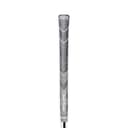
Plain rubber is excellent until it is genuinely wet, at which point it gets slick. Cord grips — rubber with cotton fibers embedded in the surface — keep working in rain and are abrasive on bare hands. The Golf Pride MCC Plus4 splits the difference by putting cord in the upper hand only, which is the sensible answer for most golfers in a mixed climate.
When should you re-grip?
The standard advice is once a year or every forty rounds, which is written by people who sell grips. The honest test is simpler: look at them and touch them.
A grip needs replacing when it has gone smooth and shiny where your hands sit, when the surface pattern has worn flat, when it feels hard rather than slightly yielding under a thumbnail, or when there are cracks near the ends. If you find yourself wiping your hands on your trousers before every shot in dry weather, that is your answer.
For a golfer playing twenty or thirty rounds a year, every two seasons is realistic. For a set of second-hand clubs of unknown history, re-grip immediately — you have no idea how long those have been baking in someone’s car.
Should you fit them yourself?
You can, and plenty of golfers do. It needs a hook blade or a utility knife, double-sided grip tape, grip solvent, and somewhere you do not mind making a mess. The process is genuinely straightforward: cut the old grip off, strip the old tape, wrap new tape, soak it in solvent, and slide the new grip on before the solvent dries. Budget about ten minutes per club the first time.
The reasons not to are also real. A shop will do thirteen clubs quickly and get the alignment straight, and the labor cost is often less than the value of an afternoon and a ruined grip. If you are buying a 13-grip bundle anyway, ask what fitting costs before deciding — it is frequently modest.
The putter grip is a separate decision
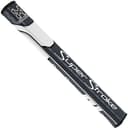
Putter grips follow different rules, and the Rules of Golf allow them to: a putter grip may have a non-circular cross-section, which is why almost every one has a flat front for your thumbs. They are also allowed to be much thicker.
A larger, less tapered putter grip reduces how much your wrists can hinge during the stroke, and wristy putting strokes are inconsistent putting strokes. That makes a putter grip upgrade the cheapest genuine change you can make to your putting — considerably cheaper than a new putter, and often more effective. Our putter roundup covers the club itself.
Grips and the Rules
Grips are covered by Rule 4 and the equipment specifications: with the exception of the putter, a grip must be circular in cross-section and must not have molded finger indentations or any built-in alignment aid. This matters if you are ever tempted by a training grip with finger shapes molded into it — those are practice aids, not conforming grips, and carrying one in competition is a breach.
Everything on this page is a standard conforming grip. If you want a molded training grip for practice specifically, our training aids roundup covers that category, where the rules on use are different.
Which size should you order?
Standard suits most golfers, midsize fixes a specific problem, and jumbo is a putter thing. What size golf grip do I need has the two checks that tell you which you are, without a fitting.
Two grips here get compared against each other more than any others, and they are built from different materials for different hands: Tour Velvet vs Winn Dri-Tac settles that one. Once you have ordered, fitting them yourself takes about an hour and a few dollars of tape and solvent — how to regrip golf clubs has the step-by-step, including the no-vise method.
Grips are only half of the hand-to-club connection. If the problem is moisture rather than the rubber, best golf gloves for sweaty hands covers the glove side of the same fix - and a cord grip plus a ventilated glove is the combination golfers who sweat heavily end up with.