Tee & Tempo

The Best Golf Practice Nets for Home

A net in the garage is the difference between practicing twice a month and twice a week. Five worth buying, and the two measurements to take before you order one.

By Stephen V.Last updated How we pick

The hardest part of getting better at golf as a beginner is not the swing. It is the logistics. A trip to the range is an hour you have to find, a drive, a bucket of balls and a bay next to someone hitting it three hundred yards. Most new golfers manage it once or twice a month, decide they are not improving, and conclude that they are the problem.

A net at home removes almost all of that. Ten minutes before dinner is a real practice session when the net is already standing in the garage, and ten minutes four times a week beats an hour once a fortnight by a distance. Practicing away from a course is not a fringe activity either — the National Golf Foundation counted more than 19 million Americans who play golf only off-course, at ranges, simulators and entertainment venues.

If you want one answer: the GoSports 10 ft x 7 ft net is the safe default, because ten feet of width catches the shots you did not mean to hit. If ten feet will not fit, the Gagalileo 8 x 6 is the honest compromise. And if what you actually want is to stop chunking chip shots, the Callaway Chip-Shot costs a fraction of the others and works in a living room.

How this is funded:we earn a commission if you buy through our links, at no extra cost to you. It never changes which product we recommend, and we’ll tell you when we’d skip one. Full disclosure.

Quick picks

Ranked on forgiveness, how complete the pick is, and value for a beginner. Select a row to jump to the full write-up. We have not hit these clubs on a launch monitor — here is exactly what we do instead.

#ProductBest forPrice
1
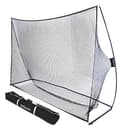
GoSports 10 ft x 7 ft Golf Practice Hitting Net

GoSports 10 ft x 7 ft Golf Practice Hitting Net

The safe default. Ten feet wide by seven tall is the size that catches a beginner's genuinely bad shots, not just their good ones, and GoSports is the brand most people end up with for a reason. If you buy one net without thinking about it, buy this one.

Best overall
$80.99 · View on Amazon

$89.9910% off

Price as of September 6, 2026. #ad How we’re funded

2
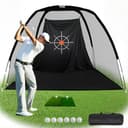
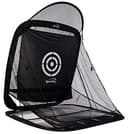
Gagalileo 8 x 6 ft Golf Hitting Net with Target

Gagalileo 8 x 6 ft Golf Hitting Net with Target

The one to buy when ten feet will not fit. Eight by six is still a real full-swing net rather than a chipping target, and the printed target gives you something to aim at, which is the difference between practicing and just hitting.

Best for a tight space
$76.90 · View on Amazon

Price as of September 6, 2026. #ad How we’re funded

3
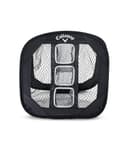
Callaway Chip-Shot Golf Chipping Net

Callaway Chip-Shot Golf Chipping Net

Not a full-swing net, and that is the point. Chipping is where beginners lose the most shots, and it is the one part of golf you can genuinely practice in a living room. This is the cheapest honest way in.

Best for chipping practice
$44.99 · View on Amazon

$49.9910% off

Price as of September 6, 2026. #ad How we’re funded

4
Spornia SPG-5 Compact Golf Practice Net (5.5 ft)

Spornia SPG-5 Compact Golf Practice Net (5.5 ft)

The garage net. Five and a half feet is small, so this is not the one to spray drivers into — but it returns the ball to your feet, and a net that does that is one you will actually use on a Tuesday evening.

Best for a garage
$169.99 · View on Amazon

$199.9915% off

Price as of September 6, 2026. #ad How we’re funded

5
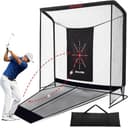
Spornia SPG-7 Golf Practice Net

Spornia SPG-7 Golf Practice Net

The buy-once net, if you know you will use it. Ball return, a target sheet, side barriers and a roof — the side barriers are the part that matters, because they catch the shots a beginner is most likely to hit.

Best step-up
$297.49 · View on Amazon

$349.9915% off

Price as of September 6, 2026. #ad How we’re funded

The picks in full

#1Best overall

GoSports 10 ft x 7 ft Golf Practice Hitting Net

The safe default. Ten feet wide by seven tall is the size that catches a beginner's genuinely bad shots, not just their good ones, and GoSports is the brand most people end up with for a reason. If you buy one net without thinking about it, buy this one.

Strengths

  • Ten by seven feet is wide enough to catch the shots you did not mean to hit
  • Big enough for a driver, not only wedges and irons
  • Folds down without tools, so it can live in a garage between sessions

Trade-offs

  • Needs a genuine ten-foot span of clear ground — measure before you order
  • No ball return, so you walk out and collect after every basket
What it is10 ft x 7 ft full-swing net, indoor or outdoor
In the boxNot published
HandednessNot published
Shaft / flexNot published
Best forBeginners with a garage or a back yard, Anyone who wants one net and no research

Beginner note. The listing states a 10 ft x 7 ft net for indoor or outdoor use. Width is the specification that matters most on a beginner's net: mis-hits leave the face at angles good shots never do, and a narrow net catches only the shots that did not need catching.

Specs read from the product listing, on August 22, 2026. “Not published” means the listing does not state it.

#2Best for a tight space

Gagalileo 8 x 6 ft Golf Hitting Net with Target

The one to buy when ten feet will not fit. Eight by six is still a real full-swing net rather than a chipping target, and the printed target gives you something to aim at, which is the difference between practicing and just hitting.

Strengths

  • Two feet narrower and a foot shorter than the standard size, which is often the difference between fitting and not
  • Comes with an aiming target rather than a blank sheet of netting
  • Still tall enough for full swings with irons

Trade-offs

  • Less margin for a genuinely wild shot than a 10 ft net
  • A less familiar brand than GoSports or Spornia
What it is8 ft x 6 ft hitting net with printed target
In the boxNet and target
HandednessNot published
Shaft / flexNot published
Best forSmall yards and single garages, Iron and wedge practice

Beginner note. The listing states an 8 x 6 ft net with a target, for home practice. Two feet of width is a meaningful loss on a beginner's net, so this is the size to choose when the space genuinely will not take a wider one — not the size to choose to save money.

Specs read from the product listing, on August 22, 2026. “Not published” means the listing does not state it.

#3Best for chipping practice

Callaway Chip-Shot Golf Chipping Net

Not a full-swing net, and that is the point. Chipping is where beginners lose the most shots, and it is the one part of golf you can genuinely practice in a living room. This is the cheapest honest way in.

Strengths

  • Practices the shot that actually costs a beginner strokes, rather than the one that is fun to hit
  • Collapses flat, so it stores behind a door instead of in a garage
  • Works indoors with foam balls and outdoors with real ones

Trade-offs

  • You cannot hit a full shot into it — it is a short-game target only
  • Small enough that a badly thinned chip will fly straight past it
What it isCollapsible chipping target net, indoor or outdoor
In the boxNot published
HandednessNot published
Shaft / flexNot published
Best forBeginners who chunk chip shots, Practicing indoors in winter

Beginner note. The listing describes a collapsible chipping net for indoor and outdoor practice. It does not publish the target's dimensions, so we do not state them. Buy it as a short-game target and nothing else — a chipping net asked to take a full swing will not survive it.

Specs read from the product listing, on August 22, 2026. “Not published” means the listing does not state it.

#4Best for a garage

Spornia SPG-5 Compact Golf Practice Net (5.5 ft)

The garage net. Five and a half feet is small, so this is not the one to spray drivers into — but it returns the ball to your feet, and a net that does that is one you will actually use on a Tuesday evening.

Strengths

  • Automatic ball return means you hit continuously instead of collecting after every ten balls
  • A 5.5 ft footprint fits where a 10 ft net cannot
  • Spornia builds ball-return nets specifically, rather than bolting one onto a plain net

Trade-offs

  • Small target — a genuinely wild shot goes past it
  • Costs several times what a plain net of the same size does
What it is5.5 ft compact net with automatic ball return
In the boxNot published
HandednessNot published
Shaft / flexNot published
Best forSingle garages and basements, Short, frequent practice sessions

Beginner note. The listing states a 5.5 ft compact net with automatic ball return. A ball return is not a gimmick on a small net: walking out to collect balls is what turns a fifteen-minute practice session into a five-minute one, and it is a common reason a home net stops getting used.

Specs read from the product listing, on August 22, 2026. “Not published” means the listing does not state it.

#5Best step-up

Spornia SPG-7 Golf Practice Net

The buy-once net, if you know you will use it. Ball return, a target sheet, side barriers and a roof — the side barriers are the part that matters, because they catch the shots a beginner is most likely to hit.

Strengths

  • Side barriers and a roof catch the shanks and skied shots a flat net lets through
  • Automatic ball return keeps a session moving
  • Target sheet gives you something to aim at rather than a blank wall of net

Trade-offs

  • Costs more than a beginner's first wedge, driver and glove combined
  • A large, semi-permanent structure — not a net you put away weekly
What it isEnclosed net with automatic ball return, target sheet, two side barriers and roof
In the boxNet, target sheet, two side barriers, roof
HandednessNot published
Shaft / flexNot published
Best forGolfers who will practice weekly, Anyone who has outgrown a flat net

Beginner note. The listing states an automatic ball return system with a target sheet, two side barriers and a roof. The barriers and roof are the reason to pay for this over a flat net: a flat net only catches shots that went roughly where you aimed, which is exactly the category a beginner's worst shots fall outside of.

Specs read from the product listing, on August 22, 2026. “Not published” means the listing does not state it.

How we picked these nets

We do not own a test lab and we have not hit balls into these — our methodology page sets out exactly what we do and do not do. What we compared is the published specification of each listing against what a first- or second-season golfer needs from a net, and we have ordered them on that basis rather than on price or feature count.

1. Width, ahead of everything else

A net has one job: catch the ball. The shots a beginner needs catching are not the ones flying straight down the middle — those would have been fine hitting a garage wall. They are the ones leaving the face twenty degrees off line, and the net has to be wide enough to be in front of those. Ten feet is the size that covers most of them. Below about eight feet you are relying on a swing you do not have yet.

2. Height, because of the shot you have not thought about

Every beginner eventually skies a drive — contact high on the face that sends the ball almost vertically. Outdoors that is embarrassing. Into a seven-foot-tall net two yards away, it goes over the top. Height matters less than width, but it is the second measurement, and it is the one people forget.

3. Whether the ball comes back to you

This sounds like a convenience feature and it is really an adherence feature. A net without a return means hitting ten balls, walking out, bending down ten times, walking back. Do that four times and the session is over. Two of the nets here return the ball to your feet, and they cost considerably more because of it.

4. Whether it survives being put away

The nets people keep using are the ones that either stay up permanently or fold down in under a minute. A net that takes fifteen minutes to erect gets erected twice. We have favored designs that go up and down without tools, and flagged the one here that is genuinely semi-permanent.

Measure twice, order once

Two numbers decide which of these you can actually buy, and both are worth checking with a tape measure before you spend anything.

The span. Stand where you would hit from and measure the clear width in front of you. A 10 ft net needs more than ten feet, because the frame sits outside the netting and the legs splay. If you have nine feet of usable wall, you are buying an 8 x 6.

The swing arc.This is the one that catches people out indoors. Stand where you would hit and make a slow full backswing with your longest club. If the clubhead touches a ceiling, a beam, a light or a garage door track, that club is not usable in that space no matter what net you buy. Many home setups are genuinely wedge-and-iron only, and that is fine — it just means you should not pay for a driver-sized net you cannot swing a driver in.

You also want a distance. Standing too close means a mishit reaches the netting before it has slowed down, and standing too far means you miss the net entirely. Follow whatever distance the maker specifies for the model you buy, and if you are indoors, err toward the longer end of it.

What a net will and will not do for your golf

A net tells you one thing honestly: whether you hit the middle of the face. You feel that in your hands and you hear it, and after a few sessions you will know the difference between a strike and a scrape without looking.

What it cannot tell you is where the ball went. Two yards of flight is not enough to reveal a slice, a hook or a push, so a net will happily let you groove a swing that curves forty yards right without ever mentioning it. That is the single most important limitation to understand before you buy one.

The fix is cheap and it is not a gadget: put an alignment stick on the ground pointing at your target and check your feet, and take the same swing to a range occasionally so you can see the ball flight. Our training aids page covers the sticks and the tempo trainers that pair well with a net, and driving range tips explains how to structure the range trips you still need.

The mat question

If you are hitting off a lawn you do not need a mat, though you will take divots out of the lawn and eventually someone will mind. If you are hitting off concrete, a driveway or a garage floor, you do need one, and it is not optional: hitting a golf ball off concrete transmits the shock straight into your wrists and elbows, and a thin mat barely helps.

Two of the nets here are sold in bundles that include a mat, which is usually the cheapest way to get both. If you buy a mat separately, thickness and the density of the backing matter more than how convincing the fake grass looks — our golf hitting mats roundup now covers the five worth buying, and how much turf depth a concrete floor actually needs.

A note on safety, briefly

A golf ball leaves the club fast enough to break a window from thirty yards, and a net is fabric. Check the netting for wear before each session, replace it when it frays rather than after it fails, and never set up so that the line behind the net is a window, a car, a fence a neighbor is standing behind, or anywhere a child or a dog might wander. Hitting foam or restricted-flight balls indoors removes most of this concern and costs almost nothing.

Who should not buy a net yet

Three cases, and they are all reasonable.

You have not bought clubs yet. A net without clubs is a piece of garden furniture. Start with a complete beginner set, play a few rounds, and buy a net once you know you are staying.

You have never had a lesson.A net lets you repeat a swing several hundred times a week. If that swing has a fault in it, you are now practicing the fault with real commitment. One lesson first is a better use of the same money — our are golf lessons worth it guide makes the case honestly, including the cases where it does not hold.

Your short game is what is costing you.For most beginners it is. If you are taking three shots from beside the green, a full-swing net is not the purchase — the chipping net on this page is, and it costs a fifth as much.

The bottom line

Buy the widest net your space genuinely takes, spend the difference on balls and a lesson rather than on features, and accept that the net is for grooving contact rather than for shaping shots. Used that way it is one of the highest-value purchases in a beginner setup, because it converts intention into repetitions — which is the only thing that has ever made anyone better at golf.

Frequently asked questions

What size golf net do I need for a beginner?

Ten feet wide by seven tall if the space allows it. A beginner's mis-hits leave the clubface at angles that a narrow net simply is not in front of, so width buys you far more than any other feature. If ten feet will not fit, an 8 x 6 ft net is the sensible compromise; below that you are into chipping targets rather than full-swing nets.

Can I use a golf net indoors?

Often, but the ceiling decides it, not the net. Stand where you would hit and make a slow full backswing with your longest club — if the head touches a ceiling, beam or garage door track, that club is unusable there. Plenty of indoor setups are wedge-and-iron only, which is still worthwhile practice. Foam or restricted-flight balls make indoor practice considerably safer.

Do I need a hitting mat as well as a net?

Only if you are hitting off a hard surface. Off grass you can hit real balls straight from the turf. Off concrete or a garage floor a mat is essential, because the shock of a slightly fat shot on concrete goes straight into your wrists. Several nets are sold in a bundle with a mat, which is usually the cheapest way to buy both.

Will practicing into a net fix my slice?

No, and it can quietly make it worse. The ball only travels a couple of yards, so a net cannot show you the curve — you could groove a forty-yard slice into it happily for a month. Use the net for strike quality, keep an alignment stick on the ground to check your aim, and get to a range or a lesson occasionally to see actual ball flight.

Is a golf net with a ball return worth the extra money?

It is if the alternative is not practicing. A return keeps you hitting instead of collecting, which roughly triples the number of balls you get through in ten minutes and removes the main reason home nets end up in the loft. If you are not sure you will practice regularly yet, buy a plain net first and find out.

Sources

Keep reading