Tee & Tempo

The Best Golf Hitting Mats for Home

The surface under the ball decides what your home practice teaches you. Five mats worth buying, and why footprint and turf depth beat every other spec.

By Stephen V.Last updated How we pick

A hitting mat is the least interesting purchase in a home practice setup and the one that decides most about it. The net catches the ball. The mat decides what your swing learns — whether your feet sit level with the ball, whether a fat shot tells you the truth, and whether your lead wrist is still comfortable at the end of a session.

It is also where beginners most often buy the wrong thing, because the mats are all photographed the same way and the specification that matters is rarely the one on the front of the box. Turf that looks convincing in a listing photo tells you nothing. Two numbers do: how big the mat is, and how deep the turf is.

If you want one answer: the GoSports Elite 5 x 4 ft is the safe default, because it is big enough to stand on and that single fact fixes more than any turf blend. If you are hitting on concrete, buy the Fanshaw 40 mm instead and buy it for your wrists. And if you just want to stop taking divots out of the lawn for about the price of a dozen balls, the CHAMPKEY strike pad is an honest first mat.

How this is funded:we earn a commission if you buy through our links, at no extra cost to you. It never changes which product we recommend, and we’ll tell you when we’d skip one. Full disclosure.

Quick picks

Ranked on forgiveness, how complete the pick is, and value for a beginner. Select a row to jump to the full write-up. We have not hit these clubs on a launch monitor — here is exactly what we do instead.

#ProductBest forPrice
1
GoSports Elite Golf Hitting Mat (5 x 4 ft)

GoSports Elite Golf Hitting Mat (5 x 4 ft)

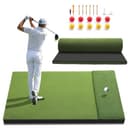
The safe default, because five feet by four is big enough to stand on. A mat you stand beside puts your feet below the ball and quietly changes every strike you make; a mat you stand on does not. If you are pairing a mat with a net in a garage, this is the shape to buy.

Best overall
$134.99 · View on Amazon

$149.9910% off

Price as of September 6, 2026. #ad How we’re funded

2
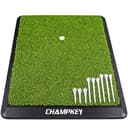
CHAMPKEY Premium Synthetic Turf Golf Hitting Mat (13 x 17 in)

CHAMPKEY Premium Synthetic Turf Golf Hitting Mat (13 x 17 in)

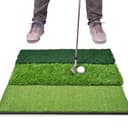
The cheapest honest way to stop hitting off your lawn. Thirteen by seventeen inches is a strike pad rather than a stance mat, and for a beginner working on contact with irons and wedges that is genuinely enough. Buy it first, and buy a bigger one later only if you find you are practicing weekly.

Best budget mat
$29.99 · View on Amazon

Price as of September 6, 2026. #ad How we’re funded

3
GoSports Tri-Turf XL Golf Hitting Mat (24 x 24 in)

GoSports Tri-Turf XL Golf Hitting Mat (24 x 24 in)

The one to buy if your short game is what is costing you shots. Three turf types on one mat means you can hit the same chip off a tight fairway lie and then out of rough, which is the pair of shots that separates a beginner from a bogey golfer. It is a practice tool first and a hitting surface second.

Best for the short game
$53.99 · View on Amazon

$59.9910% off

Price as of September 6, 2026. #ad How we’re funded

4
Fanshaw Premium Dual-Turf Golf Mat (5 x 4 ft, 40 mm)

Fanshaw Premium Dual-Turf Golf Mat (5 x 4 ft, 40 mm)

The mat to buy if you are hitting off concrete. Forty millimeters is well over twice the thickness the standard stance mat here publishes, and thickness is the only thing between a slightly fat shot and the shock of it going straight into your wrists. Buy this one for your joints, not for its features.

Best for a concrete floor
$83.99 · View on Amazon

Price as of September 6, 2026. #ad How we’re funded

5
Country Club Elite 3 x 5 ft Commercial Golf Practice Mat

Country Club Elite 3 x 5 ft Commercial Golf Practice Mat

The buy-once mat, and the only one here built to a commercial-range specification. The maker publishes a 1 in pile on a 5/8 in high-density foam backing and says the mat takes a real wooden tee, which no budget mat here does. Overkill for a first mat, and the right answer for a permanent home bay.

Best step-up
$279.99 · View on Amazon

Price as of September 6, 2026. #ad How we’re funded

The picks in full

#1Best overall

GoSports Elite Golf Hitting Mat (5 x 4 ft)

The safe default, because five feet by four is big enough to stand on. A mat you stand beside puts your feet below the ball and quietly changes every strike you make; a mat you stand on does not. If you are pairing a mat with a net in a garage, this is the shape to buy.

Strengths

  • Big enough to take your whole stance, so your feet and the ball sit at the same height
  • Three rubber tees included, which is what you need to hit a driver off it
  • From the same brand as our top-pick practice net, so the two pair naturally

Trade-offs

  • 15 mm of turf is thin over a concrete floor -- fine on grass or a wood deck, harsh on a slab
  • Twenty square feet of mat is bulky to store, so it wants a permanent spot
  • Sits at the top of the mainstream home-mat price bracket
What it is5 x 4 ft stance mat, 15 mm artificial turf, 3 rubber tees included
In the boxMat and three rubber tees
HandednessNot published
Shaft / flexNot published
Best forGarage and backyard setups paired with a net, Golfers who want one mat and no research

Beginner note. The listing states a 5 x 4 ft mat with 15 mm artificial turf and three rubber tees. Footprint is the specification that matters most on a home mat: standing off the mat drops your feet below the ball, which is a lie you never face on a course and a fault you can practice into a swing without noticing.

Specs read from the product listing, on August 26, 2026. “Not published” means the listing does not state it.

#2Best budget mat

CHAMPKEY Premium Synthetic Turf Golf Hitting Mat (13 x 17 in)

The cheapest honest way to stop hitting off your lawn. Thirteen by seventeen inches is a strike pad rather than a stance mat, and for a beginner working on contact with irons and wedges that is genuinely enough. Buy it first, and buy a bigger one later only if you find you are practicing weekly.

Strengths

  • Costs about what a dozen decent golf balls does
  • Comes with a rubber tee and nine plastic tees, so there is nothing else to buy
  • Small enough to carry to a park, a garden or the back of a car

Trade-offs

  • You stand on the ground, not on the mat, so your feet sit below the ball
  • Too small to hit a driver from with any confidence
  • Nothing anchors it but its own rubber base, so check it does not creep on a smooth floor
What it is13 x 17 in strike pad, heavy-duty rubber base, 1 rubber tee and 9 plastic tees
In the boxMat, one rubber tee, nine plastic tees
HandednessNot published
Shaft / flexNot published
Best forA first mat for iron and wedge contact, Anyone testing whether they will practice at all

Beginner note. The listing states a 13 x 17 in synthetic turf mat on a heavy-duty rubber base, supplied with one rubber tee and nine plastic tees. It does not publish a turf thickness, so we do not state one. At this size the mat protects the ground and your club, not your joints.

Specs read from the product listing, on August 26, 2026. “Not published” means the listing does not state it.

#3Best for the short game

GoSports Tri-Turf XL Golf Hitting Mat (24 x 24 in)

The one to buy if your short game is what is costing you shots. Three turf types on one mat means you can hit the same chip off a tight fairway lie and then out of rough, which is the pair of shots that separates a beginner from a bogey golfer. It is a practice tool first and a hitting surface second.

Strengths

  • Fairway, rough and tee turf on one surface, so you practice the lie and not just the swing
  • Twenty-four inches square is a real target area rather than a token strip
  • Twenty-four inches square, so it moves outdoors and back in one hand

Trade-offs

  • Still not a stance mat -- you hit from it, you do not stand on it
  • Tee turf section aside, twenty-four inches is not enough mat for real driver work
  • Three narrower strips means less margin for a shot struck well behind the ball
What it is24 x 24 in tri-turf mat: fairway, rough and tee sections
In the boxNot published
HandednessNot published
Shaft / flexNot published
Best forChipping and pitching practice at home, Golfers who already own a full-stance mat

Beginner note. The listing states a 24 x 24 in mat with fairway, rough and tee turf for indoor or outdoor training and simulator use. A rough section matters more than it sounds: the shot beginners duff most often is a chip from a slightly grabby lie, and a single fairway-length surface never lets you rehearse it.

Specs read from the product listing, on August 26, 2026. “Not published” means the listing does not state it.

#4Best for a concrete floor

Fanshaw Premium Dual-Turf Golf Mat (5 x 4 ft, 40 mm)

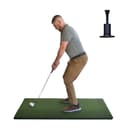
The mat to buy if you are hitting off concrete. Forty millimeters is well over twice the thickness the standard stance mat here publishes, and thickness is the only thing between a slightly fat shot and the shock of it going straight into your wrists. Buy this one for your joints, not for its features.

Strengths

  • 40 mm thick, against the 15 mm the standard stance mat here publishes
  • Full 5 x 4 ft footprint, so you stand on it rather than beside it
  • A dual-turf surface, so there are two lies to hit from rather than one

Trade-offs

  • A less familiar brand than GoSports or Callaway
  • Thick turf is heavy turf -- this is not a mat you carry to the park
  • The listing does not publish whether tees are included, so assume they are not
What it is5 x 4 ft dual-turf stance mat, 40 mm thickened turf
In the boxNot published
HandednessNot published
Shaft / flexNot published
Best forGarage, basement and driveway setups, Golfers who have had sore wrists or elbows

Beginner note. The listing states a 5 x 4 ft dual-turf mat, 40 mm thickened, for practice. Thickness is the specification that decides whether a mat is usable on a hard floor: a thin mat on a slab transmits the impact of a fat shot into the lead wrist and elbow, and repeating that a hundred times a week is how home practice ends in an injury.

Specs read from the product listing, on August 26, 2026. “Not published” means the listing does not state it.

#5Best step-up

Country Club Elite 3 x 5 ft Commercial Golf Practice Mat

The buy-once mat, and the only one here built to a commercial-range specification. The maker publishes a 1 in pile on a 5/8 in high-density foam backing and says the mat takes a real wooden tee, which no budget mat here does. Overkill for a first mat, and the right answer for a permanent home bay.

Strengths

  • Commercial-specification construction, per the Amazon listing title
  • The maker states it takes a real wooden tee, so driver practice is not fixed to one rubber-tee height
  • A published 1-3/4 in total build, which is the deepest cushion of any mat here

Trade-offs

  • Costs more than a complete beginner club set on this site
  • Very heavy -- a genuinely two-person mat to move and effectively permanent once placed
  • Three feet deep is a stance mat for a normal setup, not a wide platform
What it is3 x 5 ft commercial-specification practice mat
In the boxNot published
HandednessNot published
Shaft / flexNot published
Best forA permanent garage or basement hitting bay, Golfers who practice most weeks and have outgrown a thin mat

Beginner note. The Amazon listing title states only a 3 x 5 ft commercial golf practice mat, so the spec table above stops there. The construction figures we quote -- 1 in pile height, 5/8 in high-density foam backing, 1-3/4 in total thickness, and the ability to take a real wooden tee -- are the maker's published specification for the Country Club Elite line, read from a dealer listing on August 26, 2026 and cited in the sources on this page. Real-tee capability is the practical dividing line between a home mat and a range mat: a rubber tee fixes the ball at one height, and driver practice at a height you never actually play from is practice with a variable removed.

Specs read from the product listing, on August 26, 2026. “Not published” means the listing does not state it.

How we picked these mats

We do not own a test lab and we have not hit balls off these — our methodology page sets out exactly what we do and do not do. What we compared is the published specification of each listing against what a first- or second-season golfer actually needs from a mat, and the order below reflects that rather than price or feature count. Every ASIN here was checked as a live, in-stock listing on the day this page was written.

1. Footprint, ahead of everything else

The first question is not what the turf is made of. It is whether you stand on the mat or next to it. A strike pad sits the ball above your feet on every swing, and your body adapts to that within a few dozen shots: shallower angle of attack, a little more lean back, contact slightly thin. Then you go to the course, where the ball is level with your feet, and the adaptation is now a fault.

A full-stance mat — roughly 4 x 5 ft or larger — removes the problem entirely because your feet are on the same surface as the ball. That is the whole argument for the bigger mats here, and it is worth more than any other feature they carry.

2. Turf depth, because of what is underneath

Depth only matters if the floor is hard, and then it matters enormously. Hitting slightly behind the ball is the most common beginner mis-hit there is. On grass the ground gives. On a thin mat over a concrete slab, nothing gives, and the shock travels up the shaft into your lead wrist and elbow. Do that a hundred times a week and something starts to hurt.

The GoSports mat here publishes 15 mm, which is fine on grass, a lawn or a wooden deck. On concrete you want considerably more — the 40 mm mat on this list exists for exactly that reason, and it is the one specification we would not compromise on if your setup is a garage. Two of the five listings do not publish a thickness at all, and we say so on their cards rather than guessing.

3. What the surface teaches you

A cheap, dense mat is forgiving in the worst way: the club skids off it, so a shot struck two inches behind the ball still sends the ball forward and still feels roughly acceptable. On grass that same swing produces a chunk that travels forty yards. A mat that lets you believe a fat shot was fine is quietly teaching you to hit fat shots.

Better mats let the club work down into the turf rather than bouncing off it, so heavy contact feels heavy. That is the practical difference between a home mat and a commercial range mat, and it is why the most expensive pick here is on the list at all.

4. Whether it takes a real tee

Most mats take a rubber tee that screws or slots into a hole, at one fixed height. That is workable, but tee height is a real variable in a driver swing and practicing at one arbitrary height is practice with that variable removed. A mat you can push a normal wooden tee into is more useful if you intend to work on the driver — and only the Country Club Elite does it. That is the maker’s published claim for the line rather than something we tested, and the dealer listing we read it from is cited at the foot of this page.

Measure before you order

Two checks, both worth doing with a tape measure before you spend anything.

The floor space. A 5 x 4 ft mat needs a genuine five feet by four feet of flat, clear floor, and it does not roll up neatly into a corner afterwards. Measure the space you would leave it in, not the space you could clear temporarily, because the mats that get used are the ones that stay down.

The swing arc.If the mat is going indoors, stand where you would hit and make a slow full backswing with your longest club. If the head touches a ceiling, a beam, a light or a garage door track, that club is not usable there whatever mat you buy. Plenty of indoor setups are wedge-and-iron only, which is still worthwhile practice — it just means you should not pay for a driver-capable mat you cannot swing a driver on. The same check applies to a home net, and we cover it in more detail in our golf practice nets roundup.

Which mat suits which floor

The surface underneath decides more than the brand on top.

Grass or a lawn. You barely need a mat at all, except to stop yourself carving up the lawn. A strike pad or a tri-turf mat is plenty, and turf depth is close to irrelevant because the ground is already doing the absorbing.

A wooden deck or a garage with a wood floor.A standard 15 mm stance mat is comfortable here. Check that the mat does not slide — a heavy rubber base helps, and so does a mat wide enough that you are standing on it.

Concrete, a slab or a driveway. Go thick, without exception. This is where the 40 mm mat earns its place, and where a thin mat becomes an injury you did not have to have. If you already own a thin mat and a hard floor, putting a piece of rubber horse-stall mat or thick foam underneath it is the cheap fix.

What a mat will and will not do for your golf

Used properly, a mat gives you the one thing a beginner needs most: repetitions without a drive to the range. Ten minutes of iron contact four evenings a week beats an hour once a fortnight, and the mat is what makes those ten minutes possible on a Tuesday.

What it cannot do is show you a ball flight. Paired with a net the ball travels two yards, which is not far enough to reveal a slice, a hook or a push — a point we make at length on the practice nets page, because it is the single biggest limitation of home practice. And a mat has one deception of its own that a net does not: it hides fat contact. Keep an eye on where the club marks the turf, and if you are working on strike, our guide to hitting irons explains what you should be feeling at the bottom of the swing.

The other honest limitation is that a mat cannot fix aim. An alignment stick on the ground costs a few dollars and does — our training aids roundup covers the sticks and tempo trainers that pair naturally with a mat and a net.

A note on wrists and elbows

Golfer’s elbow and a sore lead wrist are the two complaints that come out of home practice, and both come from the same source: repeated heavy contact on an unforgiving surface. The fixes are not complicated. Buy enough turf depth for the floor you have. Stop the session when the strike goes off rather than grinding through it. Hit fewer balls with more attention. And if something aches for more than a day or two, see someone qualified rather than reading another gear page — we are a golf site, not a medical one, and we will not pretend otherwise.

Who should not buy a mat yet

Three cases, and they are all reasonable.

You are hitting on grass and it does not bother you. Then the mat is optional and the money is better spent on balls, a lesson or the set of clubs you are still borrowing.

You do not have a net yet.A mat without a net means hitting real balls somewhere, which needs a garden long enough to be safe. If home practice is the goal, the net is the purchase that unlocks it and the mat is the one that improves it — buy them in that order.

Your short game is what is costing you. For most beginners it is. In that case buy the tri-turf mat rather than the big stance mat, spend the difference on nothing at all, and work through our chipping guide off the fairway and rough sections.

The bottom line

Buy the biggest mat your floor genuinely takes, match the turf depth to what is underneath it, and treat the mat as a tool for grooving contact rather than as a substitute for seeing the ball fly. Do that and it is one of the highest-value purchases in a beginner setup — not because it makes practice better, but because it makes practice happen.
Frequently asked questions

What size golf hitting mat do I need?

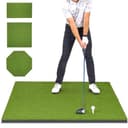
Big enough to stand on if you can fit it — roughly 4 x 5 ft. A small strike pad puts the ball an inch or so above your feet, and your swing adapts to that within a few dozen shots, which is an adaptation you then have to undo on the course. If the space will not take a full-stance mat, a strike pad is still worth having; just be aware of what it is doing.

How thick should a golf mat be for a concrete floor?

Thicker than the standard 15 mm stance mat. Hitting slightly behind the ball is the most common beginner mis-hit, and on a thin mat over concrete that shock goes straight into your lead wrist and elbow. A 40 mm mat, or a thinner mat laid over rubber or dense foam, is the difference between practicing all winter and taking six weeks off.

Can I use a real tee on a golf hitting mat?

On most of them, no — you use a rubber tee that sits in a hole at one fixed height. The maker of the Country Club Elite publishes a 1 in pile on a 5/8 in foam backing and states that the mat accepts a real wooden tee, which is more useful if driver practice is the point, because tee height is a variable you actually play with. That is the manufacturer's published claim, not a result we produced ourselves.

Do golf mats hurt your wrists?

A thin mat on a hard floor can, over time, because it does not absorb a fat shot the way turf does. Enough turf depth for the surface underneath, shorter sessions, and stopping when your strike deteriorates all but remove the risk. Persistent pain is a matter for a physiotherapist or doctor, not a gear upgrade.

Will practicing off a mat teach me bad habits?

It can, in one specific way: a dense mat lets the club skid, so a shot struck well behind the ball still goes forward and still feels acceptable. Off grass the same swing produces an obvious chunk. Check where the club is marking the turf, and get to a range or a course often enough to see what your contact really looks like.

Sources

Keep reading