How we picked these mats
We do not own a test lab and we have not putted on these — our methodology pagesets out exactly what we do and do not do. What we compared is the published specification of each product against what a first- or second-season golfer needs from a mat, and the ranking follows that rather than price or feature count. Amazon listing titles for putting mats publish little beyond a size, so every spec quoted on this page that is not in the title was read from the manufacturer’s own product page, and each of those pages is cited at the foot of this article. Every product here was confirmed as a live, in-stock listing on the day this page was written.
1. Whether the ball comes back
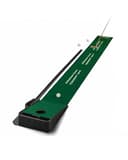
This is the specification nobody ranks first and everybody should. A mat without a return gives you one putt, then a walk, then a bend, then another putt. Ten minutes of that is perhaps a dozen strokes. A mat with a return, or a mat you feed four or five balls in a row, is three times the repetitions in the same ten minutes — and it is the repetitions that build a stroke, not the intention to practice.
It also decides whether the mat survives its first month. Practice equipment fails for one reason: friction. Every extra action between you and the next ball is a reason to stop. That is why the ball-return pick leads this list even though it is not the most sophisticated surface here.
2. Length, and why eight feet is enough
Mats run from six feet to thirteen, and the long ones are marketed as though distance were the point. For a beginner it is not. The putts that decide your score are the ones inside about eight feet — the second putt after a long approach, the one you left yourself after a chip, the tap-in you can still miss. Those are the putts you can hole and the ones you should groove.
Longer putts are about pace, not line, and pace is far more about reading a real green than repeating a stroke indoors. So an eight- to nine-foot mat covers everything a home surface can genuinely teach. Buy the extra four feet only if you have the room going spare.
3. What you actually putt at
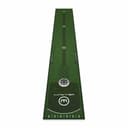
Read this before you order, because it surprises people. Several of the best putting mats sold today have no hole in them at all. Wellputt prints a target zone and sells its Ghost Hole disks separately. PuttOUT’s published pack contents for the Slim mat are the mat and a carry bag — the brand’s Pressure Putt Trainer, which is on our training aids page, is a separate purchase.
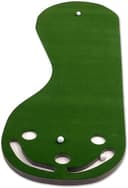
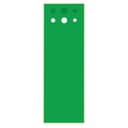
None of that is a flaw; a printed zone is arguably better feedback than a cup, because a cup rewards a putt that dribbles in and a zone does not. But if you are buying this as a gift, or you want a beginner to hear a ball drop, buy a mat with cups — the kidney-shaped mat and the step-up green here both have them, and the ball-return pick has one too.
4. Width, which is the one nobody mentions
Most putting mats are strips somewhere between ten and twenty inches wide. On a strip, every putt is dead straight. That is fine for a stroke drill and useless for the skill that actually loses beginners strokes, which is starting the ball on a line other than the one their feet are pointing at.
A three-foot-wide mat lets you set up across the surface and putt at a cup that is not directly in front of you, and a green with break pads underneath lets you practice a putt that curves. Those cost more and take more floor. If you only ever own a strip, be aware of what it is not teaching you, and read a real green with your eyes rather than assuming everything rolls straight.
5. Published green speed, where anyone publishes it
Stimp is a measure of how far a ball rolls on a surface, and a quick course green is usually somewhere around ten to twelve feet on that scale. Two of the products here publish a figure: the PuttOUT Slim reads 10, and the Wellputt 8ft Essential reads 10 to 11.5. The other three publish nothing, and we do not invent a number for them.
Why it matters: a slow mat trains a hard stroke. If your carpet-backed mat rolls at half the speed of the greens you play, you will spend the first three holes of every round running putts eight feet past the hole. A published speed close to a real green is worth paying a little for, and it is the main thing the two mid-priced picks here are selling you.
Measure before you order
Two checks, both quick, both worth doing before you spend anything.
The run-out behind the hole. A putt that misses keeps going. On a mat with a return or a backstop it is caught; on a plain strip it runs off the end and under the furniture, and after the twentieth time under the sofa you stop practicing. Leave a couple of feet of clear floor past the end of the mat, or buy something that catches the ball.
Where it will live.A mat that gets rolled up and put in a cupboard is a mat you will use twice. The honest question is not “do I have room for a nine-foot mat?” but “do I have nine feet of floor I am willing to give up permanently?” If the answer is no, buy the ten-inch-wide mat and leave it down along a wall. A narrow mat you putt on daily beats a wide one in a cupboard.
What a putting mat can and cannot teach you
A mat is genuinely good at three things. It grooves a repeatable stroke, because you can hit fifty putts without moving. It trains your start line, which is the single biggest cause of missed short putts. And it builds the small, boring habit — five minutes most evenings — that separates a golfer who three-putts twice a round from one who does not.
It cannot teach you green reading. A mat is flat, uniform and the same speed every day; a real green is none of those. It cannot teach you pace on a long putt, because eight feet of surface has nothing to say about a forty-foot lag. And it will not tell you your putter is wrong for you — if the club itself is the problem, our putters for beginners roundup covers what a beginner should actually be holding, and blade versus mallet covers the choice that follows.
Treat it, in other words, the way we treat every home-practice product on this site: excellent for the mechanical half of a skill, silent about the half that needs a golf course.
How to practice on one without wasting the time
Hitting putts at random is how most mats get used and it is close to worthless. Three drills, none of which need anything you do not already have.
The ladder.Three putts from three feet, then three from five, then three from seven — the distances the alignment guides on our top pick are printed at, and not by accident. Miss one and start the whole ladder again. It puts a small amount of pressure on an otherwise pressure-free stroke, which is the closest a living room gets to a golf course.
Past the hole, every time. A putt short of the hole has never gone in. Pick a spot a foot beyond the target and try to stop the ball between the target and that spot. This is the entire idea behind the good zone / bad zone markings on the Wellputt, and you can run it on any mat with a tee laid down as a marker.
Eyes closed. Set up, look at the target, close your eyes, putt. Then guess whether you missed left or right before you look. It is a feedback drill rather than a stroke drill, and it teaches you more about your own face control in five minutes than an hour of watching the ball. Our putting basics guide covers the grip, setup and stroke shape these drills assume.
Where a putting mat sits among the home-practice buys
If you are assembling a practice setup piece by piece, the order that makes sense is not the order the marketing suggests. The putting mat is the cheapest item, the quietest, the smallest, and the one with the most direct effect on your score — so it goes first, and it is the only one that works in a flat with a downstairs neighbor.
After that comes a net, which is what makes full swings possible at home at all, and then a hitting mat, which decides what those full swings teach you. A putting mat and a hitting mat are not substitutes and not the same product: one is a rolling surface for a putter, the other is an impact surface for an iron, and putting on a hitting mat is a waste of both.
The gap none of them fills is the chip — the shot most beginners lose the most strokes to. Only the step-up green here comes with a chipping mat and limited-flight balls, which is a real part of its argument. If you are not spending that, our chipping guide covers the setup that fixes a duffed chip without any equipment at all, and how to practice golf at home sets out a twenty-minute indoor session that uses a mat for the part it is genuinely good at.
Who should not buy one yet
Three cases, all reasonable.
You do not own a putter you like.A mat makes you better at using the putter you have. If that putter is the one that came in a starter set and you have never got on with it, the club is the better purchase — start with our putter roundup and buy the mat afterwards.
You have a carpet and a glass.The oldest putting practice there is: a straight run of short-pile carpet and a tumbler on its side. It is slower than a real green and it teaches a hard stroke, which is exactly the flaw a proper mat exists to fix — but it costs nothing, and if you will not do it for two weeks you will not use a mat either. Prove the habit, then buy the surface.
You are still borrowing clubs. Then the money belongs in your first set of clubs, every time. Practice equipment is the second purchase, never the first.
The bottom line
Buy the mat you will trip over. That is the real criterion: a surface that stays on the floor, returns the ball or catches it, and sits somewhere you pass ten times a day. Eight feet is enough length, a published green speed is worth a small premium, and a mat with no cup is not a defect — but check before you order, because the listing photo will not tell you.
Then use it for five minutes rather than fifty. Putting is the one skill in golf where a beginner can reach a genuinely competent standard in a season, and a mat by the sofa is the least demanding way anyone has found to do it.