The thing Wilson publishes that almost nobody else does
This is the entire reason Wilson deserves its own page, so here is the detail.
Most package sets are sold in one standard build. You buy the set, you get whatever length and lie the factory ships, and if you are 5 ft 2 in or 6 ft 4 in you make do. Wilson sells its Profile sets in published size bandsinstead, and an authorized Wilson dealer’s spec table sets out the women’s bands with real numbers: Petite at a height of “59 to 63 inches / 4’11” to 5’3” / 150 to 160 cm” with a fingertip-to-ground measurement of “24 to 26 inches / 61 to 66 cm”; Standard at “63 to 69 inches” with fingertip-to-ground “26 to 28.5 inches”; and Tall at “69 to 73 inches” with fingertip-to-ground “28.5 to 30 inches”.
Two things worth drawing out of that. First, Wilson gives you a fingertip-to-ground figure alongside the height, and that is the better of the two measurements, because two people of the same height can have very different arm lengths and therefore need different club lengths. Stand upright in normal shoes, arms relaxed at your sides, and measure from your fingertip to the floor. Our what size golf clubs do I need page walks through it properly.
Second, be honest about the limit of this. The same dealer table publishes the set contents — “13 degree Driver, #5 Fairway Wood, #5 Hybrid, Irons: #6, 7, 8, 9, Pitching Wedge, Sand Wedge” plus a putter, bag and three head covers, with graphite shafts in everything except the putter — and the 13-degree driver loft is the onlyloft published. No other club’s loft appears, and no club length in inches appears anywhere. So Wilson publishes more than its rivals, not everything. We tell you which it is rather than implying a full spec sheet exists.
Which Wilson set: Profile SGI or Tour Velocity?
Two complete sets on this page, and the difference is not subtle.
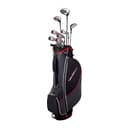
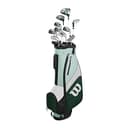
The Profile SGIis the fit-options set and the one to buy if you are not average-sized or if you want the most help from the clubheads themselves. Super game improvement design means a low, deep weight distribution to get the ball airborne and a very forgiving face — the two things a new swing needs most. It costs more than the Tour Velocity, and the fit options are most of what you are paying for.
The Tour Velocity is the value set: a lower-cost, name-brand complete bag with a stand bag included. If you are average height, trying golf rather than committing to it, and want the lowest price with a real golf brand on the headcovers, this is the sensible one. Our budget golf set page puts it against everything else at that price.
And the broader point: the USGA allows you 14 clubs in your bag during a round, and within that you can carry any conforming club types you want. Neither of these sets takes you to fourteen, which means you have room to add rather than having to subtract. That is the right position to be in as a beginner, and it is why the single-club picks further down this page exist. Our how many clubs in a bag page covers the limit, and what clubs do I need covers which gaps to fill first.
The Wilson driver built for a slice
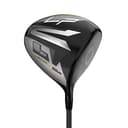
The Launch Pad driver is on this page for one reason, and it is the most common problem in beginner golf.
A slice — the ball starting left and curving hard right for a right-handed golfer — is what happens when the clubface is open relative to the path at impact. Draw-biased or offset drivers shift weight to counteract that, which does not fix the swing but does reduce the curve while you work on it. If your tee shots are leaking right and you are losing balls to it, that is a real, measurable improvement in where your ball finishes.
Two honest caveats. The driver will not cure the cause, and if you never address the cause you will eventually out-swing the correction. Our how to fix a slice guide is the thing that actually solves it, and best clubs for a slice is the cross-brand equipment shortlist. The second caveat is that a correction you no longer need becomes a problem: a draw-biased driver in the hands of a golfer who has fixed their slice starts producing hooks.
Read our Launch Pad driver review for the full write-up, and best drivers for beginners for the wider shortlist. If you are not sure you need a separate driver at all, driver versus hybrid is the honest first question.
Two single Wilson clubs worth owning
If you already have clubs, you do not need a set. You need to fill the two holes that inherited bags almost always have.
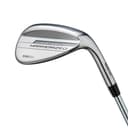
A sand wedge. This is the budget pick on this page and it is the most under-bought club in golf. Most old sets stop at a pitching wedge, which leaves you trying to play bunker shots and short pitches with a club that has nowhere near enough loft for either. A 56-degree wedge is the single club that makes greenside play possible, and the Harmonized is a steel-shafted, no-nonsense version at the lowest price here. Read best wedges for beginners for the shortlist, wedge degrees explained for which loft to buy, and how to hit out of a bunker for what to do with it.
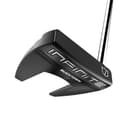
A putter you like.You will use the putter more than any other club in the bag — roughly 40 percent of your strokes in a typical round — and the putter in a package set is almost always its weakest component. The Infinite Bucktown is a 35-inch blade-style putter from Wilson’s own line, which is a real upgrade over a bundled one. Whether a blade suits you is a genuine question rather than a marketing one: blade versus mallet putters explains the difference, and best putters for beginners has the cross-brand picks.
Where Wilson sits against the alternatives
An honest brand page says where the brand loses as well as where it wins.
Wilson wins on fit. Published size bands and a fingertip measurement are a genuine advantage, and for anyone outside average height they are decisive.
Wilson wins on forgiveness philosophy.The SGI line is explicitly built for a slow, developing swing rather than being a scaled-down version of a better player’s club.
Wilson loses on bag and accessories. The bags and headcovers in these sets feel a notch below the club quality. That is a fair criticism and we make it in the write-ups. It is also a problem you can solve later for less money than the set costs, with a better bag.
Wilson loses on name recognition at the first tee, if that matters to you. Callaway is the more recognized name at the beginner end, which is why the direct comparison gets searched so often. We settle it in Callaway Strata vs Wilson Profile and cover the Callaway side in best Callaway golf clubs for beginners. The complete sets hub has the rest of the category, and our Profile SGI review is the full write-up of the set at the top of this page.