Golf Wedge Degrees Explained
Four names, one number. What loft each wedge name refers to, what each one is actually for, and why your set almost certainly has a hole in it somewhere around 52 degrees.
How this is funded: we earn a commission if you buy through our links, at no extra cost to you. It never changes which product we recommend, and we’ll tell you when we’d skip one. Full disclosure.
A wedge’s name tells you almost nothing and its loft tells you almost everything. Here is the short version: a pitching wedge is about 44 to 48 degrees, a gap wedge is 50 to 52, a sand wedge is 54 to 56, and a lob wedge is 58 to 60. More loft means higher and shorter. If you are buying one club, buy something around 56 degrees; if you are buying two, add something around 52.
The reason the names are unreliable is that iron lofts have strengthened steadily over the decades. A modern pitching wedge is stronger than some older 9-irons, which opened a gap between it and the sand wedge — and the gap wedge exists to fill that. So the letters stamped on the sole (P, A, S, L, and the marketing variants U and G) describe a maker’s intent rather than a standard. The number is the spec.
The loft chart, built from real clubs
Every number below is a loft published by a wedge we actually recommend, rather than a generic table copied from somewhere. The names are the common labels for that loft band.
| Loft | Usual name | What it is for |
|---|---|---|
| 44–48° | Pitching wedge (P) | Full approach shots. Comes with almost every set we recommend, so you already own it. |
| 50° | Gap / approach wedge (A, G, U) | The in-between loft. Cleveland’s Smart Sole Full-Face publishes 50 degrees with an extra-wide sole. |
| 52° | Gap wedge | Full shots 10 to 15 yards shorter than a pitching wedge. The Tour Edge E525 and the Pinemeadow set both publish 52. |
| 56° | Sand wedge (S) | Bunkers and short pitches. The standard sand loft; the Wilson Harmonized publishes 56. |
| 58° | Lob wedge (L) | High, short shots over an obstacle. Cleveland’s CBX4 ZipCore publishes 58 in a cavity back. |
| 60° | Lob wedge | The highest, shortest shot in the bag, and the least forgiving club you can carry. |
If you want the whole alphabet rather than the wedges — the numbers on the irons, the letters on the sole, the flex letter on the shaft — golf club numbers explained covers the markings. This page is about what to do with the loft once you can read it.
How to space them, and the four-degree rule
Wedges should be spaced four to six degrees apart. Closer than four and two clubs fly the same distance; wider than six and you get a yardage with no club for it. That is why 52/56/60 is the standard modern ladder — four degrees between each.
Work it out from the pitching wedge you own rather than from a chart. Find the loft of your set’s pitching wedge (it is usually on the maker’s spec page, and often not stamped on the club), then add roughly five degrees per wedge from there. If your pitching wedge is 45 degrees, a 50 and a 56 give you sensible steps. If it is 48, a 52 and a 56 fit better.
The practical consequence is the one almost nobody tells a new golfer: most package sets jump from a pitching wedge to a sand wedge, or to nothing at all, which leaves a 30-yard hole in your distances exactly where approach shots live. The single most under-bought club in beginner golf is a gap wedge — how many wedges you need goes through the count, and our complete-set roundup lists which sets include what.
Bounce and sole width, briefly
Loft is the headline number; the second number on a wedge is bounce, the angle between the leading edge and the lowest point of the sole. High bounce makes the club skid rather than dig, which is what you want in soft sand and fluffy lies. Low bounce suits firm ground and a shallow swing.
For a beginner the more useful version of that conversation is sole width. A wide sole resists digging, so a fat strike still gets the ball out, which is why the extra-wide wedge is the forgiving choice for a golfer who chunks and thins their wedges — and that is most golfers in their first two seasons. You can ignore the bounce numbers entirely and just buy a wide sole.
Which lofts to buy, in order
All four are from our wedge roundup, chosen here by loft rather than by ranking: a 50, a 52, a 56 and the three-wedge ladder if you want all of them at once. Every loft is read from the product’s own listing, and prices are live with the date they were checked.
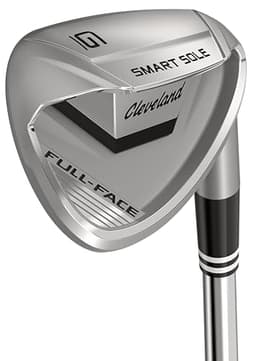
Cleveland Smart Sole Full-Face Wedge (50°)
The wedge built for people who chunk and thin wedges, which is every beginner. The extra-wide sole is designed to skid along the turf instead of digging in, so a slightly fat strike still gets the ball out. If you buy one wedge to stop the short-game disasters, buy a Smart Sole.
- What it is
- 50-degree wedge, extra-wide Smart Sole base
- Who it’s for
- First wedge for anyone who chunks and thins - 50 degrees plus the widest sole here.
Price as of October 16, 2026. #ad How we’re funded
Specs read from the product listing, on August 28, 2026.
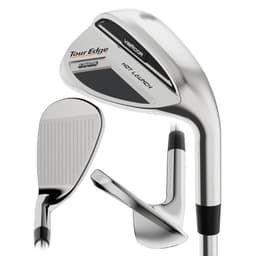
Tour Edge Hot Launch E525 VibRCor Gap Wedge (52°)
The single most under-bought club in beginner golf. Package sets jump straight from a pitching wedge to nothing, which leaves a 30-yard hole in your distances. A 52-degree gap wedge fills it, and Tour Edge's version is cheap and genuinely well made.
- What it is
- 52-degree gap wedge, True Temper MPH 95 steel shaft
- Who it’s for
- Filling the 30-yard hole a package set leaves between pitching wedge and sand wedge.
Price as of October 16, 2026. #ad How we’re funded
Specs read from the product listing, on August 11, 2026.
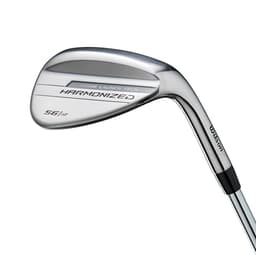
Wilson Harmonized Golf Wedge (56°)
The sensible first sand wedge. It is a brand-name club at an off-brand price, it comes in the lofts a beginner actually needs, and it does the job of getting out of a bunker without asking you to make a tour swing. Buy it, learn on it, replace it in three years if you still care.
- What it is
- 56-degree sand wedge, steel shaft
- Who it’s for
- The standard sand loft, bought once and kept - bunkers and short pitches.
Price as of October 16, 2026. #ad How we’re funded
Specs read from the product listing, on August 11, 2026.
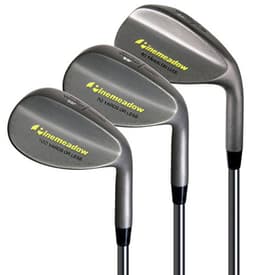
Pinemeadow 3-Wedge Set (52°/56°/60°)
Three wedges for roughly the price of one branded wedge. If you want to learn the difference between a gap, sand and lob wedge without spending several hundred dollars finding out, this is how you do it honestly.
- What it is
- 52, 56 and 60 degrees, regular-flex steel shafts
- Who it’s for
- Learning what each loft does without spending hundreds finding out - all three at once.
Price as of October 16, 2026. #ad How we’re funded
Specs read from the product listing, on August 11, 2026.
| Pick | What it is | Who it’s for |
|---|---|---|
| Cleveland Smart Sole Full-Face Wedge (50°) | 50-degree wedge, extra-wide Smart Sole base | First wedge for anyone who chunks and thins - 50 degrees plus the widest sole here. |
| Tour Edge Hot Launch E525 VibRCor Gap Wedge (52°) | 52-degree gap wedge, True Temper MPH 95 steel shaft | Filling the 30-yard hole a package set leaves between pitching wedge and sand wedge. |
| Wilson Harmonized Golf Wedge (56°) | 56-degree sand wedge, steel shaft | The standard sand loft, bought once and kept - bunkers and short pitches. |
| Pinemeadow 3-Wedge Set (52°/56°/60°) | 52, 56 and 60 degrees, regular-flex steel shafts | Learning what each loft does without spending hundreds finding out - all three at once. |
What the Rules say about adding wedges
You may carry a maximum of 14 clubs, and you may choose any conforming types you like. That freedom is also the constraint: every wedge you add is a club you remove. For a beginner, trading a hybrid or a 5-wood for a third specialist wedge is almost always the wrong call, because the long clubs cover far more shots per round than a 60-degree ever will.
Our honest wedge bag for a first full season: the pitching wedge from your set, a 50 to 52 degree, and a 56. Three clubs, four-to-six degree steps, and every yardage inside 110 covered by something you can hit. How many clubs in a bag covers the limit itself, and what clubs you actually need sets out the whole fourteen.
Finally, a word on the lob wedge, because it is the club beginners most want and least need. Sixty degrees produces a shot that needs real speed and a precise low point, and the two misses — the blade across the green and the shot that goes nowhere — are both worse than anything a 56 will do to you. Learn the basic chip with less loft first, and add the lob wedge when the sand wedge has stopped surprising you.
Frequently asked questions
What degree wedge is a sand wedge?
56 degrees is the standard sand-wedge loft, and you will see 54 and 55 degrees used for the same club. Our budget sand-wedge pick, the Wilson Harmonized, publishes 56 degrees, and the Pinemeadow three-wedge set uses 56 for its sand wedge too.
What degree wedge is a gap wedge?
Usually 50 to 52 degrees. It is called a gap wedge because it fills the distance gap between a modern pitching wedge and a sand wedge. The Tour Edge Hot Launch E525 gap wedge publishes 52 degrees, and Cleveland's Smart Sole Full-Face publishes 50.
What degree is a pitching wedge?
Typically 44 to 48 degrees, and it is the one wedge that comes in almost every set, so you probably already own it. Lofts have strengthened over the years - a modern pitching wedge is often stronger than a 9-iron from thirty years ago, which is precisely why the gap wedge had to be invented.
What degree wedge is a lob wedge?
58 to 60 degrees, sometimes 64. It hits the highest, shortest shot in the bag. It is also the least forgiving club you can own, and we would not recommend a beginner carry one before they can strike a sand wedge cleanly - the miss with a lob wedge is spectacular in both directions.
How many wedges should a beginner carry?
Two beyond the pitching wedge that came with your set: something around 50 to 52 degrees and something around 56. That covers full shots, short pitches and bunkers with gaps you can actually feel. A lob wedge is a third wedge for later, and three specialist wedges in a beginner's bag mostly take up space the hybrids should have.
What degree wedge is best for chipping?
For a standard chip from just off the green, the lower-lofted wedge in your bag - 50 to 52 degrees - is easier and more predictable than a lob wedge, because it rolls out more and needs less speed. Many good short-game players chip with a pitching wedge or even an 8-iron for the same reason: less loft, less that can go wrong.
What is the difference between an approach wedge and a gap wedge?
Nothing. They are the same club under different marketing names - approach wedge, attack wedge, utility wedge and gap wedge all describe something in the 50 to 52 degree range. Makers stamp them A, AW, U or G, which is why the letter on the sole is less informative than the number.
Do wedge lofts count toward the 14-club limit?
Yes. The Rules allow a maximum of 14 clubs and let you choose any conforming types you like, so every wedge you add is a club you take out. That is the real constraint on a wedge ladder: a fourth wedge usually costs you a hybrid or a fairway wood, and for a beginner that is a bad trade.
Sources
- USGA — Rules Hub: Clubs — USGA overview of the 14-club limit and the freedom to carry any conforming club types (accessed July 23, 2026)
- USGA — Rule 4: The Player's Equipment — The official Rule limiting a player to 14 clubs and governing conforming equipment (accessed July 23, 2026)
Keep reading
How Many Wedges Do You Need?
The count rather than the lofts - and what each extra wedge costs you elsewhere in the bag.
Read the guideBest Wedges for Beginners
The full roundup with live prices, from the most forgiving to the step-up cavity-back.
See the wedgesGolf Club Numbers Explained
The numbers and letters stamped on every club, and what each one tells you.
Read the guideHow to Chip a Golf Ball
The technique that makes a low-lofted wedge the easiest club around the green.
Read the guideHow to Hit Out of a Bunker
Where the sand wedge earns its name, plus the Rules about touching the sand.
Read the guideBest Chippers for Beginners
The club that replaces a wedge around the green if chipping is your weak spot.
See the chippers