What Trackman actually publishes about itself
Worth setting out plainly, because most pages on this subject describe Trackman from memory. These are its own words and its own numbers, read from its own site.
Trackman iO — $13,995.Described as “optimized for indoor golf”: a ceiling-mounted unit “using a triple-sensor approach combining radar, infrared, and high-speed imaging”, which “requires no club stickers or marked balls” and “delivers precise 3D spin, spin axis, and full ball and club data in real time”. Trackman calls it “purpose-built for home and commercial simulator installations”.
Trackman 4 — $25,495.Described as “the tour-trusted launch monitor for indoor and outdoor use”, with “ultra-precise dual-radar technology delivering comprehensive data on every aspect of club motion and ball flight”, and as “the official measurement technology of the PGA Tour, DP World Tour, LPGA Tour, and LIV Golf”.
Two details in there are the real difference, and neither is the word “accuracy”. The first is no stickers and no marked balls: the iO reads spin off an unmarked ball. The second is ceiling mounting and an indoor-first design, which removes the hitting room problem that constrains every radar unit below. Those two things are what $13,995 buys that a few hundred dollars of consumer radar does not.
What Trackman does not publish anywhere on that page: a numeric accuracy tolerance for either unit, a breakdown of which figures are measured and which are calculated, or a subscription cost. So this page quotes no Trackman tolerance.
Measured or calculated: the question that actually separates these
This is the distinction almost nobody shopping a cheap launch monitor is told about, and it matters far more than the headline metric count.
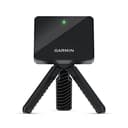
Garmin publishes exactly where the line falls on the R10, which is why it is our top pick. Measured by the radar: club head speed to within 3 mph, ball speed to within 1 mph, launch angle to within 1 degree, launch direction to within 1 degree. Calculated by an algorithm: club face angle to within 2 degrees, apex height to within 5 feet, carry distance to within 5 yards.
Spin is the one to understand. Garmin states that indoors, ball spin is “calculated using a machine-learned model that uses measured radar metrics as inputs”; outdoors it is observed from the ball’s trajectory or measured by the radar — and critically, “if hitting outdoors into a net the device will use the Indoors calculation”. Garmin also publishes that from software 3.80 onward, spin is not measured when the ball is seen for less than 20 m or for balls slower than 90 mph, that marked balls with metallic stickers may degrade performance, and that wind affects spin accuracy.
Hold that against the iO’s claim of “precise 3D spin, spin axis, and full ball and club data” from an unmarked ball indoors, and you have the clearest statement of the gap anyone can make from published sources. Indoors, into a net, a consumer radar is inferring your spin. A ceiling-mounted camera-and-radar system is reading it.
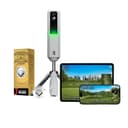
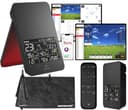
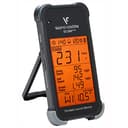
The others are honest about the same limitation in their own ways. PRGR’s manual describes its flight distance as an estimatedfigure “derived from large amounts of accumulated swing data rather than measured”, and warns that measurement may not be possible depending on surrounding materials and distances. Rapsodo publishes eight measured parameters — ball speed, club speed, launch angle, launch direction, spin rate, spin axis, club path and angle of attack — but its spin numbers require its own RPT-marked balls. Voice Caddie publishes four metrics for the SC200 Plus (carry distance, swing speed, ball speed, smash factor) and eight for the SC4 PRO including spin rate.
Which gap actually matters to you
Three honest answers depending on who you are, because for most readers the expensive capability is one they would never use.
If you want to know whether you are getting faster, buy the cheapest one. Club head speed and ball speed are measured, not calculated, on every radar unit here including the cheapest one here. Smash factor — ball speed divided by club speed — is arithmetic on two measured numbers. Those three figures tell you whether this winter’s practice worked, and no amount of money improves them in any way you would notice.
If you want to know why the ball curved, you need launch direction and spin axis, and you need them outdoors.That rules the SC200 Plus out, puts the R10 and the SC4 PRO in, and makes the Rapsodo interesting because it shows you video of the strike as well. Beginners learn more from seeing the strike than from a table — our R10 review and golf simulator versus launch monitor pages both take that further.
If you want to play simulated golf indoors all winter, this is where the real money hides — and it is not in the hardware.Garmin’s Home Tee Hero is a paid membership on top of the R10. Rapsodo publishes Premium pricing of $199.99 a year, $329.99 for two years or $599.99 for a lifetime, and puts spin, video analysis and course play behind it once the included 45-day trial ends. The SC4 PRO is the exception: Voice Caddie publishes a free app with a bundled E6 package of five courses and a driving range, no subscription attached. Add three years of subscription to a cheap unit and the gap to a serious system narrows more than the sticker price suggests.
Room size is the constraint nobody budgets for
A consumer radar unit sits behind you and needs to see the ball fly for a distance before it can say anything useful. That is a physical requirement of the technology, not a software limitation, and it is the single most common reason a cheap launch monitor ends up in a cupboard.
Garmin is the only maker here that publishes placement distances in feet in its own owner’s manual, which means you can measure your garage before you order rather than after. Treat that as a feature. The Trackman iO sidesteps the whole issue by mounting on the ceiling and being designed indoor-first, which is a large part of what its price reflects.
Two companion purchases are not optional if you are hitting indoors. You need a net you trust and a matthat will not wreck your wrists on a concrete floor. Budget for both before the monitor, not after — and note Garmin’s own warning that hitting outdoors into a net still forces the indoor spin calculation, so a net changes your data as well as your ceiling height.
One more thing to check: the SC4 PRO’s own documentation states it is not designed to assess non-standard golf balls, which rules out foam balls and most range balls. If your plan was foam balls in a garage, read that twice.
When you should buy the Trackman instead
Four cases, stated honestly, because a page like this is worthless if it pretends the expensive thing is never the right answer.
You are fitting clubs or teaching for money.If someone is paying you for a number, the number has to be defensible, and “the official measurement technology of the PGA Tour” is a published claim that a consumer radar cannot match.
You are building a permanent indoor bay in a low room. Ceiling-mounted and indoor-first is a design answer to a problem the units on this page solve only by moving house.
You genuinely need spin off an unmarked ball indoors. No unit here does that. Rapsodo needs its own marked balls; Garmin infers it from a model. If 3D spin and spin axis indoors are the whole point of your purchase, nothing on this page delivers it.
You are an elite player chasing small, repeatable differences. A 5-yard carry tolerance is irrelevant when you are learning to find the middle of the face, and decisive when you are choosing between two prototype shafts.
If none of those four is you — and if you are reading a beginner golf site, it probably is not — then the question is not which Trackman alternative is closest to a Trackman. It is which of these five gives you the one number you will actually act on. For most first-season golfers that is swing speed, and the cheapest unit here measures it. The full field ranked without the Trackman framing is at best golf launch monitors, and if the real goal is practising at home rather than measuring, how to practice golf at home is the cheaper starting point.