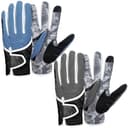
Gloves you swing in, mitts you do not
This is the distinction that makes the whole category confusing, and once you have it the shopping takes five minutes.
A winter glove is a compromise product. It has to be warm enough to help and thin enough to swing in, and those two goals fight each other. You wear a pair for the whole round, both hands, and you accept slightly less feel on the grip than a summer glove gives you.
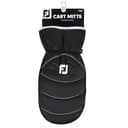
A cart mitt makes no compromise at all, because you take it off to hit. It is a big insulated shell that goes over the glove you are already wearing, and it lives on the handle of your cart or in a pocket between shots. Mitts are warmer than any glove you can swing in, by a distance. The name is literal, incidentally: they hang on a push cart handle, which is where the carts in our Clicgear 4.5 vs Bag Boy Nitron comparison keep their consoles and magnetic pads too.
Here is the part that decides it: your hands do not get cold swinging. They get cold on the walk between shots. A round of golf is four hours of walking and about ninety seconds of swinging. If you fix the four hours, the ninety seconds look after themselves. That is the argument for mitts, and it is the reason cold-weather regulars at northern clubs tend to own mitts rather than winter gloves.
So the honest shape of this decision is not “which winter glove”. It is:
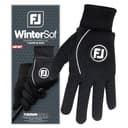
Cool, say 45 to 60F, and mostly dry. A pair of winter gloves on their own is plenty, and the WinterSof is the safe default.
Genuinely cold, below about 45F, or windy. Your normal glove plus mitts beats any winter glove, and it costs about the same. If you only buy one thing on this page, and you play in real cold, buy the mitts.
Cold and wet together.Neither of these is the answer on its own — fleece holds water. Rain gloves are a separate product designed to grip when soaked, and our guide to gloves for damp hands covers the material that does that job, while rain jackets handles the rest of you.
What to look for, when nobody publishes a number
In most gear categories we rank on published specs. This one has almost none, so these are the four things you can actually check, in the order they matter.
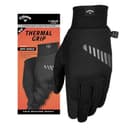
1. Is it a pair?This is the single most common winter-glove mistake and it is entirely the listings’ fault. An ordinary golf glove is sold as ONE glove, for your lead hand — the left hand if you play right-handed, which our which-hand guideexplains properly. Winter gloves are usually sold as a PAIR, because the point is warmth in both hands. Some listings put “Pair” in the title and some say nothing. If the title does not say, assume nothing: on this page, the FootJoy, the Callaway and the Geyoga all state their quantity, and the Mizuno does not. We flag it rather than guess, and you should read the listing before you click buy.
2. What is the palm made of?The palm is the half that has to grip. A knit or suede-textured palm — FootJoy’s Sure-Grip Autosuede is the example with published copy — grips better than leather when it is cold and damp, because leather goes slick and stiff in the cold. The trade is precision: a knit palm is a less exact connection to the grip than cabretta leather. For a beginner this is a good trade. For a low handicapper it is the whole reason winter gloves feel wrong.
3. What is the back made of?The back is the half that has to be warm. Fleece is the standard answer and a windproof membrane over fleece is the better one. FootJoy publishes “Weather Shield foam fleece on the back of the glove” that “helps retain warmth while resisting cold air and wind”, which is as specific as this category gets. Where a listing just says “thermal”, that is an adjective, not a material.
4. Does it seal at the wrist?The most underrated detail on a winter glove. Cold air entering at the cuff undoes everything the rest of the glove is doing — this is why a glove that seals beats a thicker glove that gapes. FootJoy is the only maker here that publishes anything about it: a “Warm+ Wrist Cuff” described as “an ultra-soft stretch wrist cuff with targeted Warm+ fleece” that “helps seal in warmth and keep cold air out”.
And one thing NOT to look for: a temperature rating. Nobody publishes one. If you see a winter golf glove advertised as good to a specific number of degrees, that number came from a marketing department rather than a laboratory.
Sizing, and why winter gloves fit differently
Two traps here, and both of them send gloves back.
Winter gloves are meant to fit snugly, not tightly.Insulation works by trapping a thin layer of still air, and a glove squeezed onto your hand has no air left to trap — a too-tight winter glove is a cold winter glove. That is the opposite of a summer glove, where you want it skin-tight for feel. If you are between sizes in a winter pair, size up.
“Cadet” is a shape, not a size.This catches people out every season. A Cadet glove has shorter fingers and a wider palm than a regular glove of the same nominal size — it is built for a broad hand with short fingers, not for a smaller hand. The Callaway listing we can link on this page is specifically the Cadet build in Medium, which is why it sits where it does in the ranking: it is a perfectly good glove in the wrong shape for most hands. If your fingers are long for your palm, skip it.
Unisex sizing, which the Mizuno uses, is a third convention again. Read the listing’s own chart rather than assuming your men’s size carries across. Our main glove guide covers measuring your hand properly, and it applies here with the one change above: snug, not tight.
Is a winter glove legal? What the Rules actually say
Worth settling, because the question comes up every winter and the answer is simple.
Rule 4.3a(5) of the Rules of Golf covers gloves and gripping agents. Allowed, in the Rule’s own words: “Using a plain glove that meets the requirements in the Equipment Rules”, “Using resin, powders and other moisturizing or drying agents”, and “Wrapping a towel or handkerchief around the grip”. Not allowed: a glove that does not meet those requirements, or “using other equipment that gives an unfair advantage with hand position or grip pressure”.
A commercially sold winter golf glove from a golf brand is a plain glove. Play in it without a second thought. The Rule’s concern is gloves with built-in gripping devices or strapping that fixes your hands to the club, which is not what anything on this page is.
Mitts sit outside the question entirely, because you are not wearing them when you make a stroke. The Rule says nothing about mittens between shots, and nothing about hand warmers either — so treat both as a comfort decision rather than a Rules one. If you are ever genuinely unsure about a piece of equipment, the Rule’s own closing advice is to ask the Committee for a ruling. Our rules guide for beginners covers the handful of Rules that actually affect a casual round.
What else keeps your hands warm (and costs nothing)
Three habits that do more than any upgrade on this page, free.
Keep your gloves dry, and rotate two pairs.A damp glove is a cold glove, and a glove is damp after nine holes whatever the weather. The two-pack and two-pair options on this page are not just cheaper per glove — they let one pair dry in your bag while you wear the other. Do not dry either on a radiator; fast heat stiffens the palm material and shortens the glove’s life.
Put your hands in your pockets, not around the grip.Holding a cold steel or graphite shaft for four hours is a heat leak. This is also exactly what a push cart fixes without you thinking about it — the clubs ride, your hands stay in your pockets, and the cart does the carrying.
Start the round warm. Hands that start cold do not recover during a round; the body prioritizes your core and your fingers are last in the queue. Ten minutes of movement before the first tee is worth more than any glove. Our range warm-up guide has the short version.
One pace-of-play note, since winter rounds are usually slower: being ready to play when it is your turn is the whole of the USGA’s pace guidance, and fumbling mitts on and off is where that goes wrong. Take them off while you walk to the ball rather than when you reach it, and nobody behind you will notice you are wearing them at all.
How cold is too cold?
There is no Rules answer and no official one, so here is an honest practical one.
Below about 50F the ball goes shorter — cold air is denser and a cold ball compresses less — and you will lose distance no matter what you are wearing. Below about 40F the course itself starts making the decisions: frozen ground will not take a tee or hold a pitch, and most clubs will put you on mats or close the greens. And frost delays are not a courtesy; walking on frosted grass kills it.
Which leads to the honest advice about spending: before you buy winter gloves, be sure you are going to play enough winter golf to want them. If the answer is three rounds, buy the cheapest pair on this page or just borrow a pair of mitts. If the answer is every weekend from November to March, buy the mitts and a proper pair of gloves, and look at a shell that blocks wind next, because wind is what makes a cold round miserable. Our what to wear golfing page covers layering the rest of you, and practicing at home is the honest alternative on the days when the course is frozen.