Pick on the shot you actually hit
These three drivers are not ranked on quality, because at this price they are all value-brand builds. They are ranked on which problem each one solves.
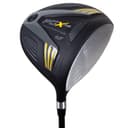
If your miss is a slice, buy the offset Pinemeadow.Offset is a real, visible design feature and the most useful thing available at this price. Pushing the face back behind the hosel biases the club toward squaring up, and the slice — a ball starting left and curving hard right for a right-handed golfer — is the dominant beginner miss by a wide margin. If you do not know what your miss is, it is almost certainly this one. Read how to fix a slice alongside the purchase, because the club is a crutch and not a cure.
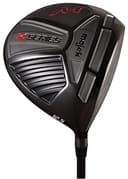
If your drives never get airborne, buy the Majek.Its loft is the point: 12.5 degrees, where almost everything else in the category is 9 to 10.5. Extra loft is the cheapest way to get a slow swing’s ball into the air, and this one pairs it with a senior-flex graphite shaft, which loads more easily at lower speed. The cost is roll-out — a higher ball lands steeper and runs less on a firm fairway. Our what loft driver should a beginner use page is the full version of that trade, and regular versus stiff shaft covers the flex half.
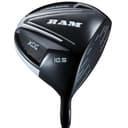
If you just need a driver and the budget is the budget, buy the Ram.It is a 460cc 10.5-degree head on a 45-inch graphite shaft in regular flex, which is a perfectly sane beginner specification, and the headcover is included so there is nothing else to add to the basket. It will not out-perform the two drivers above this page’s ceiling and we are not going to pretend otherwise. It will get the ball in the air.
What 460cc actually means, and why it matters here
It is the single most relevant number on all three listings, and it is the same on all three.
460 cubic centimetres is the maximum head volume the Rules of Golf allow, which is why effectively every driver aimed at a beginner is built right up against it. A bigger head means a bigger face, a wider forgiving area, and more resistance to twisting when you miss the middle. There is no legal way for an expensive driver to give you more of that, which is the core reason a cheap driver is a far better buy than a cheap iron set or a cheap wedge.
It also means any driver advertised as larger than 460cc is non-conforming, and therefore not legal for competition or for a posted handicap score. If a listing brags about an oversized head, that is a warning rather than a feature. The 14-club limit and the freedom to carry any conforming club types are set out in Rule 4.1b(1) — our how many clubs in a bag page covers the practical side.
One more Rules point, relevant because none of these three is adjustable and the two drivers above this line are: you must not deliberately change a club’s playing characteristics during a round and then play a stroke with it — the penalty is disqualification, with an exception if you restore the original setting first. A non-adjustable driver cannot get you into that trouble, which is a small, genuine advantage of a simple club.
What the drivers above this line publish that these do not
This is where the money goes, and the clearest way to see it is to look at what the maker is willing to print.
Cleveland publishes a full specification table for its Launcher XL family — head weights, a stated moment of inertia, a named stock shaft, a named grip, a rail design on the sole and a specific countermeasure for a slice. Its Launcher XL 2 spec table names a 460cc head with a 46-inch build length, a published MOI described as the highest in a Cleveland driver, a HiBore crown step that “drops the center of gravity for high-launching shots”, an Action Mass CB counterweight in the grip end, and an Accuracy Build at a shorter length with a lighter swing weight.
None of the three drivers on this page publishes an MOI figure, a head weight, a swing weight, a named shaft or a named grip. That is the real gap. You are not buying a smaller face or an illegal head; you are buying a club nobody will tell you the details of, built to tolerances nobody states, with a stock grip that is usually the weakest component on it.
Three practical consequences worth weighing:
Resale is effectively zero.A value-brand driver has no second-hand market. A Cleveland or a Cobra does. If you expect to upgrade in two seasons, that changes the true cost of each — our used versus new golf clubs page is where to think that through, and a used name-brand driver is often the smartest purchase on this whole subject.
Sound and feel are not nothing. A cheap titanium head can sound tinny, and if you dislike how your driver sounds you will swing it worse. That is not a spec we can measure for you; it is a reason to buy from somewhere with easy returns.
The grip is the cheap fix.A fresh grip transforms how any driver feels and costs a few dollars — see how to regrip golf clubs and what size golf grip do I need. On a sub-$200 driver it is the single best upgrade available.
Who should not buy a driver at all
A real answer, and for a lot of readers it is the right one.
If your complete set already came with a driver, the honest ranking of where $200 does the most good for your score puts a new driver near the bottom. A wedge fills the gap your set left and gets used on the shot you face most often after a full swing — see best golf wedges under $100. A putter touches a third of your strokes — see best putters for beginners. A lesson changes the swing rather than the tool — see are golf lessons worth it.
And if you cannot yet find the middle of a 7-iron, a driver is the hardest club in the bag to learn with: longest shaft, lowest loft, least margin. Many good players will tell you to tee off with a fairway wood or a hybrid for a season, and they are right. Our driver versus 3-wood page makes that case properly.
For everyone else: the Pinemeadow is the pick if you slice, the Majek is the pick if you hit it low, the Ram is the pick if the number is the number — and the full field with no price ceiling is at best drivers for beginners.