The numbers Cleveland actually publishes
Three examples, straight from the maker’s own spec pages, so you can see what “publishes numbers” means in practice.
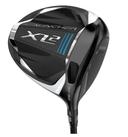
The Launcher XL driver. Cleveland publishes a 460cc head, a 45.75-inch standard build length, and a measured MOI of 5,200 g-cm², which its own page calls “our most ever in a Cleveland Golf driver”. The adjustable hosel is published too: “Adjust your loft from 9 to 12 degrees to optimize your launch angle, distance, and shot shape. Loft can be adjusted at 0.5 deg increments with 12 positions in all”, with primary settings marked at 9.0, 10.5, 12.0 and 10.5 Flat.
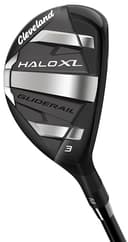
The Launcher XL Halo hybrid.Lofts and head sizes by number: 3H at 18.0 degrees and 143cc, 4H at 21.0 and 132cc, 5H at 24.0 and 118cc, 6H at 27.0 and 108cc, with lie angles from 60.5 to 62.0 degrees and standard build lengths from 40.5 inches down to 39.0. Published MOI is 2,961 g-cm², again described as the most in a Cleveland hybrid. The technology wording is specific rather than vague: GlideRail is “Three rails along the sole of the club help keep the face straight through impact”, the HiBore crown step “drops the center of gravity for high-launching shots”, and Action Mass CB is “An 8g weight placed inside the end of the grip” for balance.
And where Cleveland stops. This is the part other sites leave out. The driver page publishes no spin-rate or ball-speed figures. The hybrid page publishes no carry-distance numbers. A retailer spec table for a sibling fairway wood publishes head lofts, lie angles, lengths and shaft weights but nohead volume, no MOI and no grip model. So Cleveland publishes far more than its price rivals — not everything. Anywhere a figure does not exist, we say so rather than borrowing one from a review site.
What MOI means, and why it is the number to care about
MOI is the only published spec on this page that directly predicts how a club behaves on a bad swing, so it is worth understanding properly.
Moment of inertia measures a clubhead’s resistance to twisting. When you hit the ball off the center of the face — which is what a developing swing does on most shots — the head wants to rotate around the impact point. A high-MOI head resists that rotation, so the face stays squarer, the ball starts closer to your intended line and loses less speed. That is the entire meaning of the word “forgiveness”.
Two things to know about the figure. First, the governing bodies cap it, so no driver can have unlimited MOI — the 5,200 g-cm² Cleveland publishes sits near the practical top end of what is allowed, which is exactly where a beginner wants to be. Second, MOI is published far less often than it should be, which makes a brand that prints it unusually easy to evaluate. Our easiest golf clubs to hit page is built around this idea, and game improvement versus players irons explains the same trade in iron design.
What to buy first, if you are not buying everything
Six clubs is a lot of money, and nobody should buy all of them at once. The useful question is sequencing.
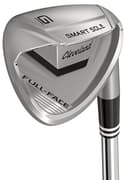
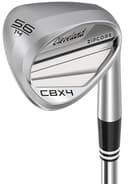
First: a wedge. This is the budget pick and the cheapest meaningful upgrade in golf. Most inherited or package-set bags stop at a pitching wedge, which leaves you attempting bunker shots and short pitches with a club that has nowhere near enough loft. A 58-degree wedge changes what is physically possible around a green. Read wedge degrees explained for which loft to buy and how many wedges do you need for how many.
Second: a hybrid.The biggest hole in a beginner’s bag is the long shot from the fairway. A 3-iron is close to unhittable for most new golfers; the Halo hybrid at a published 21 degrees and 132cc does the same job with a wide sole and a low center of gravity, which is why it gets airborne when an iron will not. See best hybrids for beginners and hybrid versus fairway wood.
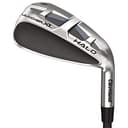
Third: the irons.You hit irons more than anything except the putter, so this is where the biggest single improvement lives — it is also the biggest spend. The Launcher XL Halo set is hybrid-style through the long irons, which means the clubs that frighten beginners are built like the club that does not. Read best irons for beginners for the cross-brand view.
Fourth: the driver.Later than most people expect. A driver is the hardest club in the bag to hit and the one you can most easily do without — plenty of beginners score better teeing off with a hybrid. Read driver versus hybrid for beginners before you spend, and what loft to buy if you do.
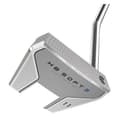
Fifth: the putter.Not because it does not matter — it is roughly 40 percent of your strokes — but because putter choice is almost pure personal preference and the one in your bag may already suit you. See blade versus mallet putters and best putters for beginners.
The adjustable hosel, and why most beginners should leave it alone
The Launcher XL driver publishes an adjustable loft sleeve with twelve positions between 9 and 12 degrees. That is genuinely useful and also the most misused feature in golf.
Useful, because loft is the single biggest influence on how high the ball starts, and a beginner almost always wants more of it than they think. If you are not getting the ball up, turn the sleeve up rather than buying a new club. Set it near the top of its range and leave it there.
Misused, because the temptation is to adjust it after every bad hole. Do not. You cannot evaluate a setting over three swings, and you will end up chasing your own inconsistency round the dial. Also know the Rule: you are not allowed to deliberately change a club’s playing characteristics using an adjustable feature during a round, and the penalty for making a stroke in breach of that is disqualification. Set it in the car park, not on the fourth tee.
Worth remembering too that the USGA allows you fourteen clubs during a round and lets you carry any conforming club types within that, so there is no obligation to own one of everything. A beginner bag of eight clubs that you can all hit is better than fourteen including three you cannot. Our how many clubs in a bag page covers the limit, and what clubs do I need covers what to leave out.
Where Cleveland sits against its rivals
An honest brand page says where the brand loses too.
Cleveland wins on published detail.No brand at this price publishes more. For a buyer who cannot try before buying — which is most people buying online — that is the most valuable thing a maker can offer.
Cleveland wins on wedges.The brand’s reputation was built on short-game clubs and that is still where its strongest products are, which is why two of the six picks here are wedges.
Cleveland loses on complete sets. It does not make a beginner package set, which means it is a brand you buy into club by club rather than in one box. If you need a whole bag today, start with best golf clubs for beginners, or the brands that do build full sets: Callaway and Wilson.
Cleveland loses on price against the budget end. These are single-club purchases at single-club prices. Buying the six clubs on this page costs several times what a complete set does, which is correct for a second purchase and wrong for a first one.
We have full write-ups of several of these: the Launcher XL2 driver review and the Smart Sole wedge review, both of which say what the listings do not publish as well as what they do.