What makes a golf club easy to hit
Four things, and every club on this page has at least two of them. None is marketing; each is a physical property you can read off a listing.
1. High MOI — the head resists twisting
MOI stands for moment of inertia, which is a technical way of saying “how hard this head is to twist.” Strike a low-MOI head off the toe and it rotates, the face opens, and the ball leaves sideways. A high-MOI head barely moves, so a slightly toe- or heel-struck drive still flies reasonably straight. It is the single most useful trait in a beginner driver, and it is why the big, blocky-looking heads are the easy ones.
2. A cavity back, not a blade
Cavity-back irons move weight out to the edges of the head, which enlarges the forgiving zone — the exact opposite of the thin blades better players use. If an iron photo shows a hollowed-out back, it is built to help you. If it shows a smooth slab of metal, it is built for someone who finds the center of the face every time. Our guide to game-improvement vs players irons goes through the visual difference in detail.
3. Offset — a legitimate anti-slice feature
Offset means the face sits slightly behind the hosel, which gives your hands a fraction more time to square the club. It is a Rules-conforming way to fight a slice, which is the beginner’s most common miss, and it appears on the irons and driver we have picked here. It is also why some cheap-looking clubs outperform expensive ones for a new golfer: the Wilson Launch Pad driver is the most offset, most anti-slice driver we track, and it was built for exactly one job.
4. A wide sole and more loft than you think
A wide sole skids across turf instead of digging into it, which is what saves a fat strike. More loft gets the ball up with less help from you. Together they explain why a 21-degree hybrid is easier than a 3-iron, why a chipping club with a heavy sole beats a sand wedge for a beginner, and why every club on this page launches high by design. If you are unsure what the numbers on your clubs mean, start with golf club numbers explained.
Why these five clubs
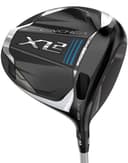
Easiest driver: Cleveland Launcher XL 2
The driver is the hardest club in the bag for everyone, beginner or not, because it is the longest and the least lofted. The Launcher XL 2 answers that with a large, high-MOI head in a 10.5-degree loft with a regular flex — a sensible beginner spec rather than a tour one. It is the pick if you want something a step above a package-set driver without flagship prices.
If your miss is specifically a slice rather than general mishitting, the more targeted answer is an offset driver, and our beginner drivers roundup ranks both approaches side by side. If your slice is severe, read how to fix a slice before spending anything — equipment reduces a slice, it does not remove one.
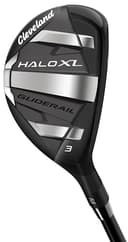
Easiest long club: Cleveland Launcher Halo XL Hybrid, 21 degrees
Twenty-one degrees replaces roughly a 3-iron: same job, wider sole, lower center of gravity, and a great deal more help getting the ball airborne. The Halo line is built around launching high from the rough, which is where beginners spend a lot of their round. It will not shape shots — it does one thing, high and straight — and for a new golfer that is the feature, not the limitation.
Whether a hybrid or a fairway wood belongs in your bag is a real question with a real answer; our hybrid vs fairway wood comparison settles it, and driver vs hybrid for beginners covers the golfers who should tee off with this club instead of a driver.
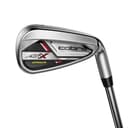
Easiest iron set: Cobra Air-X 2
Light, offset and cavity-backed, from a major brand still stocked new. That combination is rarer than it sounds: plenty of forgiving irons are heavy, and plenty of light irons are off-brand orphans you cannot replace a single club from. The light overall build helps a slower swing get the ball up, and the offset addresses the slice at the same time.
It is a real cost step up from the irons in a package set, so if you are still in your first season our complete beginner sets remain the better buy. Our Cobra Air-X review goes through the set in full, and best irons for beginners ranks it against four alternatives.
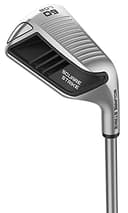
Easiest club around the green: Square Strike Wedge
The hardest shot in golf for a beginner is not the driver, it is a 20-yard chip. A wide, heavy sole that skids across turf instead of digging in fixes the chunked chip for most people, and the length — between a wedge and a putter — is what stops the deceleration that causes the duff in the first place. The listing also states it is legal for tournament play, which matters because some two-faced chippers are not conforming.
It is useless from a bunker or anywhere you need height, so it is an addition to a sand wedge rather than a replacement. Our chippers roundup compares it with cheaper options, and how to chip a golf ball is the free version of the fix.
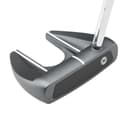
Easiest putter: Odyssey DFX V Line Fang
Fang-style mallets place weight far back and to the sides of the head, which resists twisting when you miss the center of the face — the same high-MOI idea as the driver, applied to a stroke where a tiny twist is the difference between holed and missed. The oversized grip quiets the hands, which is exactly what a nervous beginner needs.
One measurement first: the listing states 35 inches, which is long for anyone under about 5′10″. Putter length is the spec beginners most often get wrong, and our Odyssey DFX review explains how to check it. If you prefer a classic shape, read blade vs mallet putters before you decide — the easy answer and the comfortable answer are not always the same one.
What “easy to hit” will not do
It will not make a bad swing good. Every feature on this page widens the margin for error on a reasonable strike; none of them rescues a swing that is coming over the top at the ball. If your misses are wild rather than slightly off-center, an hour with a coach does more than any club on this page — our guide to whether golf lessons are worth it is honest about when they are and are not worth the money.
Easy clubs also have a shelf life, which is the trade-off nobody mentions when selling them. Anti-slice bias can feel like too much once your swing straightens out, and game-improvement shaping will not suit a player who improves quickly. That is not a reason to avoid them at the start; it is a reason to buy them at a price you are happy to replace. Our guide to when to upgrade your golf clubs lists the signals that the club, rather than the swing, has become the limit.
The cheapest way to make your current clubs easier
Before you buy anything here, two things cost almost nothing and change more than a new club head. The first is new grips: a slick, hardened grip makes you squeeze, and squeezing is the fastest way to lose both distance and control. It is the cheapest real upgrade in golf, and our grips roundup covers what to buy.
The second is the right shaft flex. A shaft too stiff for your swing feels like hitting with a scaffolding pole and costs you both height and distance, and most beginners are in a stiffer shaft than they should be. Regular vs stiff shaft explains how to tell which you need, and steel vs graphite covers the weight question that matters just as much for a slower swing.
The bottom line
Buy for forgiveness at every point in the bag and golf gets markedly less frustrating: a high-MOI driver, a 21-degree hybrid instead of a long iron, cavity-back offset irons, a chipping club with a heavy sole, and a mallet putter you can aim. If you are buying your first clubs rather than replacing one, do it in a single box instead — the best beginner sets are built from exactly these principles and cost less than two of the clubs on this page.