What a golf GPS watch actually does
Worth being precise, because the category is routinely oversold and the honest version is still good.
A golf GPS watch holds a database of mapped courses. It works out which one you are standing on, which hole you are playing, and gives you distances to the front, middle and back of the green. You glance at your wrist, you pick a club, you hit. There is nothing to aim, nothing to hold steady, and nothing to take out of a pocket.
What it cannot do is tell you the distance to the flag. It knows where the green is, not where the pin was cut this morning, and on a deep green that is a twenty-yard spread. That is the one thing a laser rangefinder does better, and if precise numbers to specific targets are what you want, our rangefinders under $200 page is the other half of this decision at the same ceiling. Our rangefinder versus GPS watch comparison works the choice through properly.
For a developing golfer, front-middle-back is usually plenty. If your shots scatter twenty yards either way, a pin-accurate number is precision you cannot use — and the watch is faster, works in fog and over a hill, and needs no hands.
The specs that matter, and the one that does not
These listings publish four things consistently. Three of them are worth reading.
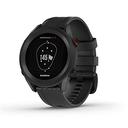
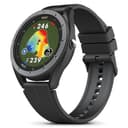
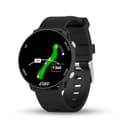
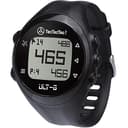
1. The course count, with a caveat.Every watch here publishes one — 42,000-plus on the Garmin, 40,000-plus on the Voice Caddie, 38,000-plus on the Shot Scope and the TecTecTec. Those are large numbers and they are all large enough: the difference between 38,000 and 42,000 courses matters only if your home course sits in the gap. Check your own course by name on the maker’s site before you buy— that single check is worth more than any comparison of the headline figures.
2. Whether it needs a phone. This splits the category and the listings are quiet about it. Some watches are a display for an app and want your phone in your pocket and a course download before you play. The TecTecTec ULT-G publishes that it needs no app, which is a genuine convenience for someone who does not want another account, and a limitation for someone who wants shot tracking and stats afterwards.
3. Screen type and hole maps.A monochrome screen gives you numbers; a color screen can draw the hole. The Shot Scope G6 and the Voice Caddie T11 LT both publish color screens with hole detail, which is genuinely useful on a dogleg where you cannot see the green — it tells you where the trouble is, not just how far away it is. The Garmin’s plainer display is easier to read in bright sun. That is a preference, not a ranking.
And the spec to ignore: battery life in days.A golf watch that publishes “up to 15 days” means in watch mode with GPS off. The number that matters is rounds per charge, which almost nobody publishes, and the practical answer is that every watch here will finish eighteen holes from a full charge. Charge it the night before and the figure is irrelevant.
Slope, and the Rule you need to know
One of these four — the Voice Caddie T11 LT — publishes a slope mode, and that changes its status in competition.
Under Rule 4.3a(1) you are allowed to get distance or directional information from a device. What you are notallowed to do is use a device that measures elevation change, or that interprets information into a club recommendation or a line of play. The R&A states it in those terms directly, and it adds that a Committee may prohibit distance-measuring devices entirely by Local Rule.
A slope reading measures elevation and gives you an adjusted “plays like” number. Useful in a casual round, not allowed in a competition one. The T11 LT can be switched out of slope mode, and if you only ever play social golf the feature is a real benefit on a hilly course. If you play club competitions, switch it off and check the committee’s position on devices generally before you rely on one at all. Our slope rangefinder page covers the same rule on the laser side, and rules for beginners covers the rest of what actually affects a casual round.
What you give up under $200
Honest accounting, because the step-up watches are genuinely different products rather than the same thing with a bigger number.
Everyday smartwatch use.The watches on this page are golf instruments. They tell the time and most will count steps, but they are not the watch you wear to work. The Garmin Approach S44, which sits above this ceiling, is — that is most of what the extra money buys, and our main golf watch roundup covers it.
Automatic shot tracking. Logging every shot and distance for you, rather than you reading a number and swinging, is a step-up feature. Some of it can be added with separate tags.
Touchscreen polish and build. Bezels, straps and screens are where cost is saved at this end. They work; they do not feel expensive.
What you do not give up: the actual distances. Front, middle and back of green is the same job on a $110 watch and a $400 one, and the GPS chip is not what separates them. That is the whole argument for this price band.
Does a watch lower your score?
Indirectly, and less than the marketing implies — but in two ways that are real.
Calibration. Most beginners badly overestimate how far they hit each club, usually by a club or two, because the one shot they remember is the best one they ever struck. A few rounds with a GPS replaces that memory with data. Knowing you are a 145-yard 7-iron rather than a 165-yard one removes more strokes than any equipment purchase, because it stops you coming up short of every green. You can do the same work free at a driving range, and almost nobody does.
Pace.The USGA’s pace guidance comes down to being ready to play when it is your turn. A golfer pacing off a sprinkler head and then changing clubs twice is slow; a golfer who glanced at their wrist while walking is not. A watch is better than a laser here, because you do not stop to use it. Our first round etiquette page covers the rest, and how long a round takes sets the expectation.
What a watch will not do is improve your strike. If you are topping the ball or slicing it, the number on your wrist is not the problem — that guide and this one are better value than any device on this page.
Who should spend more, and who should spend nothing
Spend more if you want one watch for golf and for everyday wear, or if you want your rounds logged automatically. That is the Approach S44 case and it is a fair one.
Spend nothing if you have a smartphone and play a handful of rounds a year. A free or cheap golf GPS app does front-middle-back perfectly well; what it costs you is the time taken to pull the phone out, which is exactly the convenience a watch is selling. Try the app for a season, and if the reaching-into-your-pocket irritates you, buy the watch then. We would rather say that than sell you a watch you use twice.
Buy a laser instead if you play the same course repeatedly, want the distance to a specific bunker or tree, or care about the exact pin rather than the middle of the green. The rangefinders under $200 page is that decision at this exact ceiling.
For everyone else, the Approach S12 is the pick and the TecTecTec ULT-G is the sensible cheap way in. The balls, bags and gear hub has the rest of what goes in the bag.