What the Rules actually allow, and where slope breaks them
This is the only genuinely important thing on this page, and most listings are vague about it.
Under Rule 4.3a(1), you are allowed to get distance or directional information from a device. What you are not allowed to do is use a device that measures elevation change or interprets information into a club recommendation or a line of play. The R&A puts it in those terms directly: a player may obtain distance or direction, but the device must not measure elevation changes or interpret that data for them, and a Committee may prohibit distance-measuring devices entirely by Local Rule.
That is exactly what “slope” does. A slope-enabled rangefinder measures the uphill or downhill and gives you an adjusted “plays like” number. Useful in a casual round, not allowed in competition. Every modern slope rangefinder therefore ships with a way to switch slope off — usually a physical switch or a slider that is visible from outside, so a playing partner can see it is disabled. All three picks here can be put into a conforming mode.
Two practical consequences. First, if you only ever play casual golf, slope is a genuine feature and worth having. Second, if you play in club competitions, check the committee’s position before you rely on any device at all — a Local Rule can ban rangefinders outright regardless of slope, and the Rule itself invites you to ask. Our rules guide for beginners and handicap guide cover the rest of the competition basics.
The three specs that actually separate rangefinders
Rangefinder listings publish a lot of numbers. Most of them do not matter. These three do.
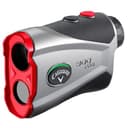
1. Pin lock, or whatever the maker calls it.Pointing a laser at a flag two hundred yards away means the beam is also hitting trees behind the green. A pin-lock mode tells the unit to report the nearest target rather than the strongest return, which is the difference between “152 to the pin” and “171 to the oak behind it”. If a listing does not publish some version of this, treat every number it gives you near trees with suspicion. The Callaway publishes it.
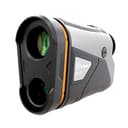
2. Image stabilization. The honest problem with cheap lasers is not accuracy, it is holding them still enough to acquire the target. At 6x magnification, a small hand tremor moves the reticle several yards across the green. Stabilization fixes that, and the TecTecTec ULT-S is the only pick here whose listing publishes it. If you are older, cold, or simply not steady-handed, this is the feature to buy rather than slope.
3. Vibration or audible confirmation. A rangefinder that buzzes when it has locked the flag tells you the number is real. Without it, you are trusting that the reading on screen came from the thing you were aiming at. The TecTecTec publishes vibration confirmation; the others do not.
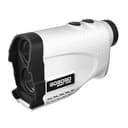
And the spec to ignore: maximum range. The Gogogo publishes a stated 1,200 yards, which is a perfectly honest number and completely irrelevant, because you will never need a distance over 350. Maximum range figures are measured against large reflective targets in ideal light, not against a flag in drizzle. Read them as marketing, not capability.
Laser or GPS watch at this price?
Under $200 you have a real choice, and they are not the same tool. This page is lasers; the GPS watch roundup is the other half.
A laser gives you one exact number to anything you can see. The flag, a bunker lip, a tree you are trying to clear. It needs line of sight and a steady hand, and it does not know anything about the hole you are standing on.
A GPS watch gives you front, middle and back of green without aiming at anything. It works in fog and over a hill, it needs no hands, and it is faster. What it cannot do is give you the distance to a specific bunker or a precise pin position, because it only knows where the green is, not where the flag is today.
For a beginner, the honest answer is often the watch, because front-middle-back is plenty of information when your dispersion is twenty yards wide, and because a watch is faster to use. Our rangefinder versus GPS watch comparison works it through properly. Buy the laser if you like having an exact number, if you play the same course repeatedly and want to learn your real distances, or if tree-lined holes mean a watch cannot tell you what you need.
Pace of play, which is the real reason to own one
The USGA’s pace guidance comes down to being ready to play when it is your turn, and a rangefinder helps with that more than it helps with your scores.
A golfer without a distance pacing off a sprinkler head, then changing clubs twice, takes a long time. A golfer who ranged the flag while walking to the ball is ready. The trick is to use the device on the way to your shot rather than when you arrive at it, which costs nothing and saves the group behind you several minutes a round. Our first round etiquette page covers the rest of that, and how long a round takes sets the expectation.
The second honest benefit is calibration. Most beginners have no idea how far they actually hit a 7-iron, and most overestimate by a club or two. A rangefinder turns guesswork into data over a handful of rounds, and that single piece of self-knowledge removes more strokes than the device itself. You can do the same work at a driving range for free, but far fewer people actually do.
When to spend more than $200
Two cases, and only two.
You want a unit that locks the pin in one attempt, every time. The step up from this band mostly buys faster, more confident target acquisition and better optics in poor light. That is a real improvement and it is what the Bushnell Tour V6 Shift charges for. Our full rangefinder roundup covers the options above this ceiling, including the step-up unit we would buy at $250.
You need slope that is unambiguous to switch off. Premium units make the conforming mode visible from outside the device, which matters if you play competitions regularly and do not want a conversation about it on the first tee.
For everyone else the Callaway 300 Pro is the pick, and the Gogogo is a genuinely sensible first laser if you are not sure you will use one. The balls, bags and gear hub has the rest of what goes in the bag, and rangefinders with slope covers that feature on its own terms.