How we picked these watches
We do not own a test lab and we have not worn these round a course — our methodology page sets out exactly what we do and do not do. What we compared is the published specification of each listing against what a first- or second-season golfer actually needs, and we have ordered them on that basis rather than on feature count.
1. Course coverage, first and by a distance
Every other spec is decoration if the watch does not have your course. All five here publish coverage in the tens of thousands of courses, which in practice means any regular public course in the United States is on it. Check yours against the manufacturer’s course-finder before you buy if you play somewhere unusual — a new build, a nine-hole municipal or a course that has recently re-routed.
2. Whether it works without your phone
This is the difference between a golf watch and a golf app. A dedicated watch holds the course maps itself and gives you yardages with your phone in the car. That matters more than it sounds: the single biggest practical advantage of a watch over a phone app is that you never take the phone out, which means you never lose four minutes a hole to it.
3. Readability, not resolution
A monochrome screen in bright sunshine is easier to read than a color one, and a color one shows you the shape of the hole. Neither is better; they are different purchases. We have put one of each near the top rather than pretending there is a single right answer.
4. Subscription-free operation
Some golf GPS products charge annually for course updates. Every watch on this page states that it does not, and we checked that on each listing rather than assuming it. A subscription is not automatically bad, but a beginner should not discover one after the fact.
What a golf GPS watch actually tells you
It gives you the distance from where you are standing to three points on the green: the front, the middle and the back. It knows where you are from satellites and it knows where the green is from a surveyed map of the course it already holds.
The middle number is the one most golfers use, and for a beginner it is nearly always the right one. The front and back numbers matter when the green is long, or when there is a bunker short and you would rather be past it than in it.
What a GPS watch does not do is tell you the distance to the flag. The flag moves around the green day to day; the map does not. That gap is usually within about ten yards, which for a beginner is comfortably inside the margin their own strike creates. It is also the exact reason better players carry a laser instead.
Some of these watches add hazard distances — how far to carry a bunker, how far to the water. On a course you have never seen, that is arguably more useful than the green yardage, because it stops you hitting a driver into a lake you could not see from the tee.
Do you need a golf watch as a beginner?
Honestly: no, not in your first month. Nothing on this page will lower your score while your contact is still finding the middle of the face, and we are not going to claim otherwise.
What it does do is remove one variable and speed you up. A beginner without a distance device paces off a sprinkler head, guesses, walks back to the bag, changes club, and takes ninety seconds over a shot that will travel wherever it travels anyway. A glance at a wrist is quicker, and pace of play is the thing new golfers are most self-conscious about.
The stronger argument is what it teaches you. After a season with a GPS you know roughly how far you hit a 7-iron, because you have seen the number before the shot a hundred times. That knowledge is worth more than the device, and you cannot get it by guessing.
So the sensible order is: clubs first, then balls, then a bag, then this. Our what golf costs to start guide lays out where a watch sits in a realistic first-year budget, and it is not near the top.
Slope, and why it is switched off in competitions
Slope means the watch adjusts the yardage for uphill and downhill. A shot playing 150 yards on the flat but climbing thirty feet does not play 150; slope tells you the number to actually hit.
It is genuinely useful on a hilly course and it is not permitted in competition play, which is why devices that offer it also offer a way to turn it off. If you only ever play social golf, slope is a nice feature. If you intend to enter a club competition, make sure you know how to disable it — carrying a device in a non-conforming mode is the golfer’s problem, not the device’s.
Only one watch on this page publishes a slope mode. That is not an oversight in the others; distance devices split fairly cleanly into “simple and legal everywhere” and “clever and switchable,” and a beginner is usually better served by the first.
Golf watch or rangefinder?
The short version, because we have written the long one in full here: a laser tells you the precise distance to a thing you can see and aim at; a GPS tells you the shape and distances of the hole without you doing anything.
A beginner gets more from the GPS. Aiming a laser at a flag two hundred yards away with unsteady hands is a skill in itself, and the precision it buys you is wasted when your own shots vary by twenty-five yards. Buy the watch first. If you get good enough that the difference between 148 and 152 yards matters, buy a laser then — our rangefinder roundup covers that purchase properly.
What to check before you buy
- Your course is in the database. Every brand publishes a course-finder. Two minutes now saves a refund later.
- Battery in golf mode, not in watch mode. GPS is what drains a battery. A watch quoting a fortnight of standby may give you two or three rounds of GPS use.
- Strap size and weight.You are wearing it for four hours through a full swing. Heavier watches are more noticeable on the lead wrist — many golfers wear a watch on the trail wrist for exactly this reason.
- Water resistance versus waterproof. They are different claims. A water-resistant watch survives rain; it is not a promise about a soaked bag.
- Whether you want a map at all. A hole map is genuinely useful on an unfamiliar course and genuinely a distraction on your home one.
The short version
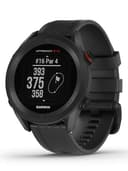
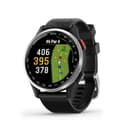
Buying one watch and not thinking about it again? The Garmin Approach S12. Biggest course list, simplest to use, easiest to read in the sun.
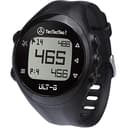
Not sure you want a GPS yet? The TecTecTec ULT-G. It does the core job for the least money, and it owes you nothing if you decide you prefer guessing.
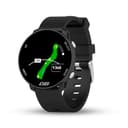
Play courses you do not know?The Shot Scope G6, for the hole maps — seeing the trouble is worth more than the yardage on a first visit.
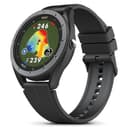
Play somewhere hilly? The Voice Caddie T11 LT, for slope. Just learn where the off switch is before you enter anything.
Want one watch for golf and everything else? The Garmin Approach S44. It is a lot of money and it is the only one here you would wear on a Tuesday.
Our top pick, examined in full
If the S12 is where you have landed, our Garmin Approach S12 review goes through Garmin’s own published specs line by line — the 42,000-plus course database, the 30-hour GPS battery, and the three features Garmin itself confirms the watch leaves out.