What “spikeless” actually means
A spiked golf shoe has small removable plastic cleats screwed into the sole. A spikeless shoe has a one-piece molded sole with dozens of rubber lugs, nubs or dimples pressed into it instead. That is the entire difference, and it has three consequences worth understanding before you spend money.
Nothing to replace. Cleats wear down and get swapped out, usually once a season for a regular player, which means a small ongoing cost and a tool you will lose. A spikeless sole wears down as one piece, and when it is smooth the shoe is finished. For a beginner playing a dozen rounds a year, that is a feature: the shoe will outlast your interest in replacing cleats.
Walkable anywhere. Cleats click on concrete, chew up clubhouse flooring, and are kept out of plenty of indoor areas. A spikeless shoe walks from the car to the first tee to the restaurant without a shoe change. This is the reason the category exists and the reason it dominates the beginner end of the market.
Less grip under a hard swing.Here is the part the marketing skips. A cleat digs into soft turf; a rubber lug sits on top of it. On dry fairway in summer, you will not notice. On wet grass, on a side-slope, with a driver and a full turn, you can feel the sole let go — and a foot that slides mid-swing is a foot that ruins the shot. Our spiked versus spikeless comparison works through that decision properly if you are still weighing it.
Is there a Rule about spikes?
No, and it is worth settling because the question comes up.
Rule 4.3a of the Rules of Golf is the Rule that governs how you may use equipment. It opens “A player must not create a potential advantage by:” and then sets Allowed and Not Allowed lists under six sub-clauses: distance and directional information, wind and weather information, information gathered before or during the round, audio and video, gloves and gripping agents, and stretching or swing aids. Footwear is not one of them. Shoes appear in that Rule exactly once, in its closing line: “Further guidance on the use of equipment described above and other types of equipment (such as clothing and shoes) is found in the Equipment Rules.”
So no Rule of Golf requires, prohibits or prefers spikes. What can exist is a footwear policy at an individual club, and in practice those run the other way — courses that restrict footwear usually restrict metal spikes, which nothing on this page has. Our rules guide for beginners covers the handful of Rules that genuinely affect a casual round, and what to wear golfing covers the dress codes that actually get enforced.
How we ranked these
We own none of these shoes. So rather than invent a traction test, we ranked on what each listing publishes and on how specific that published detail is — the same standard we apply everywhere on this site.
1. Does the listing say spikeless in its own words? All five do, which is why they are here and other shoes in our registry are not. Sole type is the one spec that decides this category, and a shoe whose listing is vague about it does not belong on a spikeless page.
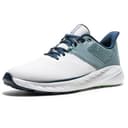
2. Waterproof, water-resistant, or neither?These are three different claims and makers use them precisely, because they carry different obligations. “Waterproof” is a warranted claim. “Water-resistant” often means a mesh upper that will wet through in dew. The FJ Flex listing is honest about this and says water-resistant rather than waterproof, which is a mark in its favor, not against it — and it is why a damp-morning golfer should look at a waterproof spiked shoe in our main golf shoe guide instead.
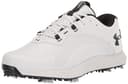
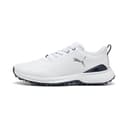
3. What do the upper and midsole actually consist of? Cushioning foam has real names and real behavior. PUMA publishes a plush cushioning platform; Under Armour publishes its Charged foam, which is firmer and more responsive. Those are preference choices, not quality rankings, and we describe them as preferences.
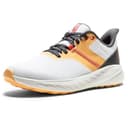
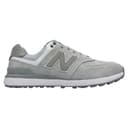
4. Is it built on a golf last or a sneaker last?The New Balance 574 Greens is built on the company’s classic 574 sneaker with a golf sole fitted to it, which is exactly why it looks the way it does and exactly why its grip is the most casual here. We say that plainly in its write-up rather than selling it as a performance shoe.
And one thing we deliberately do not rank on: a traction number. No maker in this category publishes a coefficient of friction, a lug count or a grip figure of any kind. If you see a spikeless shoe scored out of ten for traction, somebody made that number up.
Sizing a spikeless shoe
Two things that cost people a return.
Golf shoes are worn for four or five hours on your feet, and feet swell. That is different from a sneaker you wear to the shop. If you are between sizes, take the larger one, and try them on late in the day rather than first thing. A shoe that fits perfectly at 8am can be tight by the fifteenth green.
Width is the spec nobody publishes.None of the listings here states a width option, which is why we will not tell you which of these suits a wide foot — we would be guessing. If you know you need width, buy from a retailer with a free return window and treat the first pair as a fitting.
A point about where the money goes, too. Participation data from the National Golf Foundation shows how much of the modern game happens away from a regulation course — at ranges, in simulators, on short courses. If most of your golf is a bucket of balls on a mat, a spikeless shoe is not just adequate, it is the correct purchase: there is nothing on a range mat for a cleat to bite into. Our walking-focused shoe guide covers the other end of that spectrum, and a push cart does more for tired feet over eighteen holes than any shoe on this page.
Who should buy spiked instead
An honest page says who should walk away. Buy a spiked shoe instead if any of these is you.
You play early mornings on wet grass. Dew is the condition where spikeless soles are weakest and waterproofing matters most.
You have a fast, aggressive swing. The more force you put through your feet, the more you will notice the sole giving way. This is less common in a first season than people think, but if you came from another rotational sport, it applies to you.
Your course is hilly. Side-slopes are where feet slide, and a hilly walking course is a lot of side-slopes.
For everyone else — most beginners, playing in reasonable weather, on flattish ground, a handful of times a year — spikeless is the right default, and the FJ Flex is the one to buy. If you would rather read the whole footwear decision from the start, do you even need golf shoes answers the question underneath this one, and the shoes and apparel hub has the rest of the wardrobe.