Why Skechers sells so many golf shoes
Because comfort is the spec beginners most underrate, and Skechers is a walking-shoe company that happens to make golf shoes rather than a golf company that happens to make footwear.
Eighteen holes is roughly four miles on uneven ground, carrying or pushing weight, for four hours or more. Most beginner rounds end badly for a reason that has nothing to do with the swing: feet hurt, concentration goes, and the last five holes get played in a hurry. A traditional golf shoe is built stiff for lateral support during the swing, which is a real benefit and a real cost — the stiffness you want at the moment of impact is the stiffness you resent on the walk between shots.
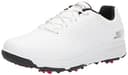
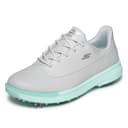
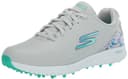
Skechers resolves that trade the other way round. All three shoes here are built on sneaker-style cushioned platforms, and the Go Max Arch Fit is built on the company’s arch-support last, which is exactly the feature a walker with aching feet is shopping for. What you give up is the last few percent of lateral support on a soaking wet sidehill lie, and at beginner swing speeds that is a trade most people should take happily. Our best golf shoes for walking page ranks the walking case across brands, and do you need golf shoes answers the prior question honestly.
Spiked or spikeless: the only real decision here
Two of these three are spikeless. One is spiked. That is the choice this page actually comes down to.
Spikelessmeans moulded rubber lugs built into the sole. The Go Max Arch Fit is the spikeless pick: you can drive in them, walk the course in them, and walk into the clubhouse in them, and modern spikeless soles give plenty of grip at a beginner’s swing speed. The limitation is wet grass on a slope, where there is nothing to dig in.
Spikedmeans small replaceable plastic cleats screwed into the sole. The Jasmine 2 is the spiked pick, and its advantages are specific: better grip on wet or sloping ground, and a sole you can renew. When the spikes wear down you replace them by hand for a few dollars, which effectively resets the most worn part of the shoe — a genuine cost advantage over a spikeless shoe whose lugs cannot be replaced at all, and worth weighing against the lower sticker price of the spikeless pick.
Worth knowing: these are softspikes, which means plastic. Metal spikes have been banned by most courses for decades because of what they do to greens, so a modern spiked golf shoe is not the shoe your grandfather complained about. The one social cost remains — plenty of clubhouses still ask you to change out of spikes indoors. Our spiked versus spikeless page is the full comparison, and best spikeless golf shoes is the spikeless field across all brands.
Waterproof is the other spec that is actually published
All three of these listings state waterproof construction, and it is the most useful thing on any of them.
It is useful because of when beginners play. Early tee times are cheaper and quieter, and early tee times mean dew — a soaking first nine from grass rather than rain. A shoe that keeps that out is dry for the back nine; one that does not is wet for four hours. There is no middle ground and no amount of grip compensates for it.
What none of these listings publishes is a waterproofing standard, a membrane name, or a warranty period on the waterproofing. Some golf-shoe makers publish a one- or two-year waterproof guarantee as a figure; Skechers does not on these listings, so we do not quote one. Treat “waterproof” here as the claim it is: good for dew and showers, not a promise about standing water for a season.
What the Rules say about golf shoes, which is almost nothing
Worth stating because it is a question people assume has a complicated answer.
Rule 4.3 is the Rule that governs what a player may and may not use equipment for during a round, and it is specific: it lists distance and direction devices, gloves and gripping agents, training and swing aids, clothing worn to help with alignment, and a few other categories. Footwear appears in none of its sub-clauses. Shoes turn up only in the Rule’s closing line, which points to the Equipment Rules for the technical detail.
In other words: spike or spikeless is not a Rules question. It is a comfort and traction question, with a local etiquette question attached about whether the club wants spikes on its carpet. If a course has a footwear policy it is a course policy, not a Rule, and it will be posted at the pro shop. Our first round etiquette page covers the rest of what nobody tells you before your first tee time.
What Skechers does not publish, and what to do about it
Three gaps, and one of them is the reason this page cannot answer the most common follow-up question.
Width.Not one of these three listings states a width fitting. Skechers has a general reputation for a roomier toe box than traditional golf brands, and a reputation is not a published spec, so we will not tell you these are the shoes for a wide foot. If width is your constraint, buy from a retailer with free returns and send back what does not fit — that is a better plan than any page’s guess.
Traction, as a number. No maker in this category publishes a coefficient of friction or a lug count, Skechers included. What is published is the sole type, which is why this page is organised around spiked versus spikeless rather than around a grip score.
Arch support, as a measurement. The Go Max Arch Fit names arch support as a design feature, which is a genuine differentiator and not a figure. If you have a diagnosed foot condition, that is a conversation for a professional rather than a product page, and we are not going to make a medical claim for a golf shoe.
Two of the three shoes here are published as women’s builds and one as a men’s, which is simply what the brand lists. If you are shopping the wider field, best golf shoes ranks the whole beginner field, best women’s golf shoescovers the women’s market in full, and best golf shoes under $100 is the same decision with a price ceiling. For what else you actually need to turn up in, start at what to wear golfing.