Break the Orange Whip into four parts and price each
This is the only honest way to answer an “alternatives” question. The original does four things, and three of them are gettable cheaply.
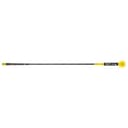
1. Tempo feedback — gettable, and cheaply. A flexible weighted shaft lags behind your hands if you rush, and arrives on time if you do not. That single mechanism is the reason these trainers work, and the SKLZ Gold Flex has it. You do not need anyone to tell you when it went wrong; you feel it. This is the piece most buyers are actually after.
2. A genuine warm-up tool — gettable. Both the Orange Whip and the Gold Flex are swung before a round to loosen up and find a rhythm, and that is arguably their most valuable everyday use. A beginner who takes thirty seconds to find a tempo before the first tee has saved more shots than most drills save in a month.
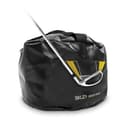
3. Impact position — gettable, but with a different tool. Neither whippy trainer teaches you where your hands should be at the moment of contact. A fill-it yourself impact bag does, by feel and immediately: you learn that the hands lead the clubhead rather than flicking at the ball. That is the SKLZ Smash Bag, and it is a completely different kind of feedback from a tempo stick.
4. Counterbalancing, and therefore swing plane — NOT gettable here. This is the Orange Whip’s actual differentiator. Weight at both the grip end and the head end means the trainer resists being pulled off plane, so it trains the path of the swing as well as its rhythm. None of the three picks on this page is counterbalanced, and we are not going to pretend otherwise. If swing plane is what you are trying to fix, the alternatives genuinely do not do it.
The Orange Whip is also built to last decades and is sold in mid-size and junior lengths, which matters if you are buying for a smaller golfer — see best junior golf clubs for the rest of that problem.
The alignment sticks are the one nobody expects
They are not a swing trainer at all, and they are on this page because they fix a bigger problem than tempo for most beginners.
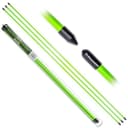
Two sticks laid on the ground tell you where you are actually aiming, as opposed to where you believe you are aiming. A very large number of golfers discover they have been set up well right of the target for years, and have built a compensating swing on top of it. No amount of tempo work fixes a swing that is correcting for a misaimed stance; you are rehearsing the compensation.
A three-pack also lets you set aim, ball position and swing-path drills at once, which is more practice value per dollar than anything else in this category. Our best golf alignment sticks page covers the whole category, and driving range tipsgives you drills to point them at — because sticks on their own do nothing.
The Rule that decides whether you can use any of these on the course
Short answer: not during a round. And the detail is worth having, because people get this wrong in both directions.
Rule 4.3a lists what a player must not use equipment for during a round. Under training or swing aids it names “using any type of golf training or swing aid (such as an alignment rod or a weighted headcover or ‘donut’)”. Under distance and direction it separately names “using an alignment device... to help align the ball”. A first breach carries the general penalty, and Rule 4.3b adds that where the breach happens between two holes the penalty applies to the next hole.
So: an Orange Whip, a Gold Flex and a set of alignment sticks are all named or captured by that Rule during a round. They are practice tools. Using one to loosen up before you tee off is fine — the Rule governs the round, not the car park — and in a practice round or on the range you may use them freely.
There is a second Rule that catches a habit people fall into with sticks. Rule 10.2b(3) states that “a player must not set an object down to help with aiming or to help in taking a stance for the stroke to be made”, where setting an object down means it is touching the ground and the player is not touching it. The Rule explicitly adds that “if the player breaches this Rule, they cannot avoid penalty by removing the object before the stroke is made”. Dropping a headcover down to line up a putt is therefore a penalty even if you pick it up again. Our golf rules for beginners page covers the rest of what applies to a casual round.
What to buy, in what order
If you are buying one thing, buy by fault rather than by price.
If your tempo is rushed and your contact is inconsistent, buy the Gold Flex. It is the direct substitute and roughly half the money. The honest caveat is in its own description: it teaches rhythm, not technique, and it will not fix a sliceby itself. It also needs real space — 48 inches of flexible shaft is not a kitchen tool.
If you top or thin the ball, buy the Smash Bag instead. Hands ahead of the ball at impact is the single most important position in the golf swing, and the bag teaches it by feel in minutes. Two warnings from its own listing: fill it with towels, old clothes or foam rather than sand, and expect repeated heavy hits to be hard on cheap clubs. Our how to stop topping the ball page is the drill side of the same problem.
If you do not know what your fault is, buy the alignment sticks first. They are the cheapest item here and the most likely to tell you something you did not know. Then come back for a trainer once you know what you are training.
And the honest counter-argument to all three: one lesson often beats all of them combined, because a coach tells you which fault to work on rather than leaving you to guess. See are golf lessons worth it— the answer for a beginner is usually yes, and a trainer is what keeps the lesson alive between sessions.
When to buy the Orange Whip anyway
Four cases, and if you are in one of them stop comparing.
You are working on swing plane, not tempo. The counterbalanced design is the feature, nothing here copies it, and buying a cheaper trainer will not get you there.
You want a one-time purchase. It is built to last decades. Across ten years the price difference against a cheaper trainer stops being interesting.
You are buying for a junior or a smaller adult. Mid-size and junior lengths exist; a single 48-inch alternative does not fit a twelve-year-old.
You will use it before every round. A warm-up tool you actually reach for is worth more than a cheaper one in the garage, and the Orange Whip is the one people reach for.
Where to go next: our best golf training aids roundup ranks all five of these side by side with no brand framing, and how to practice golf at home is where to start if you would rather spend nothing at all.