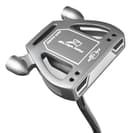
What a Scotty Cameron actually is
Worth stating carefully from what is published, because most writing on this subject runs on reputation rather than specifications.
Here is what an authorized dealer publishes. The construction line, verbatim, is “Solid milled construction from 303 stainless steel”. The weighting is described as “Performance balanced weighting uses interchangeable, customizable sole weights”, the profile as “Sleeker profile with a thinner, flatter topline”, and the hosels by model — a “Flow neck hosel” with “maximum toe hang” on the Del Mar, a “Slant back hosel” with “near maximum toe hang” on the Flowback 5.5. A headcover is included. The brand’s own marketing line on the same page is “Meticulously crafted from the finest materials.”
And the prices, from the same dealer’s putter listings on November 11, 2026: Special Select $399.00, Phantom X $429.00, Phantom $449.00, Super Select $449.00, Studio Style $499.00, Phantom Long Design $499.00, Phantom 11R OC $549.00.
That is the whole sourced picture and we are going to stay inside it. We are not going to quote you a loft, a lie angle or a head weight for a Cameron, because the pages we can reach do not publish those figures — scottycameron.com returns a 403 to an automated fetch and the dealer’s own spec block stops at material, hosel and toe hang. What is documented is enough: a Cameron is a solid-milled 303 stainless head with adjustable sole weights and a specific neck geometry, at roughly four hundred to five hundred and fifty dollars.
What that buys, broken into parts you can price separately
A putter is a simpler object than a driver, which is helpful here: you can pull a Cameron apart into four things and work out which of them you can get cheaply.
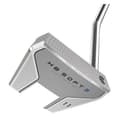
1. A milled face.Milling means the face is machined from solid metal rather than cast and finished. The practical consequence is consistency of feel and a face that is the same from heel to toe — a milled face sounds and feels identical on a putt struck slightly off-center, which is why good putters talk about “feel” as if it were a measurement. You can get this cheaply. The Cleveland HB Soft 2 on this page publishes a milled face at under a fifth of a Cameron, and that is why it is our top pick here.
2. Toe hang and neck geometry.A flow or slant neck produces toe hang — the head wants to rotate open and closed through the stroke, which suits a golfer whose putting stroke naturally arcs. A face-balanced putter stays square, which suits a straight-back-straight-through stroke. This is a genuine fitting variable and the Cameron copy publishes it explicitly for each model. You can get this cheaply too, but you have to read the listing: a blade with a slant neck arcs, a big face-balanced mallet does not. Our blade versus mallet guide is the long version of this.
3. Adjustable sole weights.Interchangeable weights let you change the head’s total mass to suit green speed and personal preference. This is the part that is genuinely hard to find under $200, and none of the picks here publishes it. If this is why you want a Cameron, this page will not replace it. We say so rather than pretending otherwise.
4. The badge, the finish and the resale. A Cameron holds its value in a way nothing on this page does, and the finish quality is part of what you are paying for. These are real things to want. They are not performance.
Does an expensive putter roll the ball better?
The honest answer is more interesting than either marketing or cynicism allows.
A putt is a low-speed, low-energy strike. There is no ball compression to optimize, no aerodynamics, no spin loft. The head simply has to arrive square, at the right speed, with the face doing something consistent. That is why a $70 putter and a $450 putter can roll a well-struck ten-footer almost identically — and why putting is the part of golf where equipment matters least and the golfer matters most.
Where a better putter genuinely helps is in the margins, and they are not nothing: consistency of feel across the face, a head weight that suits your tempo, an alignment aid your eye actually trusts, and a shape that makes you want to use it. That last one is more important than it sounds. A putter you like looking at gets used with confidence, and confidence over a four-footer is worth more strokes than any milling process.
Which leads to the real advice. You will use the putter for roughly 40 percent of the strokes in a round— more than any other club by a distance — so it deserves care. But care means picking one that fits your stroke and your eye, not spending the most. Our best putters for beginners page ranks this category on fit rather than on its relationship to a tour brand, and putting basics for beginners is, frankly, where the strokes actually are.
Length is the spec that beats the brand
If you take one practical thing from this page, take this: a putter of the wrong length will cost you more putts than any amount of milling will save.
Putters are sold in 33, 34 and 35 inch lengths, and the listings here publish theirs — two 35-inch models and two 34-inch ones among the picks. The standard advice is 34 inches for most adults, 33 for shorter golfers, 35 for taller ones, but the real test is simpler: set up to a ball in your normal posture, and your eyes should sit over or just inside the ball with your hands hanging naturally under your shoulders. If you are reaching, the putter is too long. If you are crouching, it is too short.
A putter that is too long is the more common error and the more damaging one, because it pushes you upright and away from the ball, and from there the stroke works inside-out and pushes putts right. Our club sizing guide covers the measurement approach for the rest of the bag, and the same logic applies here.
Grip size is the second variable and an underrated one. An oversized, non-tapered grip quiets the wrists, which is the most common fault in a beginner’s stroke — two of the picks here publish an oversized grip. If your putting miss is a nervous flick at short range, that is the feature to look for, and our grips page covers putter grips as an upgrade you can make to a putter you already own.
Rules: what a putter is allowed to be
Briefly, because it only matters in one case. The USGA limits you to 14 clubs in your bag during a round, and within that you may carry any conforming club types you like. There is no rule requiring a putter at all, and no rule about its shape, its milling or its price.
The one thing worth checking if you are buying something unusual is that the putter is on the conforming list — this catches out buyers of long putters and some arm-lock models, where the anchoring rules bite. Nothing on this page is affected: all five are conventional-length putters in conventional shapes. Our how many clubs in a bag page covers the limit itself.
Who should buy the Cameron anyway
An honest alternatives page says who should ignore it, so here it is.
Buy the Cameron if you are already a good putter.If you hole your share from eight feet and your stroke is repeatable, the margins a premium putter offers — weight tuning, a face you trust completely, a shape fitted to your arc — are margins you can actually use.
Buy it if you want adjustable sole weights. Nothing on this page has them and we are not going to pretend an alternative exists.
Buy it if the object itself matters to you. Golf is a hobby, a Cameron is a beautifully made thing, and wanting a nice one is a perfectly good reason that nobody needs to justify with a performance claim.
Do not buy it as a first putter.If you are still learning what stroke you have, you do not yet know whether you want toe hang or face balance, a blade or a mallet, 34 inches or 35. Buying a $449 putter before you know those things means buying the wrong $449 putter. Start with something on this page, play a season, find out what you like — and if you still want the Cameron after that, you will know exactly which model to buy.
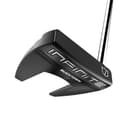
For everything else, the Cleveland HB Soft 2 is the pick, the Wilson Infinite Bucktown is the one that looks most like what you are imagining, and the Ray Cook SR500 is the cheap way to find out what you actually prefer. Our Odyssey DFX review covers the most forgiving pick here in full, and the golf clubs by type hub has the rest of the bag.