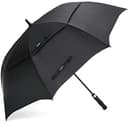
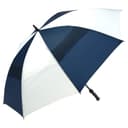
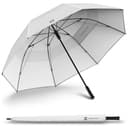
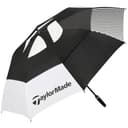
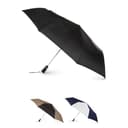
How we picked these umbrellas
Umbrella listings are unusually thin. Most publish a canopy diameter and whether it opens itself, and then stop — no frame material, no rib count, no tested wind speed. Rather than fill those gaps with numbers nobody published, we ranked on the four specifications that are actually stated and flagged the silence where it matters.
1. Canopy diameter: 62 inches is the floor
Golf umbrellas are measured across the open canopy in a straight line, not around the rim, which is why a 62-inch umbrella does not feel twice the size of a 30-inch one. At 62 inches you cover yourself and most of a bag leaning against your leg. At 68 inches you cover both properly, and at 64 to 68 you can stand under it with a playing partner if you are both prepared to get a shoulder wet.
Bigger is not free. A 68-inch canopy catches more wind, weighs more in one hand for four hours, and will not slide into every bag’s umbrella sleeve. If you walk and carry, that trade is worth thinking about before you buy the biggest thing on the page.
2. Double canopy is the wind spec
A single-layer umbrella has one sheet of fabric and nowhere for air to go, so a gust lifts the canopy and inverts the ribs. A double canopy has vents cut into the lower layer with a second layer floating above them: wind passes up through the gap instead of loading the frame.
Three of our five picks are built that way and say so on the listing. It is the single most useful word to look for, and it is the reason the cheap double canopy here outlasts an expensive single-layer umbrella from a fashion brand.
3. Auto open, manual open, or auto open and close
Automatic open matters more on a golf course than anywhere else, because one of your hands is usually holding a bag strap, a club or a trolley handle. Pressing a button and having the canopy go up is worth something real.
The trade is mechanical. The spring that fires the canopy takes the full load every time, and on a budget umbrella it is the first thing to fail. That is why our budget pick is deliberately a manual-open stick and why the only pick here that both opens and closes itself is also the one with the most moving parts to go wrong.
4. Where it lives when it is not raining
A full-length 68-inch stick is about as long as a driver and needs a sleeve on the bag or a cart to live in. A folding umbrella fits a bag pocket. The second kind is the one you still have with you on the day a forecast is wrong, which is the entire argument for the compact pick on this page even though it covers less.
If your bag has no umbrella sleeve, that is worth checking before you buy a full-length one — our golf bag buying guide covers which bags have one and which do not.
What nobody publishes, and why we say so
Four of these five listings publish no frame material, no rib count and no tested wind speed. One of them costs over seventy dollars and still publishes no canopy diameter. We have written that into the cards rather than around it, because “windproof” with no number behind it is marketing copy, not a specification.
What that means in practice: buy from a seller whose return window you are comfortable with, and treat the price difference between a twenty-dollar double canopy and a seventy-dollar one as a bet on build quality rather than a documented upgrade. We are not able to settle that bet for you with published data, so we are not going to pretend the premium is proven.
The rule nobody tells a beginner
You may hold an umbrella over your own head while you play a shot. Somebody else may not hold it for you.
Rule 10.2b(5) of the Rules of Golf says a player must not make a stroke with a caddie or any other person or object deliberately positioned to give protection from sunlight, rain, wind or other elements — while expressly permitting the player “taking their own actions to protect against the elements while making a stroke, such as by wearing protective clothing or holding an umbrella over their own head.” Breaching it costs the general penalty, which is two strokes in stroke play.
In a friendly fourball nobody is going to call it on you. It is still worth knowing, because the instinct when it is pouring is to ask a playing partner to hold the umbrella while you swing, and that is the one version of this that is against the Rules. Hold it yourself, or put it down.
An umbrella is not lightning protection
This is the part of a golf umbrella page that usually goes unwritten. A golf course is an open field with isolated tall trees on it, and you are carrying metal. If there is thunder, the umbrella is irrelevant.
The National Weather Service’s published guidance is blunt: the only completely safe action is to get inside a safe building or vehicle. It tells you to avoid open fields and hilltops, to stay away from tall isolated trees and other tall objects, to stay away from water, wet items and metal objects, and to wait 30 minutes after the last rumble of thunder before resuming play. No umbrella appears anywhere in that advice.
So: when the horn sounds or you hear thunder, mark your ball, leave the umbrella down and get to the clubhouse or the cart barn. Rain is a comfort problem and an umbrella solves it. Lightning is a different category of problem and nothing in your bag solves it.
What actually gets wet, in order
New golfers buy an umbrella to stay dry and then discover the umbrella was never the main problem. The order things go wrong in a wet round is:
1. Your grips. A wet grip slips, and a slipping grip makes you hold on harder, which ruins the swing you were working on. This is the real reason tour players keep a towel inside the bag hood and dry the grip before every shot. An umbrella protects the clubs while you are standing still, which is most of the round.
2. Your hands. A wet leather glove gets slick and then stiff. If you play in rain more than once a season, a second glove kept dry in a pocket is a cheaper fix than anything else on this page — see our golf gloves roundup for the ones that handle damp.
3. You. A rain jacket keeps you dry while you walk and while you swing, which an umbrella cannot do. If you only buy one of the two, buy the jacket: our rain jackets page covers what to look for, and what to wear golfing puts the whole wet-weather outfit in order.
4. Your scorecard and your phone. Both live in the valuables pocket, and most bags have one lined pocket for exactly this.
Do you actually need one?
Honestly: not for your first few rounds, and not if you only play in settled summer weather. Most courses will lend or sell you one at the pro shop on the day, and a beginner’s money is better spent on shoes that keep your feet dry than on an umbrella that keeps the top of your head dry.
Buy one when either of these becomes true: you have started playing regardless of the forecast, or you have started caring about your clubs. An umbrella is as much about the bag as it is about you — a full-size canopy over an open bag hood is what keeps the grips usable for the next nine holes.
And if you ride or push rather than carry, the calculus changes again. Push carts almost all have an umbrella mount, which means a 68-inch canopy costs you nothing to carry — our push carts roundup covers which ones include the holder.
The sun case for an umbrella
Nobody buys their first golf umbrella for shade and plenty of golfers end up using it that way. You are outdoors for four and a half hours with essentially no shade, roughly weekly, through a season. A canopy over the tee box while you wait is the easiest shade there is, and the compact pick on this page is the one small enough that you will actually have it with you in July.
Sun protection is also the one thing listings in this category do tend to state, because UV coating is a selling point. Pair it with the obvious: a hat, sunscreen on forearms, neck and ears, and golf sunglasses if glare off wet grass bothers you.
What we would spend
Buy the 68-inch double canopy, keep it in the bag sleeve or on the cart, and spend the difference on a towel you clip inside the bag hood. If you are buying for somebody else and want it to look like a gift rather than a utility purchase, the branded 64-inch double canopy does the same job with a logo on it — and it sits naturally alongside the rest of our beginner golf gifts.
What we would not do is buy a cheap single-layer umbrella from a non-specialist brand. That is the one version of this purchase that reliably ends with a bent frame in a bin after one windy Saturday.