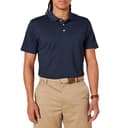
How we picked these shirts
We have not worn-tested these over a season and we are not claiming to have. What we did was compare what each listing publishes — fabric type, fit, stated size range, sun protection — against the four things that decide whether a golf shirt is worth its price, and we have said where each one falls down.
1. It has to be a collar the course accepts
A standard polo collar clears every dress code. A mock neck — the collarless band-neck shirt that has become common on tour — is accepted at most public courses and refused at some traditional clubs, so it is a slightly riskier default for someone who has not been there before. Every shirt on this page has a conventional collar.
2. Fabric decides how the fourth hour feels
Cotton absorbs sweat and holds it. Polyester knits move it to the surface where it evaporates. On a hot day that difference is the whole experience of the back nine, and it is why golf shirts are made of the fabric they are made of despite looking less smart than cotton.
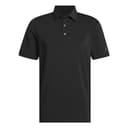
The trade is honest: a technical knit has an athletic sheen and will not pass as smart casual afterwards. If you want one shirt for golf and dinner, the adidas Ultimate365 is the closest thing here.
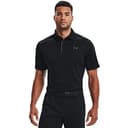
The reasoning behind our top pick is set out in full on our Under Armour Tech Polo review — including the two specs Under Armour never claims for it, and the naming confusion that has the same shirt selling at two different prices.
3. Stretch across the upper back
This is the specification nobody lists and everybody notices. At the top of the backswing your shoulders are turned roughly ninety degrees and the shirt is loaded across the upper back. A shirt that pulls there will quietly shorten your turn, and you will not connect the two things.
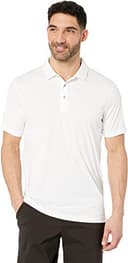
The PUMA is the stretchiest shirt here. If you have ever felt a shirt restrict you mid-swing, start there.
4. It has to come in your size
Golf apparel has a narrow default size range and a lot of golfers are outside it. The Callaway is on this page substantially because it is listed in big and tall as well as standard, which quietly rules out most of the competition for a significant number of buyers.
What golf dress codes actually enforce
Rules vary by course, so ask the pro shop if you are unsure — it is a one-sentence question and nobody minds. That said, the pattern is remarkably consistent.
Almost always required: a collared shirt, tucked in. Shorts or trousers rather than athletic shorts or jeans. Golf shoes or plain athletic shoes without metal spikes.
Almost always refused: t-shirts, tank tops, denim, cargo shorts, swimwear. At traditional clubs, also: untucked shirts and shorts above mid-thigh.
Varies: mock necks, hoodies, and shirts with large non-golf logos. Public courses are generally relaxed; private clubs are not.
Our what to wear golfing guide works through the whole outfit, including what you almost certainly already own, and our shorts roundup covers the bottom half — where dress codes are actually stricter than they are about shirts.
Do you need a golf-branded shirt?
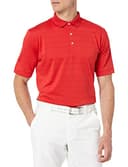
No, and we would rather say so plainly. A plain polo from any brand, in a performance fabric, is functionally identical to a golf-branded one at twice the price. The Amazon Essentials shirt on this page exists here specifically to make that point.
What the brand buys you is fabric quality that survives more washes, a cut developed around the golf swing rather than around tennis or the gym, and — if you care — looking like you belong. That last one is not nothing for a nervous beginner, and we are not going to pretend it is.
Our honest recommendation: buy two cheap shirts and one good one. Wear the cheap ones at the range and on casual rounds, and keep the good one for courses where you would rather not think about it.
Sun protection is the underrated feature
You are outdoors for four and a half hours with essentially no shade, roughly weekly, for a season. That is a lot of sun exposure, and a shirt is the easiest protection there is because you are wearing one anyway.
Several golf shirts — including the Callaway here — are listed with sun protection built into the fabric. A tightly woven synthetic blocks substantially more than a loose cotton weave regardless of whether it carries a rating. Long sleeves are the most effective option of all and are entirely normal on a golf course.
None of that replaces sunscreen on your forearms, neck and ears, which is where golfers actually burn.
Fit: what to size for
Two rules and one warning.
Room across the shoulders and upper back is non-negotiable. Raise both arms above your head in the fitting room; if the shirt pulls hard, it will restrict your swing.
Length long enough to stay tucked. A shirt that untucks itself on the third hole is a shirt you spend the round adjusting, and at a club where tucking is enforced it is a genuine problem.
The warning: “slim fit” in golf apparel is usually genuinely slim rather than a flattering label. Unless you already know a brand runs generous, take the regular fit.
How many do you actually need?
Three, if you play weekly. One in the wash, one clean, one you are wearing. Buying three cheap shirts is a better use of money than one expensive one, because the failure mode in golf apparel is not quality — it is playing in a shirt that has not dried since Tuesday.
If you are assembling a first golf wardrobe from scratch, the order we would spend in is: shoes, then shirts, then shorts, then a rain layer. Shoes matter most because four and a half hours on your feet on uneven ground decides whether you enjoy the round — see our golf shoes roundup. A rain layer can wait until the first time you get caught out, and then our rain jackets page covers it.
The two shirts people compare most
If your shortlist has come down to the Under Armour and the adidas, Under Armour vs adidas golf polo puts them head to head on fabric, stretch, the UPF rating neither publishes, and whether one is worth roughly double the other.